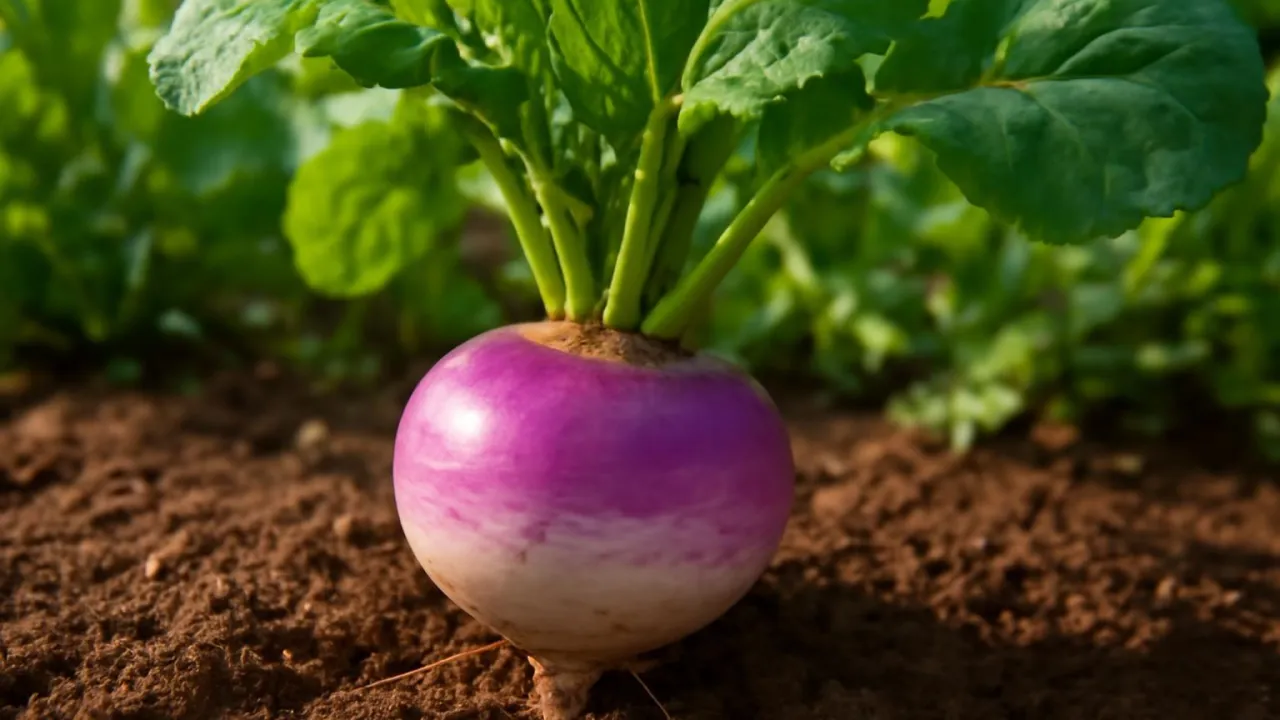
Purple Top Turnip
The Root with a Royal Crown
Turnip tops can grow big, leafy, and greenโalmost as tall as a cat!
Have you ever seen a root with a purple hat?
1 A Colorful Root
Turnips have purple tops and white bottoms. They grow under the dirt. Their leaves are green and tall.
2 Where Turnips Grow
Turnips like cool, sunny places. They need water and soft . People plant them in gardens and farms.
3 Yum! What Turnips Give Us
We eat the round and green leaves. Turnips taste sweet and crunchy. They help us stay healthy.
1. What color is the top of a turnip?
2. Where do turnips grow?
Turnip seeds can sprout in only three days after planting!
Did you know some vegetables wear purple and white?
1 Meet the Turnip
The purple top turnip has a round with a purple top and a white bottom. Its green leaves grow above the soil, waving in the sun. People love to eat both the root and the leaves.
2 How Turnips Grow
Turnips like cool weather and need lots of sunlight and water. Farmers plant turnip seeds in soft, moist soil, and the grow bigger underground. In just a few months, the turnips are ready to pick.
3 Turnips on Your Plate
Turnip taste sweet and crunchy, while the leaves are soft and tasty when cooked. People eat turnips in salads, soups, or even roasted. Eating turnips helps you get and stay healthy.
1. What do turnip roots look like?
2. Why do people eat turnips?
A single turnip plant can grow leaves longer than a ruler!
What if you pulled up a root that looked like it was wearing a purple crown?
1 A Crowned Root in the Dirt
Imagine digging in the garden and finding a round root with a purple top and a white bottom. Thatโs a purple top turnip! Its leafy green tops reach for the sun, while the root grows just below the soil. The purple color acts like a shield, protecting the root from sunlight and hungry bugs.
2 From Seed to Turnip
Turnip seeds sprout quickly in cool, moist soil, sending tiny roots downward. As the plant grows, its root swells underground and stores food for the plant. After about two months, the turnip is ready to harvest and eat. If left longer, the plant will bloom and make new seeds.
3 Turnipโs Clever Features
The thick root of a turnip stores water and , helping it survive dry days. Its purple top protects the root from too much sun and insects. The large leaves gather sunlight for , making food for the plant. These features help turnips grow strong in many gardens.
4 Turnips in Meals and Gardens
Turnips grow best in sunny gardens with loose, rich soil. People eat turnips raw, cooked, or even pickled, and the leaves can be steamed like spinach. Turnips are full of vitamin C, fiber, and minerals. Did you know a turnip is a root, not a fruit, even though it grows underground?
1. What does the purple color on a turnip do?
2. Which part of the turnip is usually NOT eaten?
Turnips can break up hard soil, making it easier for other plants to grow later!
Have you ever wondered why some roots wear a purple crown?
1 The Turnipโs Unique Look
Purple top turnips are easily recognized by their vibrant purple upper root and smooth white bottom. The purple color comes from , which are natural pigments that help protect the plant from sunlight and pests. Their broad, green leaves rise above the soil, gathering sunlight for photosynthesis. Both the root and the leaves are edible, making turnips a versatile vegetable.
2 Growing and Spreading
Turnips thrive in cool seasons and need well-drained, fertile soil with plenty of moisture. Farmers plant them in early spring or fall, and the seeds germinate quickly, producing edible roots in about two months. If left in the ground, turnips will flower and produce seeds for the next generation. Today, purple top turnips are grown all over the world, from Europe and Asia to North America.
3 Turnips and the Food Web
Turnips play an important role in gardens and food chains. Their roots provide food for people and animals like rabbits and deer, while the leaves are enjoyed by insects and some livestock. Turnips also help enrich the soil by breaking up hard ground and adding organic matter when their leaves . Farmers sometimes use turnips as a to protect and improve their fields.
4 Human Impact and Uses
People have grown and eaten turnips for thousands of years, especially in places with cool climates. Turnips are valued for their nutrition, providing vitamin C, fiber, and minerals. In some cultures, turnip roots are roasted, mashed, or pickled, while the leaves are cooked like spinach. Because turnips grow quickly and can improve soil health, they are an important crop for sustainable farming.
1. How do turnips help the soil?
2. Why are turnips called a cover crop?
Ancient Romans ate turnips daily, and some turnip roots can weigh over 3 pounds (1.4 kg)!
Did you know a humble root vegetable helped feed ancient civilizations and still improves soil today?
1 Scientific Roots and Royal Colors
The purple top turnip, Brassica rapa, belongs to the Brassicaceae family, which includes cabbage, broccoli, and mustard. Its signature purple crown is caused by pigments, which protect the root from ultraviolet radiation and deter some insects. The white lower half stores carbohydrates for the plant, while the green leaves above ground perform photosynthesis. This dual-color adaptation helps the turnip thrive in sunny, open fields and gardens.
2 Life Cycle and Growth Mechanics
Turnips are plants, meaning they complete their life cycle in two years, but most are harvested as annuals for their tender roots. Seeds germinate rapidly in cool, moist soil, with roots swelling underground and leaves growing quickly above. The root can reach 3โ5 inches (8โ13 cm) in diameter and weigh up to 1.5 pounds (0.7 kg) under ideal conditions. If left unharvested, the plant bolts, producing tall flowering stalks and hundreds of seeds for the next generation.
3 Turnips in Ecosystems and Agriculture
Purple top turnips are grown worldwide, especially in temperate regions of Europe, Asia, and North America. In ecosystems, turnip roots feed not only humans but also wildlife such as deer, rabbits, and insects. Farmers use turnips as a cover crop to prevent erosion, suppress weeds, and improve soil structure by breaking up compacted earth. When the plant decomposes, it adds organic matter and nutrients back into the soil, supporting sustainable agriculture.
4 Nutrition, Culinary Uses, and Cultural History
Turnips are rich in vitamin C, potassium, and dietary fiber, making them a nutritious addition to many diets. Both the root and greens are edible; roots can be eaten raw, roasted, mashed, or pickled, while the greens are cooked or steamed. Historically, turnips were a staple food in ancient Greece and Rome, and they remain important in cuisines across Europe, Asia, and the Americas. In some cultures, turnips are even carved into lanterns for autumn festivals, predating the pumpkin jack-oโ-lantern tradition.
5 Conservation, Challenges, and Fun Comparisons
Turnips are not endangered, but they face threats from pests like flea beetles and diseases such as clubroot. and careful soil management help protect turnip crops and maintain healthy yields. Compared to carrots, turnips grow faster and can tolerate colder temperatures, making them a reliable food source in early spring and late fall. A purple top turnip root can weigh as much as a small pineapple, while its leafy greens can reach over a foot (30 cm) tall. Their ability to improve soil and feed people makes them a true garden hero.
1. How do turnips help farmers keep soil healthy?
2. What makes the top of a purple top turnip purple?