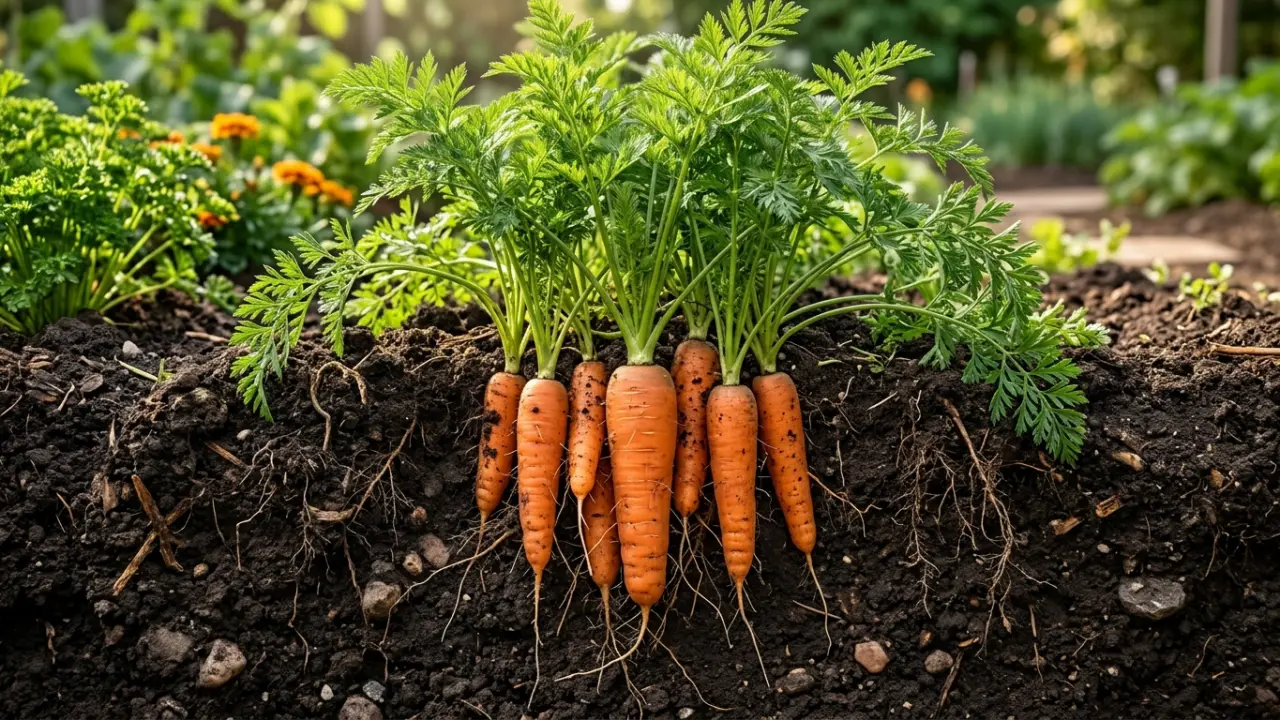
1. Which part of the Carrot plant hides underneath the brown garden soil?
2. What kind of soil helps a Carrot grow straight and smooth?
🤯 Mind-Blowing Fact • Grade 2
About 2,000 tiny carrot seeds can fit inside a single teaspoon!
✨ Word Sparks (Grade 2 Glossary)
Tap 🔊 to hear
taproot
Thick main root growing straight down
sprout
Begin growing up from a seed
moisture
Gentle wetness held inside garden soil
🪝
Why does a Carrot plant hide all its sweet food underground in one giant root?
1
Two-Part Garden Teamwork
Look at a sunny vegetable patch, and you only see half the Carrot plant! Above the ground, lacy green leaves soak up six to eight hours of sunshine, while one thick main root—called a —grows straight down in cool, moist soil.
2
A Two-Year Life Plan
Wild and garden carrots actually follow a clever two-year life cycle! During year one, the plant packs extra sugars into its underground root to survive chilly winter weather, and gardeners harvest the sweet before year two arrives.
3
Why Some Carrots Fork!
If a growing carrot tip bumps into a buried pebble in rocky dirt, it splits into funny two-legged or twisted shapes!
1. What happens if a growing Carrot taproot hits a rock buried in the soil?
2. Why does a Carrot plant store sugars inside its thick taproot during year one?
🤯 Mind-Blowing Fact • Grade 3
Carrots get even sweeter after a light autumn frost because the plant turns stored starch into natural sugar as anti-freeze!
✨ Word Sparks (Grade 3 Glossary)
Tap 🔊 to hear
pigment
Natural substance giving living things color
taproot
Central storage root anchoring a plant
nutrients
Vitamins and fuels bodies need daily
🪝
How does green sunlight above the dirt turn into eye-helping orange superpower fuel underground?
1
Solar Leaves, Underground Vault
Every crunch of a sweet Carrot begins as pure golden sunshine! Feathery green leaves above the garden soil use photosynthesis to turn sunlight, rainwater, and air into natural sugars, then pump those down tiny tubes into the swelling underground .
2
The Beta-Carotene Eye Boost
What gives a classic Carrot its blazing orange glow? Scientists actually named the bright beta-carotene right after the carrot! When you munch a crisp carrot, your body turns beta-carotene into Vitamin A—a vital nutrient that helps human eyes see clearly in dim evening light.
3
Botanical Root vs. Kitchen Veggie
In the kitchen we call carrots vegetables, and botanists agree wholeheartedly: unlike tomatoes, pumpkins, or cucumbers (which hold seeds inside and are botanical fruits), a carrot is a true storage root with zero seeds inside!
4
Secret Umbrella Flowers
Leave a garden carrot unpicked through cold winter months, and next summer its stored root energy shoots up a tall green stalk topped with lacy white flower clusters shaped like tiny umbrellas for visiting bees! Next summer, tiny winged pollinators land on those white blossoms to help make brand-new carrot seeds.
1. How does beta-carotene inside an orange Carrot help the human body?
2. Why do carrots taste sweeter when harvested after a chilly autumn frost?
🤯 Mind-Blowing Fact • Grade 4
The lacy white wildflower called Queen Anne's Lace blooming along Virginia roadsides is the exact same species (*Daucus carota*) as the crunchy orange carrot on your plate!
✨ Word Sparks (Grade 4 Glossary)
Tap 🔊 to hear
biennial
Plant completing its life in two years
umbel
Umbrella-shaped cluster of tiny plant flowers
domesticate
Tame wild plants for human farming
🪝
Did you know the world's first farm carrots weren't orange at all—they were deep royal purple and bright yellow?
1
Purple Ancestors From Central Asia
Open a farmer's basket a thousand years ago in Persia or Afghanistan, and you would never spot an orange carrot! Growers in Central Asia first domesticated Daucus carota around 1,100 years ago from skinny, bitter white wild roots, selecting tender purple and yellow taproots that traders carried westward across the Mediterranean world and eastward into China. Healthy, loose soil teeming with earthworms helps every taproot grow crisp, straight, and packed with vitamins.
2
How Dutch Growers Made Orange Famous
By the late 1500s, skilled horticulturalists in the Netherlands crossed yellow and reddish-orange carrot strains until they perfected plump, mild, bright orange taproots packed with beta-carotene. Because these hardy orange varieties thrived in cool northern soils without turning woody, they soon became the global favorite!
3
Wild Queen Anne's Lace Along Virginia Roads
Spot lacy white flat-topped wildflowers nodding beside a sunny Virginia meadow or roadside this summer? That wildflower—known as Queen Anne's Lace—is actually the exact same species (Daucus carota) as your supermarket carrot! Gently crush one feathery leaf between your fingers, and it smells unmistakably like fresh garden carrots.
4
Caterpillar Hosts and Pollinator Umbels
In backyard and farm ecosystems, feathery carrot greens nourish striking green-and-black Black Swallowtail butterfly caterpillars, while second-year umbrella-shaped flower heads—called —provide flat, easy-landing nectar stations for hoverflies, ladybugs, and tiny beneficial wasps. By attracting these helpful predatory insects, flowering carrots naturally protect neighboring garden vegetables from hungry aphids and caterpillars all summer long! From ancient purple roots in Central Asia to crisp orange garden rows in Virginia, carrots connect plant science with everyday nutrition.
1. What colors were the earliest domesticated carrots grown in Central Asia over 1,000 years ago?
2. How is the roadside wildflower Queen Anne's Lace related to the garden Carrot?
🤯 Mind-Blowing Fact • Grade 5
During World War II in 1940, Great Britain spread posters claiming carrots gave Royal Air Force pilots pinpoint night vision to keep newly invented onboard radar top secret!
✨ Word Sparks (Grade 5 Glossary)
Tap 🔊 to hear
phloem
Plant tissue carrying sugars from leaves
carotenoid
Yellow-orange plant pigment packed with nutrients
vernalization
Winter chilling needed to trigger flowering
🪝
How do vascular rings inside Daucus carota stockpile winter sucrose—and how did a World War II radar secret spark the myth that carrots give humans night-vision superpowers?
1
Taxonomy and Anatomy of the Storage Taproot
Classified within the aromatic plant family Apiaceae alongside celery, parsley, dill, fennel, and parsnips, the cultivated carrot (Daucus carota subsp. sativus) is a herbaceous biennial dicot. Slice a taproot crosswise and inspect its two concentric anatomical zones: a fibrous central vascular core (xylem) that conducts water and dissolved minerals upward, encircled by a thick, crisp outer ring of secondary cortex where the plant stockpiles sucrose, glucose, and —making that outer ring the sweetest part of every bite! Whether roasted warm or eaten raw, Daucus carota remains a cornerstone of global agricultural nutrition.
2
Chromoplast Biochemistry and Provitamin A
Inside orange carrot cells, specialized organelles called chromoplasts accumulate dense crystalline needles of alpha- and beta-carotene—reaching 8,300 micrograms per 100 grams of fresh root weight. During human digestion, intestinal enzymes cleave each symmetrical beta-carotene molecule into two molecules of retinal (Vitamin A), which bind opsin proteins inside rod photoreceptor cells of the eye's retina to power low-light scotopic vision.
3
World War II Radar and the Night-Vision Myth
Although Vitamin A prevents clinical night blindness in vitamin-deficient diets, eating surplus carrots cannot grant superhuman owl vision! That enduring legend began in 1940 during World War II, when Great Britain's Ministry of Information credited Royal Air Force pilots' nighttime interceptions to eating heaps of homegrown British carrots—cleverly disguising newly invented onboard Airborne Interception radar.
4
Vernalization and Bolting Physiology
Developing sharpest color and sweetness at 60 to 70 °F (15 to 21 °C) in deep, stone-free sandy loam, Daucus carota requires —six to eight weeks of winter chilling between 35 and 50 °F (2 to 10 °C)—to activate floral hormones that bolt a 4-foot (1.2-meter) compound umbel of over 1,000 tiny white florets skyward in year two.
5
How 'Baby-Cut' Engineering Slashed Food Waste
Before 1986, supermarkets rejected up to half of harvested field carrots purely for crooked shapes or minor skin blemishes, relegating tons of nutritious produce to livestock feed or compost. When California farmer Mike Yurosek pioneered industrial peelers that shaped imperfect roots into uniform two-inch 'baby-cut' carrots, the innovation slashed agricultural food waste dramatically while doubling per-capita fresh carrot consumption across North America! Modern plant breeders now cultivate rainbow heirloom varieties in purple, yellow, red, and orange so students can taste living botanical history in every crunchy bite.