1. Which direction do you pull the rope on a single top pulley to make a flag go up?
2. What keeps the rope from slipping off a pulley wheel?
🤯 Mind-Blowing Fact • Grade 2
Theater stage crews hide dozens of block-and-tackle rigs high above the curtain to fly heavy painted castle walls up and down in seconds!
✨ Word Sparks (Grade 2 Glossary)
Tap 🔊 to hear
block
A sturdy case holding pulley wheels
tackle
Strong ropes threaded between pulley blocks
load
The heavy object being lifted up
🪝
Could you pull a giant wooden sailing ship onto a beach all by yourself?
1
One Rope, Big Power
Picture standing on a sunny dock beside a huge wooden ship. Sailors groan because they cannot budge it, yet one inventor steps up and tugs a looped rope. Slowly, the heavy ship glides across the sand!
2
Meet the Block and Tackle
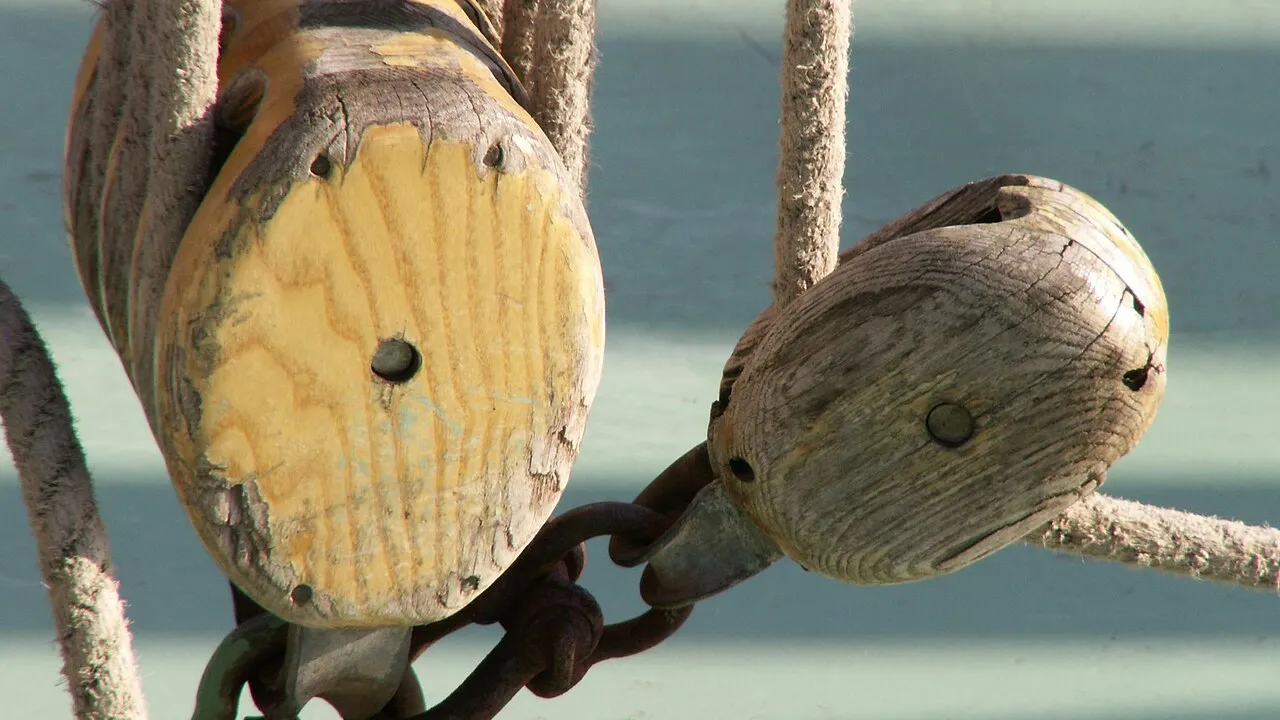
One grooved wheel changes the direction of your pull, so tugging down lifts a bucket up. When engineers group several wheels inside wooden or metal frames called , the rope called the shares the weight.
3
Trading Distance for Strength
Each extra loop of rope holds part of the , making heavy stones feel light. You must pull more rope through your hands, and cranes, elevators, and theater stages use this clever trick every day.
1. What happens when you add more pulley wheels and rope loops to a block and tackle?
2. What is the trade-off when a block and tackle makes a heavy crate twice as easy to lift?
🤯 Mind-Blowing Fact • Grade 3
An 18th-century tall sailing ship carried more than 1,000 wooden pulley blocks in its rigging to control gigantic canvas sails in howling ocean winds!
✨ Word Sparks (Grade 3 Glossary)
Tap 🔊 to hear
sheave
The spinning grooved wheel inside a pulley
mechanical advantage
How much a machine multiplies your force
movable pulley
A pulley block that rises with cargo
🪝
Why does threading one rope through four wheels make a 200-pound boulder feel like 50 pounds?
1
A Ship-Moving Challenge
Splash, creak, heave! Around 250 BCE in ancient Syracuse, King Hieron doubted that math could move mountains. Inventor Archimedes accepted the challenge, rigged a multi-wheel rope system to a loaded warship, and smoothly drew the vessel ashore while sitting calmly.
2
Inside the Blocks
Inside every block sits one or more grooved wheels called , spinning freely on sturdy axles. An upper block anchors to an overhead beam, while a lower movable block hooks directly onto the heavy cargo below.
3
Mechanical Advantage in Action
When a single continuous rope winds back and forth between both blocks, every vertical strand supports an equal fraction of the weight. Four supporting strands give a of four, cutting your needed pull force to one fourth!
4
From Tall Ships to Skyscrapers
Notice the catch: to raise that boulder one foot, you must pull four feet of rope. Sailing crews trimmed towering canvas sails with wooden blocks, and modern tower cranes still thread steel cables through to build skyscrapers.
1. If four rope strands support a 200-pound crate on a movable block, about how much pull force do you need (ignoring friction)?
2. What is the spinning grooved wheel inside a pulley frame called?
🤯 Mind-Blowing Fact • Grade 4
During the Portsmouth Block Mills breakthrough of 1803, engineer Marc Isambard Brunel built steam-powered machines that mass-produced 130,000 naval pulley blocks a year—launching the world's first modern factory production line!
✨ Word Sparks (Grade 4 Glossary)
Tap 🔊 to hear
tension
Pulling force transmitted along a stretched rope
compound pulley
Combined fixed and movable pulleys multiplying force
work
Force multiplied by the distance something moves
🪝
How do engineers lift multi-ton bridge beams without breaking the laws of energy?
1
Redistributing Tension Across a Single Line
Stand beneath a towering harbor crane as steel cables hum under and a forty-ton shipping container floats effortlessly off a deck. No magic shrinks the container's mass; instead, an ancient simple machine called the block and tackle divides gravity's pull across multiple parallel lines.
2
Fixed Versus Compound Systems
A lone fixed pulley anchored to a ceiling beam provides a mechanical advantage of just one: it redirects a downward tug into an upward lift without reducing effort. Pairing that fixed block with a lower movable block creates a compound tackle where equalizes throughout one continuous rope.
3
Conservation of Work and Friction Limits
Physics demands that total —force multiplied by distance—remains constant. When six supporting rope segments slice a 600-newton load down to a 100-newton pull, the operator must haul six meters of line to raise the load a single meter. Bearing friction at each axle steals small percentages of efficiency, which modern ball bearings minimize.
4
Building Empires and Modern Skylines
After Mesopotamian well-drawers pioneered simple pulleys around 1500 BCE and Archimedes formalized compound polyspaston rigs around 250 BCE, Roman builders hoisted marble temple columns into place. Today, elevator counterweights, rescue harnesses, sailboat mainsheets, and offshore derricks rely on the exact same geometry.
1. Why doesn't a single fixed pulley attached to a ceiling reduce the force needed to lift a heavy bucket?
2. If an ideal six-strand block and tackle lifts a statue 2 meters upward, how much rope must pass through the operator's hands?
🤯 Mind-Blowing Fact • Grade 5
Giant offshore crane vessels thread miles of braided steel cable through 40-sheave traveling blocks over three stories tall to hoist entire 10,000-ton oil-rig decks out of the sea!
✨ Word Sparks (Grade 5 Glossary)
Tap 🔊 to hear
polyspaston
Ancient Greek multi-pulley crane perfected by Archimedes
equilibrium
Balanced state where opposing forces cancel equally
efficiency
Ratio of useful work output to input
🪝
Why can't engineers string a thousand pulleys together to lift a mountain with a pinky finger?
1
Archimedes and the Geometry of Force
When ancient chroniclers watched Archimedes draw a fully laden three-masted transport ship across dry land in Syracuse around 250 BCE, witnesses marveled as though witnessing sorcery. In reality, his —the compound block and tackle—demonstrated one of classical mechanics' cleanest truths: tension distributed continuously along a flexible line multiplies human force in strict proportion to its supporting segments.
2
Free-Body Mechanics of Ideal Tackles
Consider two multi-sheave blocks—a stationary crown block overhead and a traveling block attached to a payload of weight W. Because an unstretched, low-mass cable carries uniform tension T along its entire length, n vertical rope segments cradling the traveling block exert an upward force of n × T. Neglecting losses, requires T = W / n, defining an ideal mechanical advantage (IMA) equal to n.
3
Conservation of Energy and Kinematic Trade-Offs
No simple machine manufactures free energy. Raising the traveling block by height h shortens every one of the n supporting strands by h, requiring the hauling end (the fall) to be drawn a distance d = n × h. Input work (T × n × h) matches output gravitational potential energy (W × h), trading displacement velocity directly for force amplification.
4
Real-World Efficiency and Capstan Friction
Why not thread hundreds of sheaves together? Each time steel wire rope bends over a sheave and presses an axle bearing, internal fiber flexure and bearing drag absorb roughly 2% to 5% of transmitted force. Beyond ten or twelve sheaves, cumulative friction losses erode actual mechanical advantage (AMA) so severely that extra wheels hinder rather than help unless ultra-low-friction roller bearings are used.
5
Enduring Engineering Legacy
From Roman Vitruvian construction cranes and Age-of-Sail rigging to 20,000-ton offshore subsea gantry hoists and mountain crevasse Z-drag rescue kits, the block and tackle remains indispensable wherever immense tension must be governed smoothly, predictably, and safely.