1. What tiny animal is beloved across Puerto Rico for singing 'ko-kee, ko-kee' at night?
2. Are people born in Puerto Rico citizens of the United States?
🤯 Mind-Blowing Fact • Grade 2
Old San Juan, founded in 1521, is the oldest European-built capital city anywhere under the flag of the United States!
✨ Word Sparks (Grade 2 Glossary)
Tap 🔊 to hear
territory
land belonging to a nation that isn't a state
fortress
strong thick-walled fort built to guard a harbor
tropical
warm sunny region near Earth's middle zone
🪝
Where can you hike inside America's only tropical national forest and explore a five-hundred-year-old stone fort on the same afternoon?
1
Waterfalls of El Yunque
Step beneath giant tree ferns and listen to waterfalls splash down emerald slopes! El Yunque in northeastern Puerto Rico is the only rainforest in the entire U.S. National Forest System. Bright green Puerto Rican parrots fly above misty peaks while tiny coquí frogs chirp from bromeliad leaves.
2
Stone Forts of Old San Juan
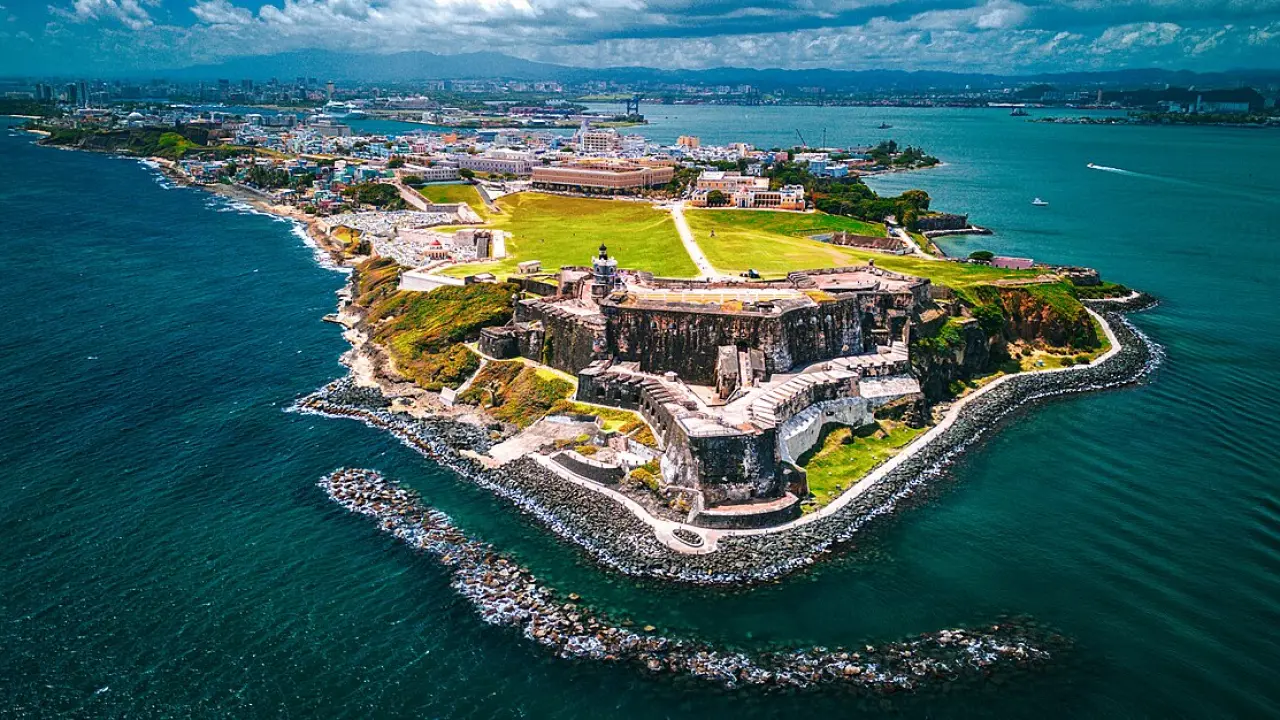
Just down the coast in San Juan, thick stone walls of El Morro fort have guarded the harbor since the 1500s—long before Jamestown or Plymouth were built!
3
An American Commonwealth
Roughly a thousand miles southeast of Florida, Puerto Rico uses U.S. dollars and U.S. mail as a proud American commonwealth.
1. What makes El Yunque National Forest in Puerto Rico unique in the U.S. National Forest System?
2. Which historic stone fortress guards the entrance to San Juan Bay?
🤯 Mind-Blowing Fact • Grade 3
Mosquito Bay on the Puerto Rican island of Vieques holds the world record as the brightest bioluminescent (living-light) bay on Earth!
✨ Word Sparks (Grade 3 Glossary)
Tap 🔊 to hear
archipelago
chain or group of islands clustered together
bioluminescent
able to glow with natural living light
heritage
traditions, music, and stories passed down generations
🪝
Did you know common English words like 'hurricane,' 'hammock,' and 'barbecue' came from Puerto Rico's earliest people?
1
Borikén and Taíno Gifts
Sail past Puerto Rico's palm-lined shores—alongside smaller sister islands Vieques and Culebra—and you see an long called Borikén by the Indigenous Taíno people! Taíno villagers wove comfortable hanging nets ('hamaca'—hammock), weathered tropical storms ('hurakán'—hurricane), and paddled wooden boats ('kanowa'—canoe), gifting words we still speak every day.
2
Blending Three Rich Cultures
After Spanish ships arrived in 1493, San Juan's harbor earned the name 'Puerto Rico,' meaning 'Rich Port.' Over centuries, Taíno, Spanish, and West African traditions blended into vibrant bomba and plena music, colorful festivals, and savory plantain dishes.
3
U.S. Territory and Commonwealth
Puerto Rico became a U.S. territory in 1898, Congress affirmed U.S. citizenship in 1917, and voters adopted a Commonwealth constitution in 1952, electing their own governor.
4
Glowing Waters of Vieques
In Mosquito Bay on Vieques, millions of microscopic dinoflagellates flash blue-green light whenever fish or kayaks stir the water!
1. Which everyday English words originally came from the language of the Taíno people of Borikén (Puerto Rico) and the Caribbean?
2. What makes Mosquito Bay on Vieques glow bright blue at night when splashed?
🤯 Mind-Blowing Fact • Grade 4
Just north of Puerto Rico's coast plunges the Puerto Rico Trench—at more than 27,400 feet deep, it is the deepest spot in the entire Atlantic Ocean!
✨ Word Sparks (Grade 4 Glossary)
Tap 🔊 to hear
trade winds
steady tropical breezes blowing east to west
microclimate
local weather zone different from nearby areas
humanitarian
person dedicated to helping others in need
🪝
How does a hundred-mile-long Caribbean island hold misty cloud peaks, a dry cactus forest, and underground limestone rivers?
1
Surprising Microclimates Across One Island
Although Puerto Rico's main island measures roughly 100 miles long by 35 miles wide (3,515 square miles including Vieques, Culebra, and Mona), its central mountain spine—the Cordillera Central, rising to 4,390-foot Cerro de Punta—creates dramatic weather contrasts! Warm northeast drop nearly two hundred inches of rain on El Yunque's cloud forest, yet just across the mountains on the southwestern coast, Guánica Dry Forest receives so little rain that towering cacti thrive beside coral beaches. Meanwhile, northern karst limestone hills hide the Río Camuy Cave System, one of the largest underground rivers in the world.
2
Taíno Borikén and Centuries as San Juan Bautista
Taíno communities gathered in ceremonial plazas called bateyes across Borikén long before Christopher Columbus landed in 1493 and Juan Ponce de León founded the colony's early settlement. Guarded by the UNESCO World Heritage ramparts of El Morro and Castillo San Cristóbal, walled Old San Juan protected ships sailing between the Americas and Europe for nearly four centuries.
3
How U.S. Territories Differ From States
Ceded by Spain to the United States in 1898, Puerto Rico gained statutory U.S. citizenship under the 1917 Jones-Shafroth Act and organized local self-government as Estado Libre Asociado (Commonwealth) in 1952. Residents carry U.S. passports, serve proudly in the U.S. armed forces, and elect a governor, legislature, and a Resident Commissioner who speaks in Congress—though while living on the island they do not cast Electoral College votes for president.
4
Roberto Clemente and Modern Science
Puerto Rico leads major medical and pharmaceutical manufacturing and celebrates heroes like Baseball Hall of Famer Roberto Clemente, remembered worldwide for both athletic brilliance and kindness.
1. Why does El Yunque in northeastern Puerto Rico get soaking rainforest showers while Guánica in the southwest grows dry cacti?
2. Who represents Puerto Rico's more than three million U.S. citizens inside the U.S. House of Representatives?
🤯 Mind-Blowing Fact • Grade 5
In the 1970s, fewer than fifteen wild Puerto Rican parrots remained on Earth, until dedicated conservation scientists in El Yunque and Río Abajo forests rescued the species and helped hundreds fly free again!
✨ Word Sparks (Grade 5 Glossary)
Tap 🔊 to hear
mogote
steep rounded limestone hill in karst landscapes
sovereignty
supreme legal authority to govern a territory
unincorporated
U.S. territory not yet made a state
🪝
How do plate tectonics, Taíno-Hispanic-African synthesis, and U.S. territorial law converge on the 'Island of Enchantment'?
1
Tectonic Crest Beside the Atlantic's Deepest Trench
Anchored between the Caribbean Sea and the North Atlantic Ocean roughly 1,000 miles southeast of Miami, the archipelago of Puerto Rico—comprising the main island plus Vieques, Culebra, Mona, and coastal cays across 3,515 square miles—forms the easternmost of the Greater Antilles. Along its northern submarine margin, oblique boundary motion between the North American and Caribbean plates carved the 27,480-foot Milwaukee Depth inside the Puerto Rico Trench, the deepest abyss in the Atlantic Ocean! Inland, uplifted volcanic ridges of the Cordillera Central (peaking at 4,390-foot Cerro de Punta), northern haystack karst riddled by the Río Camuy cavern network, El Yunque's montane cloud forest, and the UNESCO-recognized Guánica subtropical dry forest compress extraordinary ecological diversity into thirty-five miles of latitude.
2
Taíno Borikén and Four Centuries of Atlantic Crossroads
Archaeological plazas at Tibes and Caguana preserve stone-lined ceremonial courts built by Arawak-speaking Taíno chiefdoms (yucayeques) led by caciques across Borikén—a heritage still echoed when Puerto Ricans proudly call themselves Boricuas. Following Spanish colonization in 1508 under Juan Ponce de León and the founding of San Juan on its walled islet by 1521, engineers erected the massive masonry bastions of La Fortaleza, El Morro, and San Cristóbal. Over four centuries, Indigenous Taíno roots, Iberian language and architecture, and West African musical rhythms (bomba) fused with coastal plena storytelling into a distinctive Caribbean identity; slavery was abolished peacefully on the island on March 22, 1873.
3
1898 Treaty, 1917 Citizenship, and 1952 Commonwealth
Months after Spain granted Puerto Rico an Autonomous Charter in late 1897, the Spanish-American War transferred to the United States under the 1898 Treaty of Paris. Under the Constitution's Territorial Clause (Article IV, Section 3), Congress enacted the Foraker Act (1900) and the Jones-Shafroth Act of March 2, 1917, conferring U.S. citizenship on Puerto Ricans—hundreds of thousands of whom, including the decorated 65th Infantry Regiment ('Borinqueneers'), have served with distinction in the U.S. military. Under Governor Luis Muñoz Marín, voters ratified a constitution establishing the Commonwealth of Puerto Rico (Estado Libre Asociado) on July 25, 1952.
4
Civic Representation and Ongoing Constitutional Dialogue
As an U.S. territory, Puerto Rico shares the U.S. federal court system, currency, and postal service, elects its governor and bicameral legislature, and sends a Resident Commissioner to the U.S. House of Representatives for a unique four-year term. While island residents vote in presidential primaries, only U.S. states (and D.C. under the 23rd Amendment) appoint presidential electors—making Puerto Rico's future political status an enduring topic of democratic civic study.
5
Bioluminescence, Conservation, and Global Contributions
From safeguarding the critically endangered Puerto Rican parrot (Amazona vittata) in El Yunque and studying Pyrodinium bahamense dinoflagellates in Vieques's Mosquito Bay to producing a major share of America's sterile pharmaceuticals and honoring figures such as Supreme Court Justice Sonia Sotomayor (of Puerto Rican heritage) and humanitarian Hall of Famer Roberto Clemente, Isla del Encanto enriches every facet of American life.