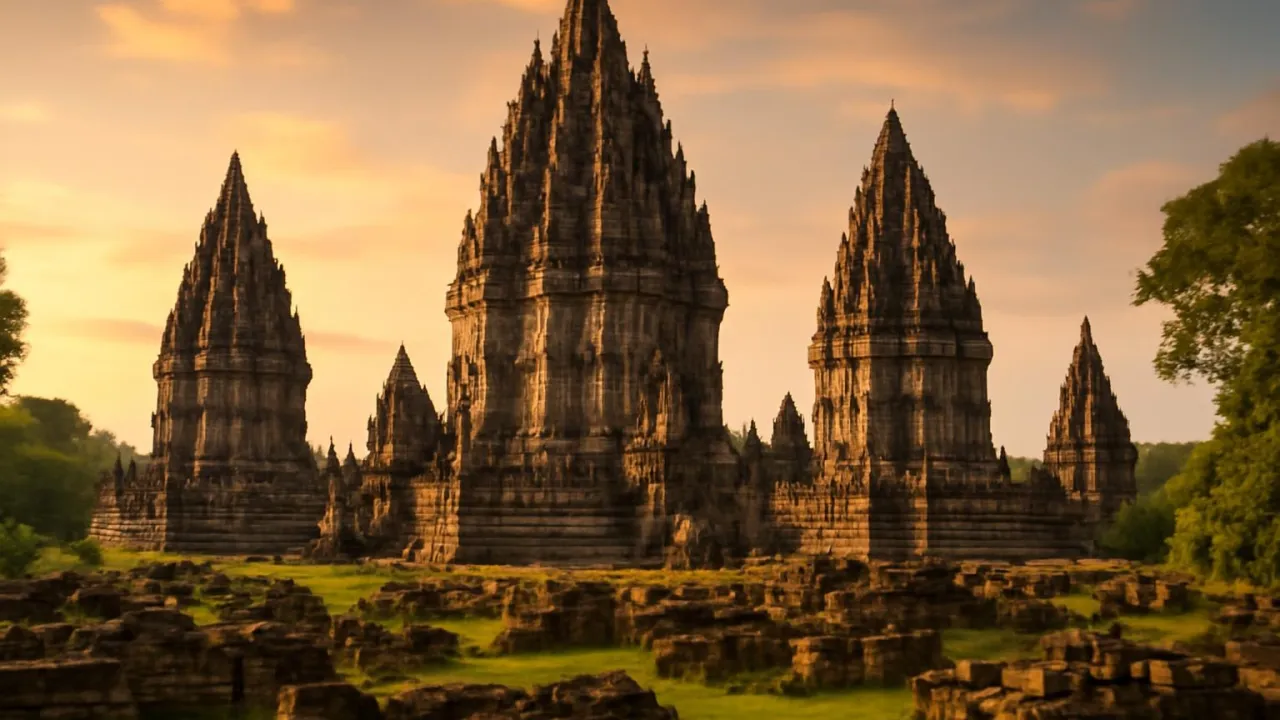
Prambanan has many tall towers made from gray stone. People built them a long time ago, and they still stand today. The tallest tower is higher than most trees.
2
Walking and Looking
walk around the temple and look at the carvings. Some carvings show animals, while others tell stories from old . It feels like stepping into a storybook made of rock.
3
A Place for Prayers
Prambanan is a special place for prayers and festivals. People come from many places to celebrate here. The temple is both a wonder to see and a place to honor traditions.
The Ramayana Ballet is performed at Prambanan with the temple as a glowing backdrop.
✨ Word Sparks (Grade 3 Glossary)
Tap 🔊 to hear
bas-relief
A picture carved into a flat wall
volcanic stone
Rock made from cooled lava
erosion
Wearing away by wind or rain
🪝
Imagine hearing your footsteps echo between ancient stone towers—what stories would you find?
1
A Forest of Stone Spires
Prambanan Temple rises from the green Java plain, with tall spires that almost touch the clouds. Built in the 9th century, its largest tower reaches 47 meters high. The temple complex once had 240 shrines, making it the biggest Hindu temple site in Indonesia. Each tower is carefully stacked with blocks.
2
Carved Legends and Ancient Art
The walls of Prambanan are covered in carvings called . These carvings tell stories from the Ramayana, a famous Hindu legend. You can see animals, gods, and battles all etched into stone. The details show how skilled the ancient artists were.
3
How Did It Stand So Tall?
Builders used strong and clever stacking to create tall, stable towers. The main tower’s base is wide, so it can support the heavy stones above. Arches and thick walls help the towers resist earthquakes and . The design shows early engineering skills.
4
A Place for Festivals and Wonder
Today, people visit Prambanan for festivals, prayers, and to learn about history. The temple is a UNESCO World Heritage site, protecting its beauty for everyone. At night, special dances bring the Ramayana stories to life. Prambanan inspires visitors with its ancient wonder.
Prambanan’s main temple is nearly as tall as a 15-story building!
✨ Word Sparks (Grade 4 Glossary)
Tap 🔊 to hear
UNESCO
A group that protects world treasures
artisans
People skilled at making things
interlocking
Fitting together like puzzle pieces
🪝
What would it feel like to stand in the shadow of a stone tower built over 1,000 years ago?
1
Stepping Into Ancient Java
Imagine walking across grassy fields and suddenly seeing stone towers rising above the trees. Prambanan’s main temple reaches 47 meters high, almost as tall as a modern building. The temple complex was carefully arranged in geometric patterns, with 240 shrines built from volcanic stone blocks. Ancient builders shaped and stacked each block by hand, using no modern machines.
2
Stories Etched in Stone
All around you, the temple walls are covered in intricate bas-relief carvings. These carvings tell the Ramayana epic, showing gods, animals, and legendary battles. Every detail was chiseled by skilled to teach lessons and connect people to their faith. Walking the corridors, you can follow these ancient stories from one stone to the next.
3
Engineering for the Ages
Prambanan’s towers have survived earthquakes and centuries of weather thanks to smart engineering. Builders made wide bases and thick walls to hold the heavy stones above. blocks and arches help the towers resist shaking and erosion. The temple’s lasting strength shows the builders’ deep knowledge of design and materials.
4
A Living Wonder Today
Prambanan is now a World Heritage site and a center for celebration. Each year, people gather for Hindu festivals and the famous Ramayana Ballet, performed with the glowing temple behind. Visitors from around the world come to admire the art, history, and spiritual meaning. Prambanan links the creativity and devotion of the past to the present day.
1. How did builders make Prambanan’s towers last so long?
2. Why do people visit Prambanan today?
🤯 Mind-Blowing Fact • Grade 5
Prambanan’s main temple uses over 18,000 tons of volcanic stone, all assembled without modern cranes or cement.
✨ Word Sparks (Grade 5 Glossary)
Tap 🔊 to hear
andesite
A hard volcanic rock used for building
corbelled arch
An arch made by stacking stones outward
seismic resistance
The ability to withstand earthquakes
🪝
If you could travel back in time, how would you help build a stone temple that could survive earthquakes for centuries?
1
The Rise of a Sacred City
Prambanan Temple, constructed in the mid-9th century by the Mataram Kingdom, represents the pinnacle of ancient Hindu architecture in Southeast Asia. The complex’s main tower, dedicated to the god Shiva, soars to an impressive 47 meters, making it the tallest Hindu temple in Indonesia. Originally, the site included 240 temples arranged in concentric squares, with the three largest sanctuaries honoring Shiva, Vishnu, and Brahma. The temple’s strategic placement on the fertile Prambanan Plain reflects both religious symbolism and the region’s volcanic geology.
2
Architectural Ingenuity and Structural Physics
Prambanan’s enduring strength lies in its sophisticated engineering principles and material science. Builders sourced dense volcanic stone, shaping each block to interlock precisely without mortar. The main tower’s broad base and tiered design distribute immense weight downward, while thick walls and provide . This early understanding of load distribution and resonance allowed the temple to withstand centuries of earthquakes and volcanic activity.
3
Narratives in Stone: The Ramayana Bas-Reliefs
Encircling the inner sanctums are over 1,000 meters of bas-relief carvings depicting scenes from the Ramayana, one of the world’s oldest epic poems. These panels illustrate complex stories of gods, demons, and heroic deeds, serving both as religious instruction and artistic achievement. The carvings display remarkable detail, with each figure, animal, and ornament etched to convey movement and emotion, reflecting the cultural sophistication of 9th-century Java.
4
Cultural Evolution and Modern Revival
After centuries of neglect and partial collapse due to earthquakes, Prambanan was rediscovered and restored in the 20th century. Today, it is a UNESCO World Heritage site and a symbol of Indonesian heritage, drawing scholars, artists, and tourists worldwide. The annual Ramayana Ballet, performed on an open-air stage with the illuminated temple as a backdrop, revives ancient traditions and brings the legends to life for new generations. Prambanan’s preservation demonstrates the importance of global cooperation in safeguarding cultural treasures.
5
A Living Laboratory of History and Engineering
Prambanan offers invaluable insights into early engineering, religious art, and cultural exchange across Asia. Archaeologists and engineers study its construction methods to learn about ancient seismic design and sustainable building practices. The temple’s ongoing conservation involves careful analysis of stone decay, water drainage, and restoration techniques. As both a sacred site and a scientific resource, Prambanan continues to inspire innovation and respect for the achievements of the past.