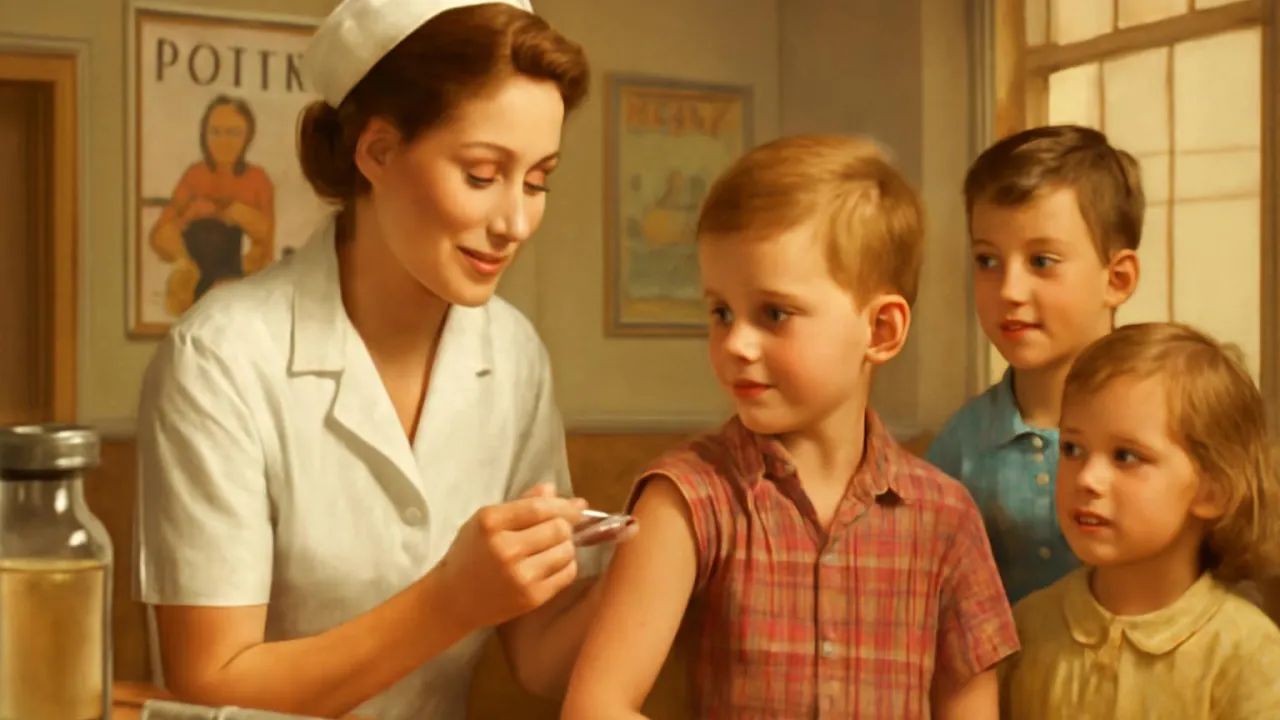
Before the vaccine, thousands of kids got polio every year in the U.S. alone.
✨ Word Sparks (Grade 2 Glossary)
Tap 🔊 to hear
vaccine
A shot that teaches your body to fight germs
immune
When your body can stop sickness
scientist
A person who studies and discovers new things
🪝
Have you ever wondered how a tiny shot can protect millions of kids?
1
A Shot That Saves
The nurse gives a small shot in your arm, and you are brave. This shot is called a , and it helps your body fight germs. The polio vaccine was made to stop a very bad sickness.
2
Polio Was a Big Problem
Polio could make children very sick, and sometimes they could not walk. Many families were worried, so worked hard to find a way to help. Dr. Jonas Salk made the first safe polio .
3
A World Without Polio
Now, most kids get the polio shot, and polio is almost gone. The teaches your body to fight the virus, so you do not get sick. This tiny shot changed the world for kids everywhere.
The first polio vaccine was tested on over 1.8 million children in 1954!
✨ Word Sparks (Grade 3 Glossary)
Tap 🔊 to hear
paralyze
To lose the ability to move
immune system
The body’s way to fight germs
immunization
Getting protected from a disease
🪝
Can you imagine a world where a single shot could stop a dreaded disease?
1
Polio’s Shadow
Decades ago, people worried about polio every summer. This dangerous virus could children, making it hard or impossible for them to walk. Hospitals filled with special 'iron lungs' to help kids breathe. Families hoped scientists would find a solution.
2
The Vaccine Breakthrough
Dr. Jonas Salk worked for years in his laboratory to create a vaccine. He used a weakened form of the polio virus to train the . When vaccinated, a person’s body learns to fight off the real virus. This scientific breakthrough brought hope to millions.
3
How Vaccines Work
Vaccines use weakened or dead germs to create immunity. The remembers the virus and acts quickly if it ever returns. This process is called , and it protects people from getting sick. The polio vaccine was one of the first to be used worldwide.
4
Changing the World
After the vaccine was introduced, polio cases dropped dramatically. Many countries now have no polio at all, thanks to vaccination. Scientists still work to make sure every child is protected. The polio vaccine is a symbol of hope and scientific teamwork.
1. What does the immune system do after a vaccine?
2. Why was the polio vaccine important?
🤯 Mind-Blowing Fact • Grade 4
Polio once paralyzed over 350,000 people each year, but now fewer than 100 cases remain worldwide.
✨ Word Sparks (Grade 4 Glossary)
Tap 🔊 to hear
eradicate
To completely get rid of something
inactivated
Made harmless so it cannot cause disease
field trial
A big test with many people
🪝
What would it feel like to wait for a life-saving shot that could end a disease forever?
1
Polio’s Threat and Fear
In the early 1900s, polio outbreaks brought fear to families around the world, especially during summer. The virus could cause paralysis, sometimes leaving children unable to move their arms or legs for life. Hospitals used large machines called iron lungs to help sick children breathe. Communities closed pools and playgrounds, hoping to avoid the invisible threat.
2
A Scientific Race
Scientists like Dr. Jonas Salk and Dr. Albert Sabin worked tirelessly to develop a vaccine. Salk’s team created a vaccine using (killed) poliovirus, allowing the immune system to recognize and destroy the real virus. In 1954, a massive tested the vaccine on 1.8 million children, proving it was safe and effective. The world celebrated this medical triumph.
3
How the Vaccine Works
The polio vaccine exposes the immune system to a harmless version of the virus, building immunity. When a vaccinated person encounters the real virus, their immune system quickly attacks and destroys it. This process, called immunization, relies on the body’s memory cells to prevent illness. Vaccines are now a vital tool in stopping many diseases.
4
Global Impact and Eradication
After the vaccine’s introduction, polio cases dropped by over 99% worldwide. Mass immunization campaigns have nearly eradicated polio, though a few regions still face outbreaks. The vaccine’s success inspired new research against other diseases. The fight to end polio shows how science and teamwork can protect future generations.
2. Why do vaccines use a harmless version of a virus?
🤯 Mind-Blowing Fact • Grade 5
By 2023, over 2.5 billion children have received the polio vaccine, preventing millions of cases of paralysis.
✨ Word Sparks (Grade 5 Glossary)
Tap 🔊 to hear
herd immunity
When most people are protected, so the disease can’t spread
antigen
A piece of a germ that helps your body learn to fight it
endemic
When a disease stays in a certain place
🪝
Imagine hearing the hopeful cheers as scientists announced a vaccine that could defeat a terrifying disease—how did this breakthrough change the world?
1
Polio’s Global Toll
Throughout the early twentieth century, polio outbreaks caused widespread panic, especially among families with young children. The poliovirus, transmitted through contaminated water or food, could invade the nervous system and cause paralysis within hours. Each year, polio paralyzed or killed hundreds of thousands of people worldwide, leaving children in leg braces or confined to iron lungs. Communities closed public spaces, and parents lived in constant fear of the invisible threat. The urgent need for a solution drove scientists and governments to invest in research.
2
The Race for a Vaccine
Dr. Jonas Salk, supported by the March of Dimes, developed the first inactivated polio vaccine (IPV) using a killed version of the virus. Salk’s team meticulously tested the vaccine in the laboratory, then launched a massive field trial in 1954 involving 1.8 million children, known as 'Polio Pioneers.' The results were groundbreaking: the vaccine was safe and over 90% effective against paralytic polio. Shortly after, Dr. Albert Sabin introduced an oral polio vaccine (OPV) using weakened live virus, which was easier to administer and provided community-wide protection.
3
Immunology and How Vaccines Work
Vaccines function by presenting the immune system with —proteins from the virus that cannot cause disease. The body’s adaptive immune response creates memory cells that recognize and attack the real virus if encountered later. Salk’s IPV required injection, while Sabin’s OPV could be given as drops on a sugar cube. Both vaccines harnessed the principles of immunological memory and , protecting not just individuals but entire populations.
4
Impact and Eradication Efforts
Following the introduction of polio vaccines, global polio cases dropped by over 99.9%. In 1988, the World Health Organization launched the Global Polio Eradication Initiative, aiming to eliminate the disease entirely. Today, polio remains in only two countries, Afghanistan and Pakistan, due to challenges like conflict and vaccine access. Continued vaccination campaigns and surveillance are critical to preventing resurgence and achieving total eradication.
5
Legacy and Scientific Inspiration
The fight against polio revolutionized public health and vaccine science, setting the stage for new discoveries against other infectious diseases. The collaborative efforts of scientists, doctors, volunteers, and communities demonstrated the power of teamwork and innovation. The polio vaccine’s legacy is a world where children can run, play, and dream without fear of a devastating disease. Its story continues to inspire global efforts to conquer other health threats through science and cooperation.