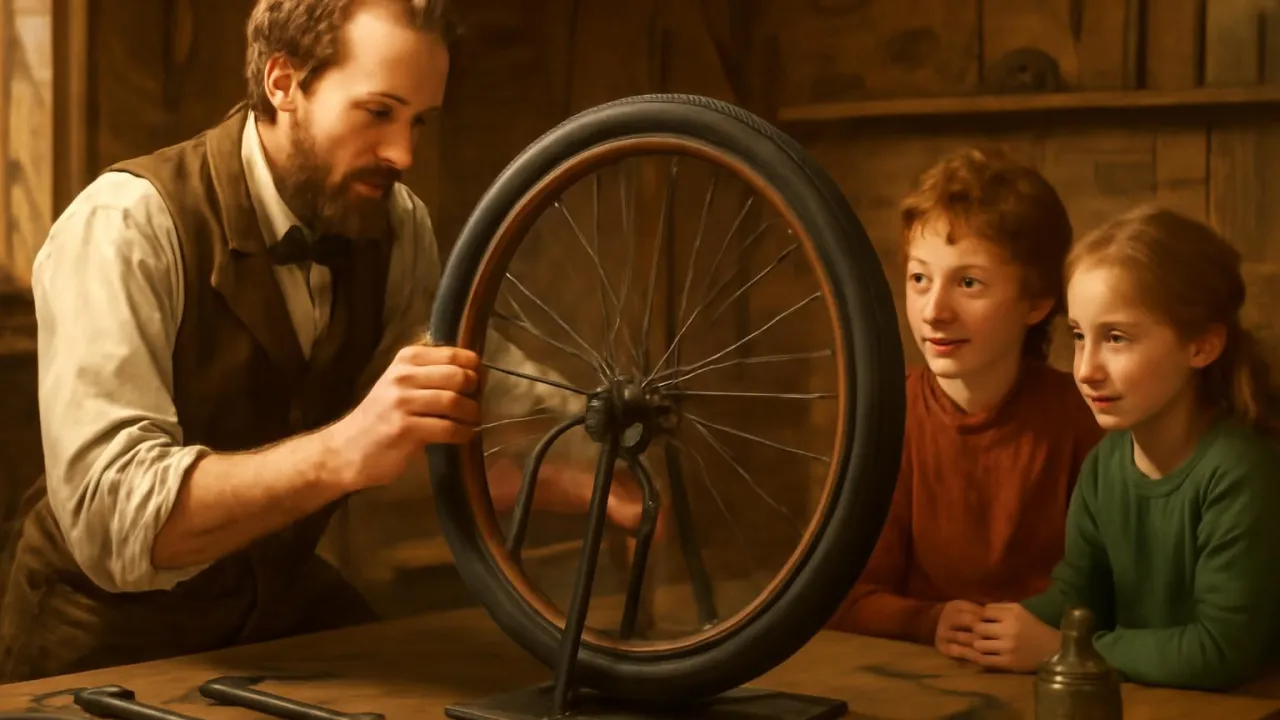
John Boyd Dunlop invented the first practical air-filled tire for his son's tricycle.
✨ Word Sparks (Grade 2 Glossary)
Tap 🔊 to hear
pneumatic
Filled with air or gas inside
grip
Helps hold on tight to something
invent
To make something new and useful
🪝
Have you ever heard the soft hiss of air in a tire?
1
Wheels That Feel Like Pillows
Long ago, wheels were made of wood or metal, and they felt very hard. When rubber tires filled with air were invented, rides became much smoother. The soft tire acts like a pillow, making bumps feel smaller. Now, people could travel faster and more comfortably.
2
How Air Makes a Difference
A tire has a rubber tube filled with air. When you ride, the tire squishes and springs back, which makes the ride gentle. The air inside helps the tire the ground better. It keeps you safe from slipping or bouncing too much.
3
Tires All Around Us
You can find these tires on bikes, cars, and even buses. People use them to travel to school, work, and fun places. Without soft tires, every trip would be much bumpier. The invention of the tire changed travel forever.
1. Why do air-filled tires help you ride smoother?
2. Who invented the first air-filled tire?
🤯 Mind-Blowing Fact • Grade 3
Some airplane tires are filled with nitrogen gas for extra safety and strength.
✨ Word Sparks (Grade 3 Glossary)
Tap 🔊 to hear
vibration
A quick, tiny shaking movement
resilience
How well something bounces back
pressure
A push from inside or outside
🪝
What would it feel like to ride a bike with wooden wheels over a rocky path?
1
Bumpy Beginnings
Before the pneumatic tire, people rode on wheels made from wood or solid rubber. These wheels made every rock and bump feel much bigger. When John Boyd Dunlop invented the air-filled tire in 1888, everything changed. Suddenly, riding a bike felt smooth and easy.
2
The Secret Inside: Air and Rubber
A pneumatic tire has a tough rubber shell and a tube filled with air. When the tire rolls, the air inside absorbs shocks and from the road. This makes the ride much more comfortable and protects the wheel from damage. The tire’s grip also helps prevent slipping, especially on wet streets.
3
How Does It Work?
The air inside the tire creates , pushing outward on the rubber tube. This pressure lets the tire squish over rocks and then spring back into shape. Engineers call this ability to bounce back '.' The tire’s special shape and material help it roll smoothly and quietly.
4
Changing the Way We Travel
Pneumatic tires are now on cars, buses, bikes, and even airplanes. They make travel faster, safer, and much more comfortable for everyone. Thanks to this invention, roads became busier and cities grew larger. The pneumatic tire is a true travel hero!
The world’s largest tire is over 80 feet tall and was built for the 1964 World’s Fair!
✨ Word Sparks (Grade 4 Glossary)
Tap 🔊 to hear
shock absorption
How something soft soaks up bumps
friction
The force that helps things grip
tread
The patterned part that touches ground
🪝
Can you imagine bouncing down a cobblestone street on a bike with no air in the tires?
1
The Birth of the Bouncy Tire
In the late 1800s, travel was uncomfortable because wheels were made of solid materials like wood or hard rubber. John Boyd Dunlop, a Scottish veterinarian living in Belfast, wanted his son's tricycle rides to be smoother. In 1888, he invented the pneumatic tire by wrapping a rubber tube filled with air around a wheel. This invention quickly spread to bicycles and, soon after, to cars and buses.
2
Engineering the Perfect Cushion
A pneumatic tire works by trapping air inside a strong, flexible rubber tube. When the wheel rolls over bumps, the air compresses and absorbs the impact, reducing vibrations that would otherwise shake the rider. This cushioning effect is called ',' and it makes travel much more comfortable. The tire’s pattern also increases , which helps vehicles grip the road and stay safe.
3
How Air Pressure Changes Everything
The key to the pneumatic tire’s success is air pressure, which pushes outward on the tire’s walls. This pressure allows the tire to flex and return to its original shape after hitting bumps, a property known as resilience. Engineers carefully balance the amount of air to make sure the tire is neither too soft nor too hard. The right pressure keeps the ride smooth and helps the tire last longer.
4
A World Rolling Forward
The invention of the pneumatic tire transformed transportation worldwide, making travel faster, safer, and more comfortable for people everywhere. Cities grew as people could travel farther and goods could be delivered more easily. Today, pneumatic tires are found on everything from bicycles to airplanes, and they remain one of the most important inventions in modern history.
NASA’s Mars rovers use special airless tires made of woven metal to survive the Red Planet’s rocky surface.
✨ Word Sparks (Grade 5 Glossary)
Tap 🔊 to hear
traction
How well something grips a surface
prototype
The very first working model
blowout
When a tire bursts from too much air
🪝
What would happen to our world if every vehicle still ran on hard, solid wheels?
1
From Rattling Rides to Smooth Journeys
Before the pneumatic rubber tire, early vehicles and bicycles used solid wheels made of wood or metal, which transferred every bump and vibration directly to the rider. In 1888, John Boyd Dunlop revolutionized transportation by inventing the pneumatic tire for his son’s tricycle, using a rubber tube filled with air to cushion the ride. This breakthrough dramatically improved comfort and control, making longer and faster journeys possible for people everywhere. The invention quickly spread to bicycles, carriages, and eventually motor vehicles. By the early 20th century, pneumatic tires had become essential for safe and efficient travel.
2
The Science of Air-Filled Engineering
A pneumatic tire consists of an airtight inner tube or chamber, encased in a tough, flexible outer rubber shell with a patterned tread. When inflated, the internal air pressure pushes outward, giving the tire its round shape and allowing it to deform over obstacles. This deformation absorbs shocks and vibrations—a process called 'shock absorption'—and reduces the force transmitted to the rider or vehicle. The tire’s tread pattern increases friction with the road, improving grip and safety, especially on wet or uneven surfaces. Engineers carefully design tire materials and patterns to balance resilience, durability, and .
3
Quantitative Impact: Pressure, Size, and Performance
The amount of air pressure inside a tire, measured in pounds per square inch (psi), is crucial for optimal performance. Too little pressure can cause the tire to sag, increasing wear and making steering difficult, while too much pressure reduces shock absorption and can lead to . Modern car tires typically use pressures between 30 and 35 psi, while bicycle tires may range from 40 to over 100 psi depending on their type. The diameter and width of a tire also affect its ability to grip the road and carry heavy loads. Air-filled tires can support thousands of pounds while maintaining flexibility and safety.
4
Global Transformation and Innovation
The pneumatic tire transformed societies by making travel accessible, efficient, and comfortable for billions of people. Roads were paved and cities expanded as cars, trucks, and buses became common. The technology even reached aviation, where aircraft tires are engineered to withstand extreme pressure and temperature changes during takeoff and landing. Today, tire companies continue to innovate by developing new rubber compounds, eco-friendly materials, and advanced tread designs for better fuel efficiency and safety. The evolution of the pneumatic tire remains a driving force in transportation engineering.
5
From Workshop to World: The Legacy Continues
Dunlop’s original has inspired countless improvements, from tubeless designs to run-flat technology and even airless tires for specialized uses. The pneumatic tire’s combination of resilience, shock absorption, and adaptability has made it indispensable for nearly every wheeled vehicle on Earth. Its invention marked a turning point in industrial history, connecting communities and powering economies across the globe. As engineers look to the future, innovations in tire design will continue to shape how we move, explore, and connect with our world.