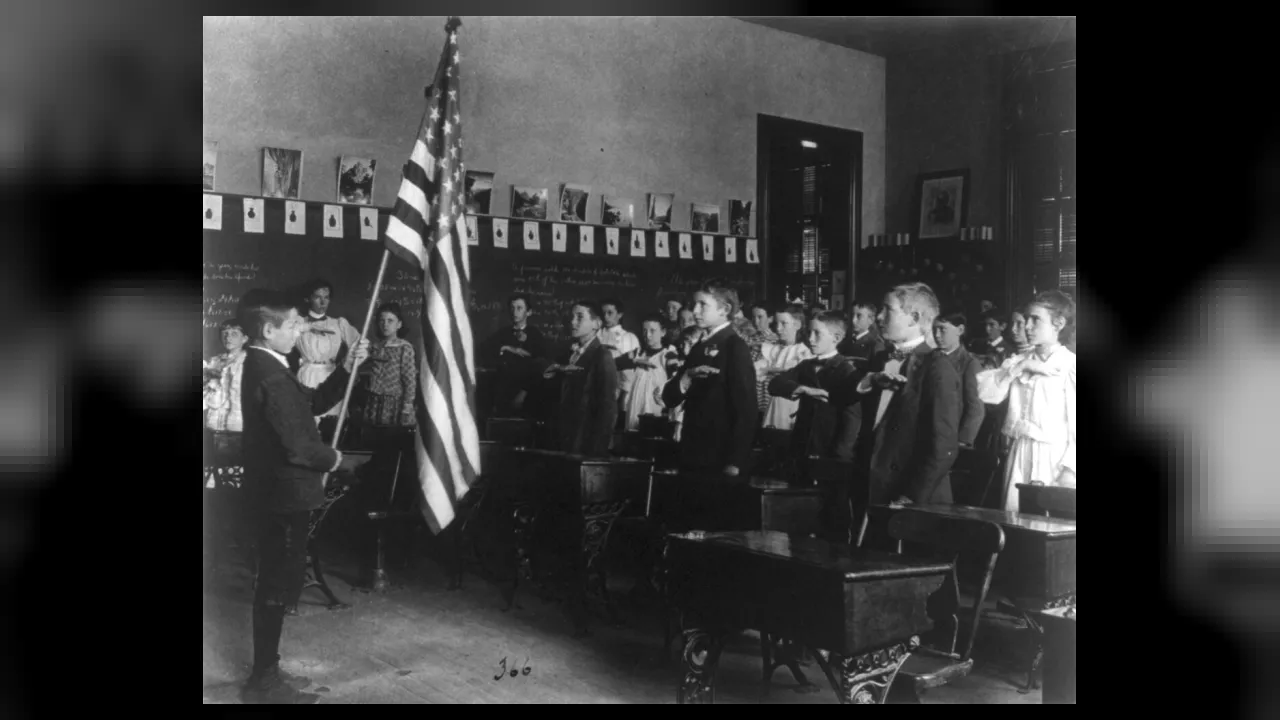
1. Who was the Pledge of Allegiance first written for in 1892?
2. What do the closing words 'with liberty and justice for all' celebrate?
🤯 Mind-Blowing Fact • Grade 2
In 1892, The Youth's Companion helped sell and place American flags above more than 26,000 public schoolhouses across the country!
✨ Word Sparks (Grade 2 Glossary)
Tap 🔊 to hear
indivisible
Joined so strongly it cannot be split apart
recite
To speak memorized words aloud carefully
anniversary
Yearly date remembering an important past event
🪝
Did you know the first Pledge of Allegiance had only twenty-two words instead of thirty-one?
1
Written in Two Hours
Picture writer Francis Bellamy sitting in his Boston office on a warm August evening in 1892! Working for The Youth's Companion magazine, he wanted short, strong words any student could say in fifteen seconds to celebrate the 400th of 1492.
2
Ten Million Voices Together
On October 12, 1892, more than ten million schoolchildren raised flags over their schoolhouses and recited Bellamy's original words: 'I pledge allegiance to my Flag and the Republic for which it stands, one nation, , with liberty and justice for all.'
3
Growing Into Thirty-One Words
Later, 'my Flag' was changed to 'the Flag of the United States of America,' and in 1954 Congress added 'under God,' creating the thirty-one words known today!
1. Who wrote the original Pledge of Allegiance in August 1892?
2. What does the big word 'indivisible' in the Pledge mean?
🤯 Mind-Blowing Fact • Grade 3
When Francis Bellamy wrote the Pledge in 1892, the American flag had 44 stars—six states still had not joined the Union yet!
✨ Word Sparks (Grade 3 Glossary)
Tap 🔊 to hear
unity
Being joined together as one whole nation
custom
A shared tradition practiced over many years
etiquette
Polite, respectful rules for special occasions
🪝
Why were the words 'my Flag' changed to 'the Flag of the United States of America' in the 1920s?
1
Flags Over Every Schoolhouse
Travel back to the 1890s, less than thirty years after the Civil War ended! James B. Upham and minister Francis Bellamy at The Youth's Companion magazine launched a campaign to place an American flag over every schoolhouse in the nation to teach civic .
2
Clarifying 'My Flag' in 1923–1924
Bellamy's September 8, 1892 magazine version began with 'I pledge allegiance to my Flag.' By 1923 and 1924, millions of newcomers had immigrated to America, so the National Flag Conference updated the phrase to 'the Flag of the United States of America' so there was zero confusion about which flag was meant.
3
Entering the U.S. Flag Code in 1942
For fifty years the Pledge was a beloved rather than a federal law. On June 22, 1942, Congress officially adopted the Pledge into the U.S. Flag Code and soon established the respectful hand-over-the-heart gesture.
4
Flag Day 1954 Update
Finally, on Flag Day—June 14, 1954—President Dwight D. Eisenhower signed a congressional resolution adding the words 'under God' right after 'one Nation,' completing the thirty-one-word text.
1. Why did the National Flag Conference replace 'my Flag' with 'the Flag of the United States of America' in 1923–1924?
2. On which patriotic June 14 holiday in 1954 did President Eisenhower sign the law updating the Pledge to 31 words?
🤯 Mind-Blowing Fact • Grade 4
Because the original 1892 Youth's Companion article did not print an author byline, a scholarly committee from the United States Flag Association investigated diaries and drafts in 1939 to confirm Francis Bellamy's authorship!
✨ Word Sparks (Grade 4 Glossary)
Tap 🔊 to hear
affirm
To state something positively and strongly as true
voluntary
Chosen freely without force or punishment
codify
To organize customs into official written law
🪝
Why does the Pledge honor BOTH the physical flag AND 'the Republic for which it stands'?
1
Echoing Lincoln After the Civil War
Read Francis Bellamy's twenty-three-word 1892 sentence carefully and listen for echoes of Abraham Lincoln's Gettysburg Address! Writing just twenty-seven years after the Civil War tested whether the Union would break apart, Bellamy deliberately chose the word 'indivisible' to that the fifty—then forty-four—states form one permanent constitutional republic.
2
More Than Cloth and Thread
In Virginia elementary civics, students learn why the Pledge links 'the Flag of the United States of America' directly 'to the Republic for which it stands.' A republic is a representative democracy governed by elected leaders under a written constitution—so honoring the flag honors the shared ideals of self-government, liberty, and equal justice.
3
Step-by-Step Timeline of Changes
Published anonymously in The Youth's Companion on September 8, 1892, for the National Public School Celebration on October 12, the Pledge evolved in three historical steps: adding 'to' after 'and' early on, specifying 'the Flag of the United States of America' at the 1923–1924 National Flag Conferences, entering the U.S. Flag Code with the hand-over-the-heart salute in December 1942, and adding 'under God' on June 14, 1954.
4
Respecting Freedom of Conscience
In a famous 1943 ruling, West Virginia State Board of Education v. Barnette, the U.S. Supreme Court affirmed that reciting the Pledge is always under the First Amendment—showing that true American patriotism honors individual freedom of conscience!
1. Why did Francis Bellamy include the word 'indivisible' when writing the Pledge in 1892?
2. What did the U.S. Supreme Court decide in 1943 regarding students reciting the Pledge of Allegiance?
🤯 Mind-Blowing Fact • Grade 5
Delivering the Supreme Court's 1943 Barnette opinion on Flag Day itself, Justice Robert H. Jackson wrote one of the most famous sentences in American law—calling freedom of conscience the 'fixed star in our constitutional constellation'!
✨ Word Sparks (Grade 5 Glossary)
Tap 🔊 to hear
quadricentennial
A four-hundredth anniversary celebration of an event
encapsulate
To express big ideas clearly in few words
orthodox
Officially required or approved way of thinking
🪝
How do the thirty-one words of the Pledge of Allegiance encapsulate post-Civil War union, constitutional republicanism, and First Amendment liberty?
1
The 1892 Schoolhouse Flag Movement
Step into the Boston offices of Perry Mason & Company—publishers of The Youth's Companion, then one of America's most widely read family weeklies—in August 1892! Marketer James B. Upham had spearheaded a grassroots drive selling flags at cost to 26,000 schools ahead of the of Columbus's 1492 voyage, proclaimed a national observance by President Benjamin Harrison. Tasked with composing a concise civic salute, Baptist minister Francis Bellamy distilled decades of constitutional debate into twenty-two rhythmic words in a single August evening.
2
Dissecting Bellamy's Constitutional Vocabulary
Bellamy weighed every syllable. Recalling the Civil War's central question—whether the United States was a dissoluble league or one perpetual Union—he paired 'Republic' with 'one Nation, indivisible.' Considered briefly and rejected was the French Revolutionary slogan 'liberty, equality, fraternity'; instead, Bellamy closed with 'with liberty and justice for all,' echoing the Preamble to the U.S. Constitution.
3
Textual Evolution from 1892 to 1954
Printed on September 8, 1892, and recited nationwide that October, the text underwent targeted refinements. In 1923, the First National Flag Conference at Memorial Continental Hall in Washington, D.C., replaced 'my Flag' with 'the Flag of the United States,' adding 'of America' in 1924. Congress codified the Pledge in Title 4 of the U.S. Code on June 22, 1942, adopting the hand-over-the-heart salute that December. On Flag Day, June 14, 1954, Congress enacted and President Dwight D. Eisenhower signed Public Law 83-396, inserting 'under God'—inspired in part by Lincoln's phrase 'this nation, under God' at Gettysburg.
4
First Amendment Landmark: Barnette (1943)
Crucially, on Flag Day 1943, Justice Robert H. Jackson authored the landmark Supreme Court opinion in West Virginia State Board of Education v. Barnette, holding that public schools cannot compel students to salute or recite the Pledge against their conscience: 'If there is any fixed star in our constitutional constellation, it is that no official, high or petty, can prescribe what shall be in politics, nationalism, religion, or other matters of opinion.'
5
Enduring Civic Touchstone
Together, the Flag Code's respectful etiquette and Barnette's constitutional protection illustrate American civic maturity—inviting millions of citizens to voice shared devotion to republic, union, liberty, and justice freely from the heart.