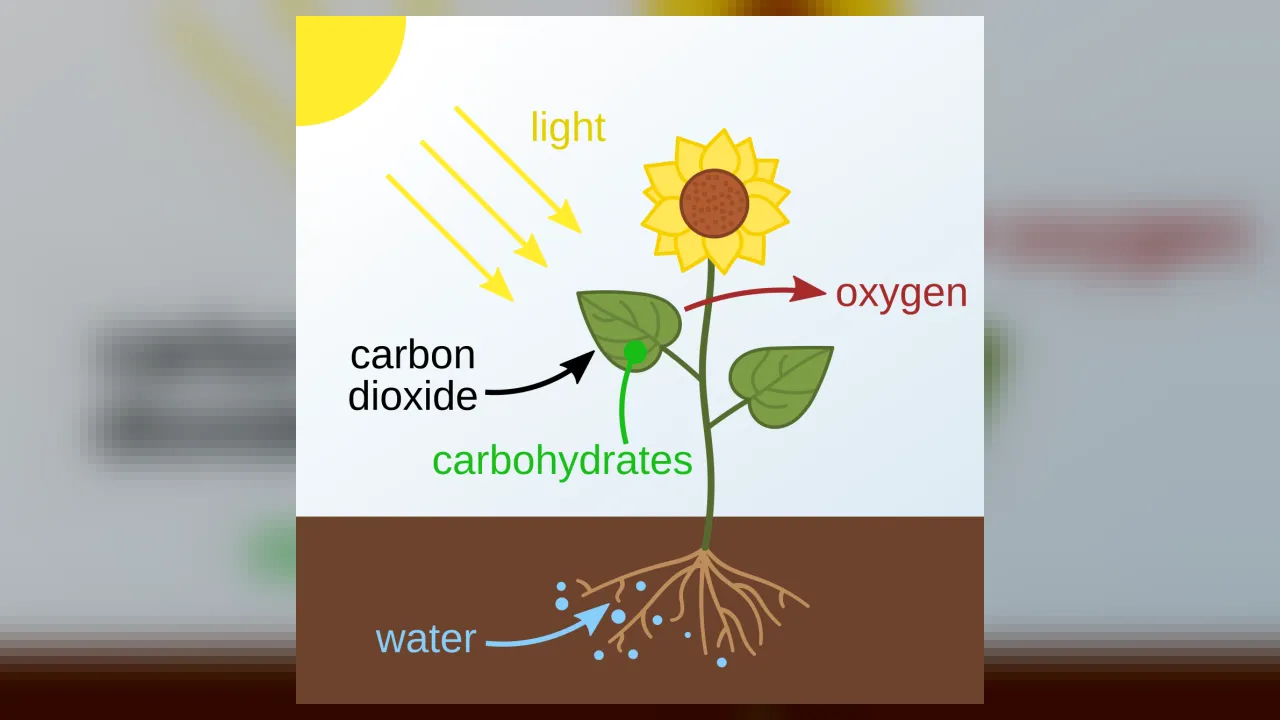
1. What three things does a green plant use to make its own food?
2. What helpful gas do green plants and ocean algae puff out into Earth's sky?
🤯 Mind-Blowing Fact • Grade 2
Early Earth had almost zero breathable oxygen in its air until tiny blue-green ocean microbes started photosynthesizing billions of years ago!
✨ Word Sparks (Grade 2 Glossary)
Tap 🔊 to hear
Photosynthesis
How green plants make food using sunlight
Chlorophyll
Green pigment inside leaves that catches sunlight
Sugar
Sweet energy food plants make for growth
🪝
Did you know half the oxygen in your lungs right now came from the ocean instead of trees?
1
Putting Light Together
Say the big word 'pho-to-SYN-the-sis'! 'Photo' means light, and 'synthesis' means putting together. Inside every green blade of grass and oak leaf sits a green helper called that catches solar energy.
2
Sugar for Plants, Oxygen for Us
Using sunlight, combines water from roots with carbon dioxide gas from tiny pores under leaves. That recipe builds sweet so the plant can grow flowers, seeds, and wood—and releases leftover oxygen gas into the sky!
3
Ocean Heroes Too!
Forests aren't working alone! Microscopic ocean drifters called phytoplankton float near sunny sea waves and produce at least half of all the oxygen on planet Earth!
1. What gives leaves their green color and catches sunlight?
2. Where does at least half of Earth's breathable oxygen come from?
🤯 Mind-Blowing Fact • Grade 3
One single ocean microbe species named Prochlorococcus—smaller than a speck of dust—produces oxygen for roughly one out of every five breaths you take!
✨ Word Sparks (Grade 3 Glossary)
Tap 🔊 to hear
Stomata
Tiny leaf pores trading air gases
Cyanobacteria
Ancient microbes that first made Earth's oxygen
Ozone Layer
High oxygen shield blocking harmful sun rays
🪝
How did rusty red rocks in Australia and Minnesota prove when ancient microbes first filled Earth's sky with oxygen?
1
Inside Microscopic Leaf Doors
Zoom in on the underside of a maple leaf with a microscope, and you will spot thousands of tiny mouth-shaped openings called ! Stomata open to let carbon dioxide in and release fresh oxygen gas out, while green chloroplasts inside cells run solar-powered chemistry.
2
Earth Before Oxygen
Travel back three billion years on young Earth, and you would need a spacesuit! The sky held nitrogen, carbon dioxide, and water vapor—yet almost zero free oxygen. Then tiny ocean invented oxygen-making photosynthesis!
3
Rusting the Ancient Oceans
At first, dissolved iron in seawater soaked up that new oxygen and sank as rusty red stripes called banded iron formations—the exact rocks mined for steel today! Once ocean iron finished rusting, oxygen bubbled into the sky.
4
Building the Ozone Shield
Today oxygen makes up twenty-one percent of our air, and high-altitude oxygen forms the that shields land life from harsh ultraviolet sunbeams!
1. What are the tiny pores on leaves that open and close to let gases in and out?
2. What geologic clue shows when ancient cyanobacteria started releasing oxygen into Earth's oceans?
🤯 Mind-Blowing Fact • Grade 4
Layered stone mounds called stromatolites found in Virginia's Shenandoah Valley limestones are fossils left behind by half-billion-year-old cyanobacteria mats pumping oxygen into shallow ancient seas!
✨ Word Sparks (Grade 4 Glossary)
Tap 🔊 to hear
Chloroplast
Green plant cell structure performing photosynthesis
Stromatolite
Layered rock mound built by ancient cyanobacteria
Glucose
Simple energy sugar built during photosynthesis
🪝
Wait—when photosynthesis releases oxygen gas, does that oxygen come from the carbon dioxide or from splitting water molecules?
1
A Surprising Chemical Twist
Look at the balanced recipe for photosynthesis: six molecules of carbon dioxide (CO2) plus six molecules of water (H2O), energized by sunlight inside , yield one molecule of sugar (C6H12O6) and six molecules of oxygen gas (O2). For decades, scientists assumed plants snapped oxygen off CO2—until tracer experiments proved every bubble of O2 released by plants actually comes from splitting water molecules apart!
2
The Great Oxidation Event
Earth is one of the only rocky worlds known to possess an oxygen-rich atmosphere (21% O2 alongside 78% N2). Around 2.4 billion years ago, booming mats of marine cyanobacteria—whose layered fossil mounds, called , still appear in Virginia limestone—triggered the Great Oxidation Event. Free oxygen flooded the atmosphere, rusted continental minerals red, and enabled high-energy aerobic respiration for complex animals!
3
Stratospheric Ozone Protection
High in the stratosphere (15 to 35 kilometers up), solar ultraviolet light splits O2 molecules so single oxygen atoms join neighbors into three-atom ozone (O3). Without photosynthesis supplying O2 to build that ozone shield, harsh UV rays would sterilize dry land, meaning forests and land animals could never have left the sea!
4
Partners With Cellular Respiration
Photosynthesis and cellular respiration form complementary halves of one planetary energy loop: store sunlight in chemical bonds while mitochondria unlock that energy using oxygen.
1. During photosynthesis, which ingredient gets split apart to release breathable O2 gas?
2. How did oxygen from ancient ocean photosynthesis make it safe for plants and animals to live on dry land?
🤯 Mind-Blowing Fact • Grade 5
About 300 million years ago during the Carboniferous Period, towering swamp forests boosted Earth's atmospheric oxygen near 30 percent—allowing giant insects like Meganeura to grow wingspans over two feet wide!
✨ Word Sparks (Grade 5 Glossary)
Tap 🔊 to hear
Photolysis
Splitting water molecules apart using light energy
Why wouldn't chopping down a forest immediately empty Earth's sky of oxygen—yet protecting ocean plankton and forests remains vital for planetary balance?
1
Photolysis of Water and the Calvin Cycle
Inside the thylakoid membranes of plant and algal chloroplasts, chlorophyll-a and accessory pigments absorb red and blue photons while reflecting green wavelengths. That captured light drives Photosystem II's manganese-calcium cluster to split liquid water via (2H2O -> 4H+ + 4e- + O2), liberating molecular dioxygen! Meanwhile, ATP and NADPH power the stroma's enzyme through the Calvin cycle, fixing inorganic CO2 into three-carbon sugars.
2
Two-Stage Oxygenation of Earth History
Geochemical sulfur isotopes and red beds reveal that Earth's 20.95 percent oxygen atmosphere rose in two grand steps. First, Archean cyanobacteria triggered the Great Oxidation Event (~2.4 to 2.1 billion years ago), saturating marine iron sinks into massive banded iron formations and lifting O2 to a few percent of modern levels. Second, the Neoproterozoic Oxygenation Event (~800 to 540 million years ago), aided by marine algae and later vascular land plants, boosted O2 high enough to fuel the Cambrian Explosion of animal life!
3
Why Net Oxygen Requires Organic Carbon Burial
Here is an Earth-system subtlety that surprises even adults: in a mature forest or sunlit gyre, nearly 99.9 percent of the oxygen produced by photosynthesis each year is consumed right back when animals, roots, fungi, and bacteria respire fallen leaves and plankton! Long-term atmospheric O2 accumulated over millions of years only because a tiny fraction of organic carbon was buried in deep marine muds and coal seams before it could decay and use up matching O2.
4
Why 21 Percent Hit a Natural Ceiling
During the Carboniferous Period ~300 million years ago, vast coal-swamp burial pushed atmospheric O2 near 30 percent—supporting seagull-sized dragonfly relatives (Meganeura) while sparking frequent wildfires that naturally stabilized oxygen near 21 percent.
5
Oxygen as an Exoplanet Biosignature
Because reactive O2 quickly rusts into crustal rocks unless living organisms constantly replenish it, astronomers aim space telescopes like the James Webb Space Telescope at distant exoplanet atmospheres searching for oxygen and ozone together as a hallmark sign of life!