The first photo ever taken showed a view from a window in France.
✨ Word Sparks (Grade 2 Glossary)
Tap 🔊 to hear
focus
To make a picture clear
film
A strip that holds pictures
sensor
A part that catches light in digital cameras
🪝
Have you ever wondered how a camera saves your favorite moments?
1
The Magic of Taking Pictures
When you press a camera button, it captures light and shapes. The lens helps what you see, and the camera saves it as a photo. Early cameras were big and heavy, but people loved seeing their faces. Today, cameras are small and easy to use everywhere.
2
How Cameras Work Inside
A camera has a lens that lets in light and it. The light shines onto a special plate or inside the camera. This makes a picture appear that you can see later. New cameras use instead of film to make digital photos.
3
Why Photos Matter to Us
Photos help us remember birthdays, trips, and fun times with friends. We can share pictures with family far away. Cameras help people tell stories with images, not just words. Taking photos lets us keep memories forever.
The word 'photography' means 'drawing with light' in Greek.
✨ Word Sparks (Grade 3 Glossary)
Tap 🔊 to hear
exposure
Letting light hit film or sensor
optical
Related to light and seeing
sensor
A part that collects light for pictures
🪝
What if you could capture a sunset and keep it forever?
1
The Birth of Photography
Long ago, inventors dreamed of saving images from real life. In 1839, Louis Daguerre in France made the first working camera. He used light-sensitive chemicals on a metal plate to create a photograph. People were amazed to see their own faces frozen in time.
2
How Does a Camera Work?
A camera uses a lens to focus light onto a surface. The light creates an image on film or a digital inside the camera. This process is called , and it captures the scene in front of the lens. The result is a photograph that can be printed or shared.
3
From Heavy Boxes to Pocket Cameras
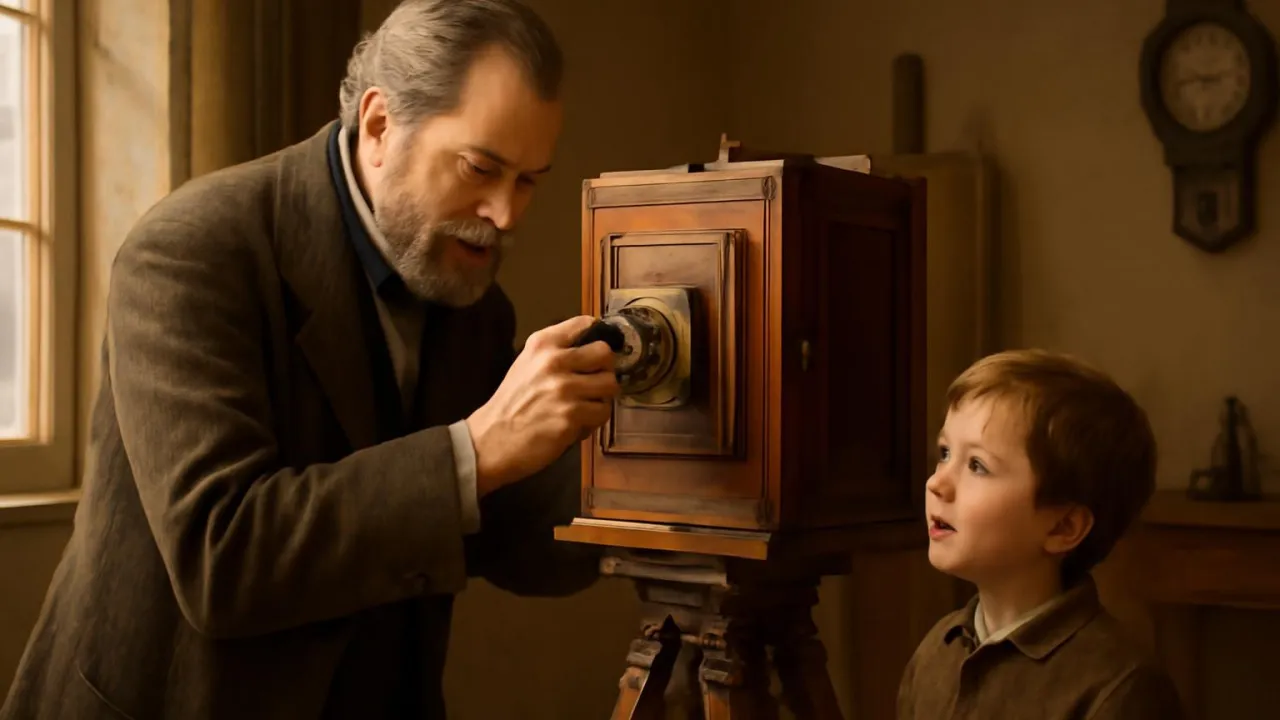
Early cameras were large boxes that needed tripods and bright sunlight. Today, cameras fit in our pockets and use electronic instead of film. Digital cameras can store thousands of pictures on a tiny memory card. Photography has become part of everyday life for people everywhere.
4
The Science Behind the Snap
Photography uses physics to bend and focus light. The lens creates a sharp image by controlling the path of light rays. Chemical reactions or electronic record the light to make a permanent picture. This invention changed how people share stories and remember history.
The first photo of a person was captured by accident—he stood still long enough on a busy street!
✨ Word Sparks (Grade 4 Glossary)
Tap 🔊 to hear
daguerreotype
An early photo made on a metal plate
exposure
The time light hits film or sensor
optical physics
The science of how light works
🪝
Imagine if every memory could be captured and shared with the world—how would you choose?
1
A New Way to See the World
In the 1800s, inventors like Louis Daguerre and Joseph Nicéphore Niépce worked to trap real images using light. Their breakthrough, the , used a polished metal plate coated with light-sensitive chemicals. When exposed to light through a lens, the plate captured a detailed image that amazed everyone. This invention allowed people to see themselves and distant places without ever leaving home.
2
The Physics of Capturing Light
A camera works by letting light pass through a carefully shaped lens, which bends and focuses the rays. The focused light hits a surface coated with chemicals or a digital sensor, creating an image through a process called . The lens’s curvature and the exposure time control how clear and bright the photo becomes. This is all based on principles of and chemical reactions.
3
From Bulky Boxes to Digital Wonders
Early cameras were large and needed long times, so people had to sit very still. Over time, inventors made cameras smaller and faster, replacing glass plates with film and then electronic sensors. Today, digital cameras and smartphones can instantly capture, store, and share thousands of photos. Photography has become a powerful tool for art, science, and news around the globe.
4
How Cameras Changed Our Lives
Photography lets us document history, celebrate special moments, and connect with people everywhere. Scientists use cameras to study space, animals, and microscopic life. Photographs can tell stories, inspire emotions, and even change how we see the world. This invention made it possible for everyone to become a storyteller.
1. Why did early cameras need people to stay still?
2. How do scientists use cameras today?
🤯 Mind-Blowing Fact • Grade 5
The Hubble Space Telescope’s camera has captured images of galaxies over 13 billion light-years away.
✨ Word Sparks (Grade 5 Glossary)
Tap 🔊 to hear
heliography
An early photo method using sunlight
sensor
A chip that turns light into digital images
megapixel
One million tiny dots in a digital photo
🪝
What if you could capture the exact moment a lightning bolt strikes—how would you do it?
1
Inventing the Art of Light Capture
In the early 19th century, inventors like Joseph Nicéphore Niépce and Louis Daguerre revolutionized how humans record reality. Niépce created the first permanent photograph in 1826 using a process called , which required hours of sunlight on a bitumen-coated plate. Daguerre improved this method in 1839 with the daguerreotype, using silver-coated copper plates and mercury vapor to develop detailed images in much less time. Their inventions marked the beginning of photography as both a scientific and artistic pursuit.
2
Optics and Chemistry: The Camera’s Inner Workings
A camera operates by harnessing the laws of optical physics, using a convex lens to bend and focus incoming light rays. When the shutter opens, light passes through the lens and strikes a chemically prepared surface or a digital . In early cameras, silver halide crystals on glass or film underwent a chemical reaction when exposed to light, forming a latent image. Digital cameras use millions of tiny photosensitive diodes on a sensor to convert light into electrical signals, which are then processed into a digital image.
3
From Heavy Boxes to Global Connectivity
The first cameras were large, fragile, and required long exposure times—sometimes several minutes per photograph. With the invention of roll film by George Eastman in 1888, photography became portable and accessible to the public. The 20th century saw rapid advances: color film, instant cameras, and finally, digital imaging in the 1990s. Today, billions of people carry high-resolution cameras in their smartphones, instantly sharing images across the globe in seconds.
4
Photography’s Impact on Science, Culture, and Memory
Photography transformed journalism, science, and art by allowing people to document real events as they happened. Scientists use high-speed cameras to study animal movement, astronomers photograph distant galaxies, and doctors use imaging to diagnose diseases. Culturally, photography has shaped public opinion, preserved family history, and inspired countless artists. The ability to capture and share moments has changed how societies remember and communicate.
5
Engineering Challenges and the Future of Imaging
Modern cameras must balance lens quality, size, and light sensitivity to produce sharp, vibrant images. Engineers design lenses with multiple glass elements to reduce distortion and improve clarity. Sensors are measured in , with some professional cameras exceeding 100 megapixels for ultra-high detail. As technology evolves, new inventions like computational photography and 3D imaging promise to further transform how we see and record the world.