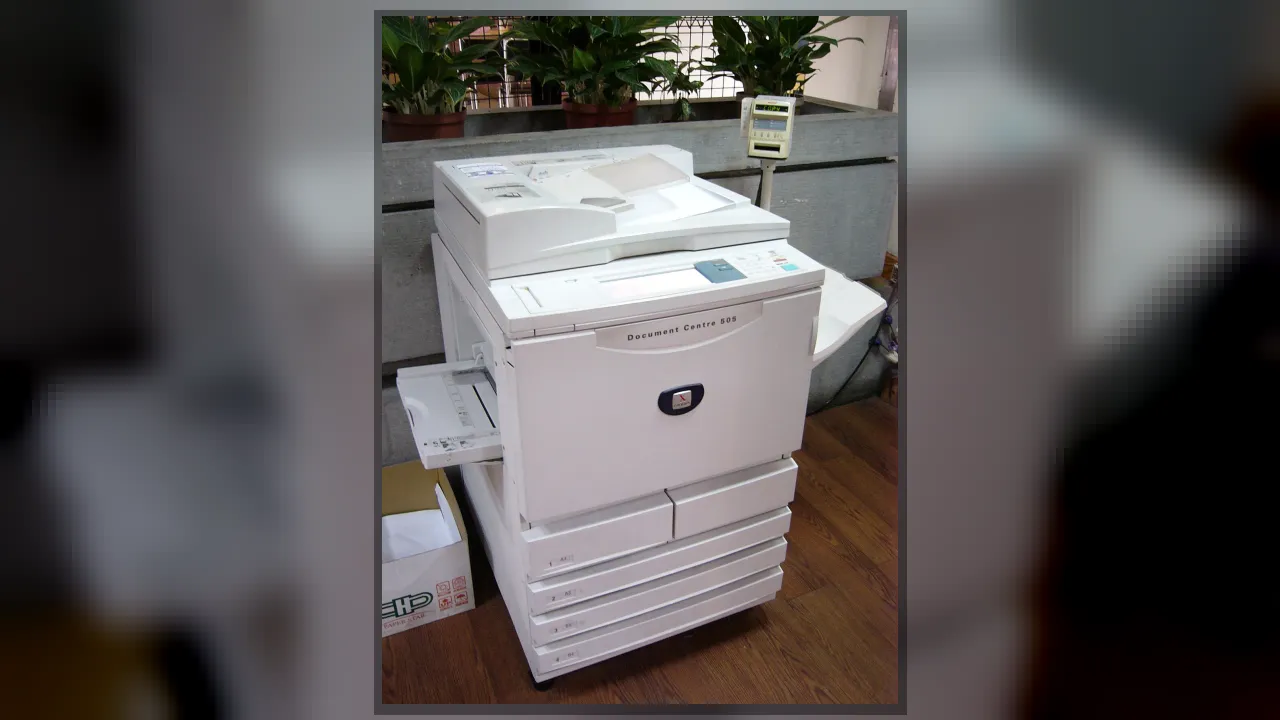
1. What invisible force pulls black toner powder onto the right spots inside a photocopier?
2. Why does a brand-new photocopy feel warm when it slides into the tray?
🤯 Mind-Blowing Fact • Grade 2
Early Haloid Xerox 914 copiers got so warm inside that the company included a tiny fire extinguisher called a 'scorch eliminator' right inside the cabinet!
✨ Word Sparks (Grade 2 Glossary)
Tap 🔊 to hear
xerography
Dry copying using light and static electricity
patent
An official paper protecting a new invention
duplicate
An exact matching copy of an original
🪝
How did people copy twenty pages of class notes before copy machines existed?
1
Sore Hands and Smudgy Paper
Clack-clack, smudge! Before photocopiers, making extra copies meant retyping every word over messy carbon sheets or developing slow wet photographs. lawyer Chester Carlson suffered painful arthritis in his hands and dreamed of pressing one quick button instead.
2
An Experiment in Queens
On October 22, 1938, Carlson and helper Otto Korner rubbed a sulfur-coated metal plate with a handkerchief to give it static electricity. Shining light through words written on glass left an invisible static pattern that grabbed dark powder—printing '10.-22.-38 ASTORIA'!
3
What Xerography Means
Over twenty big companies turned Carlson's invention down before a small firm built the famous Xerox 914 copier in 1959. Scientists named the process from Greek words meaning dry writing—because dry toner powder replaced messy liquid ink!
1. What do the Greek roots of the word 'xerography' mean?
2. How did Chester Carlson put static electricity onto his very first test plate in 1938?
🤯 Mind-Blowing Fact • Grade 3
In 1969, Xerox engineer Gary Starkweather aimed a spinning laser beam onto a xerographic copier drum—inventing the laser printer that powers schools and offices today!
✨ Word Sparks (Grade 3 Glossary)
Tap 🔊 to hear
photoconductor
Material conducting electricity only when light shines
insulator
Material holding electric charge from flowing away
fuser
Heated rollers melting toner onto plain paper
🪝
What kind of unusual material acts like an insulator in the dark—yet conducts electricity the instant light touches it?
1
The Secret of Photoconductors
Most materials either block electricity all the time or carry it all the time. Chester Carlson studied rare materials called —substances that hold static electric charges tightly in the dark, yet drain electricity away wherever bright light hits them!
2
Twenty Companies Said No
Even after Carlson proved dry copying worked in 1938, giant corporations like IBM and Kodak rejected his rough prototype for years. Never giving up, Carlson partnered with Battelle researchers and New York's Haloid Company, which later changed its name to Xerox.
3
Six Steps in Seconds
Inside a modern copier, a high-voltage wire coats a spinning light-sensitive drum with uniform static charge. Next, bright light bounces off your original page: white background reflects light onto the drum and erases static there, while black letters reflect no light—leaving an invisible charged shadow!
4
Toner, Heat, and Laser Printers
Oppositely charged dry toner clings solely to those charged letter shapes, jumps onto a stronger-charged sheet of paper, and melts permanently between hot rollers. Replace the scanner lamp with a computer-guided laser beam and you get the modern laser printer!
1. What happens on the spinning drum wherever bright light reflects off white parts of your page?
2. Which modern computer machine grew directly out of shining a laser onto a photocopier drum?
🤯 Mind-Blowing Fact • Grade 4
Independent consultants hired in the late 1950s warned that America would buy at most 5,000 Xerox 914 copiers—yet offices soon made billions of copies a year on 200,000 machines!
✨ Word Sparks (Grade 4 Glossary)
Tap 🔊 to hear
electrostatic
Relating to stationary electric charges attracting opposites
latent image
An invisible pattern waiting to be revealed
corona
Ionizing glow around a high-voltage charging wire
🪝
How did a lonely inventor reading physics journals at the New York Public Library spark both plain-paper copying and modern personal computing?
1
Homework in the Public Library
Working days in a Manhattan electronics patent office during the Great Depression and studying physics books at the New York Public Library by night, Chester Carlson deliberately hunted for a path around photography. Everyone else assumed copying required messy silver-halide wet chemicals; Carlson noticed Hungarian physicist Pál Selényi's papers on images and combined them with photoconductivity.
2
The Six-Stage Xerographic Cycle
Every plain-paper copier executes six split-second steps around a rotating cylindrical drum: (1) Charge—a wire blankets the dark drum in uniform static ions; (2) Expose—reflected light neutralizes non-image areas, leaving an invisible ; (3) Develop—oppositely charged resin-and-carbon toner particles leap onto charged letters; (4) Transfer—stronger static beneath plain paper pulls the toner across; (5) Fuse—400-degree-Fahrenheit pressure rollers melt the resin into paper fibers; and (6) Clean—wiper blades and erase lamps reset the drum.
3
The 1959 Xerox 914 Explosion
After Battelle scientists discovered selenium drums worked thousands of times faster than sulfur, Haloid unveiled the desk-sized Xerox 914 in September 1959. Analysts predicted businesses might rent 5,000 machines total; instead, customers snapped up 200,000 units, making 'Xerox' a household word while generous Carlson gave away most of his fortune—over $100 million—to charity and universities.
4
Sparking the Computer Era
Profits from xerography funded Xerox PARC in California during the 1970s, where researchers invented not only Gary Starkweather's laser printer, but also Ethernet networking and the graphical computer desktop with icons, windows, and a mouse!
1. Why does toner jump off the spinning drum onto plain white paper during step four?
2. Besides laser printers, what everyday computer breakthroughs grew out of Xerox's PARC research lab?
🤯 Mind-Blowing Fact • Grade 5
Every microscopic grain of modern copier toner—just five-millionths of a meter wide—even hides a tiny core of wax inside plastic resin so pages glide cleanly off the hot fuser rollers without sticking!
✨ Word Sparks (Grade 5 Glossary)
Tap 🔊 to hear
bandgap
Energy jump needed to free electrons inside semiconductors
triboelectric
Building static electric charge by rubbing materials
amorphous
Solid without a regular repeating crystal lattice
🪝
How do semiconductor bandgaps, triboelectric toner beads, and digital CCD arrays reproduce 1,200-dots-per-inch documents in milliseconds?
1
Solid-State Physics Inside an Office Machine
Behind the quiet hum of a modern multifunction copier operates an intricate dance of quantum semiconductor physics and electrostatics. In darkness, an organic photoconductor (OPC) drum possesses a wide energy that holds surface static ions firmly in place; the instant photons strike the drum, absorbed light excites electrons into the conduction band, draining charge from bright areas while leaving dark text charged at hundreds of volts.
2
Carlson's 1938 Astoria Lab to Selenium Drums
When Caltech physics graduate and patent attorney Chester Carlson filed his electrophotography patent in 1937 and produced his historic '10.-22.-38 ASTORIA' lycopodium-powder copy with Otto Korner in Queens, sulfur's low light sensitivity required long exposures. Battelle physicist William Bixby's 1948 discovery of selenium drum coatings multiplied quantum efficiency dramatically, culminating in John Dessauer and Joseph Wilson's landmark plain-paper Haloid Xerox 914 in 1959.
3
Triboelectric Toner and Four-Color CMYK
Modern dry toner is engineered chemistry, not simple soot: each 5-to-8-micrometer sphere blends polyester or styrene-acrylate resin with pigment and low-melting wax, tumbled against magnetic iron-oxide carrier beads so friction imparts a precise electrostatic charge. Full-color xerography layers four tandem drums—cyan, magenta, yellow, and black (CMYK)—onto an intermediate transfer belt aligned within tens of micrometers before fusing.
4
From Optical Mirrors to Digital Laser Multifunction
Classic analog copiers swept xenon flashlamps and moving lenses beneath glass platens to project reflected light directly onto the drum. Today's digital copiers scan documents once with a charge-coupled device (CCD) sensor array into memory, enabling automatic two-sided duplexing, scaling, stapling, and crisp 1,200-dots-per-inch laser output at over 100 pages per minute via spinning polygon mirrors.
5
Information Access and Technological Ripple Effects
Plain-paper xerography revolutionized journalism, classrooms, courts, libraries, and global information sharing, while revenues invested at Xerox PARC in Palo Alto during the 1970s directly birthed Gary Starkweather's laser printer, Bob Metcalfe's Ethernet local-area networking, and the graphical desktop interface that shaped modern computing.