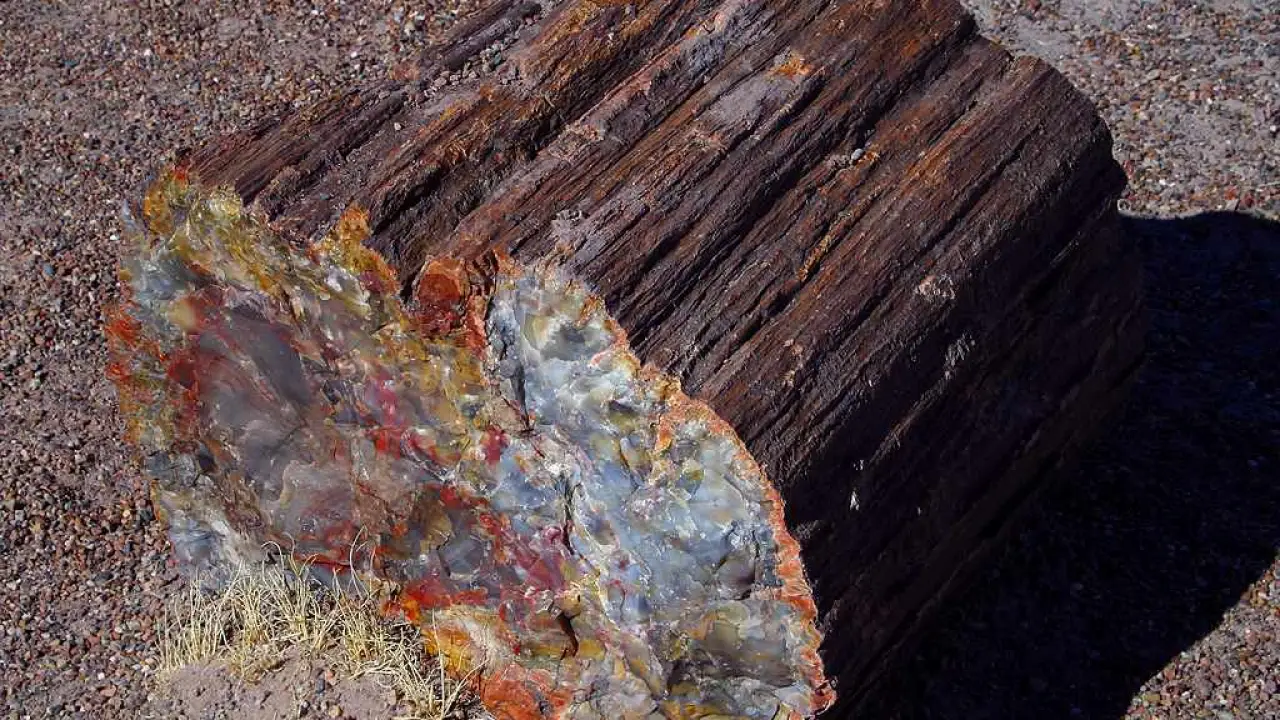
1. Why did fallen trees need to be buried quickly under mud or ash to become petrified wood?
2. What can you still see inside a polished slice of petrified wood?
🤯 Mind-Blowing Fact • Grade 2
At Petrified Forest National Park in Arizona, giant rainbow-colored stone logs are over 200 million years old—from the dawn of the dinosaurs!
✨ Word Sparks (Grade 2 Glossary)
Tap 🔊 to hear
Silica
Natural crystal material that forms hard quartz
Volcanic Ash
Fine dusty rock blown from erupting volcanoes
Oxygen
Gas in air needed by wood-rotting microbes
🪝
How can a fallen pine tree turn into solid quartz crystal without losing its bark pattern?
1
A Word That Means 'Turned to Rock'
Run your hand along the outside of a petrified log, and you can feel rough ridges that look just like tree bark! Yet tap it gently, and it clinks like glass. The word 'petrified' comes from an ancient Greek word meaning 'turned into rock.'
2
Mineral-Rich Groundwater
Long ago, floods or buried fallen forest logs under thick blankets of mud. Without air underground, the logs could not rot quickly. Instead, groundwater soaked through the wood and filled every tiny cell with dissolved crystal!
3
Nature's Paintbox
Pure quartz makes white or gray petrified wood, while tiny pinches of iron paint bright reds and yellows, and manganese adds purples and blues!
2. What creates the bright red and golden-yellow swirls inside rainbow petrified wood?
🤯 Mind-Blowing Fact • Grade 3
In Yellowstone National Park at Specimen Ridge, volcanic mudflows buried 27 separate ancient forests one on top of another—preserving petrified redwoods still standing upright!
If you look at petrified wood under a microscope, are there any wood fibers left—or is it 100 percent crystal?
1
Cell-by-Cell Permineralization
Zoom in on a wafer-thin slice of petrified wood under a science microscope, and you will see thousands of neat rectangular plant cells! This fossil process has two steps: first, mineral-laden groundwater fills every hollow cell space like jelly filling a sponge (). Second, as original cell walls slowly dissolve, silica replaces them atom by atom so a 3D stone replica remains!
2
Volcanic Ash Supplies the Silica
Why do the best petrified forests appear near ancient volcanoes? Fresh volcanic ash is packed with glassy silica that dissolves easily in rainwater. When rivers bury fallen conifers under volcanic mudflows, silica-rich groundwater quickly saturates the buried trunks.
3
Hard Enough to Scratch Steel
Because most petrified wood consists of chalcedony, , or opalized quartz, it measures a tough 7 on the Mohs hardness scale—hard enough to scratch steel pocketknives and window glass!
4
Ancient Climate Clues
count wide and narrow stone rings in fossil logs—even spotting ancient beetle tunnels and wildfire scars—to learn whether prehistoric summers were rainy or dry.
1. How does nearby volcanic ash help buried trees become petrified wood?
2. Because petrified wood is made mostly of quartz and jasper, where does it rank on the Mohs hardness scale?
🤯 Mind-Blowing Fact • Grade 4
In Virgin Valley, Nevada, prehistoric conifer branches buried in volcanic ash turned into dazzling precious 'fire opal' that flashes electric green, red, and blue in sunlight!
Hydrated silica mineral that precedes harder quartz
🪝
What did northern Arizona look like 225 million years ago when its desert stone logs were towering 200-foot evergreen trees?
1
A Tropical River System Near the Equator
Walk across the dry painted badlands of Arizona's Petrified Forest today, and you see scarce desert shrubs. Yet 225 million years ago during the Late Triassic Period, tectonic plates positioned Arizona near Earth's steaming tropical equator! Towering conifers called Araucarioxylon grew alongside giant tree ferns and horsetails, while crocodile-like phytosaurs lurked in winding rivers. Seasonal floods uprooted fallen trunks and buried them deep inside oxygen-poor river sand and silica-rich volcanic ash of the Chinle Formation.
2
From Opal Gel to Crystalline Quartz
Chemical transformation inside a buried trunk unfolds in mineralogical stages. Organic compounds in wood cell walls ( and cellulose) attract dissolved silicic acid through hydrogen bonding, depositing thin films of amorphous -A along every cell wall. Over millions of years of burial pressure and gentle heat, water-bearing opal dehydrates and reorganizes into microcrystalline chalcedony and hexagonal alpha-quartz—often growing sparkling amethyst and citrine geodes inside hollow knot cavities!
3
Elemental Color Chemistry
Trace transition metals dissolved in ancient groundwater act as permanent mineral pigments: oxidized iron (Fe3+) creates brick reds, yellows, and oranges; reduced iron (Fe2+) yields mossy greens; manganese oxides paint violet-blues and blacks; and preserved microscopic carbon leaves rich ebony streaks.
4
Fossil Logs Across Virginia and Washington
Petrified wood is not limited to desert parks! Along Virginia's Coastal Plain and Potomac River bluffs, Lower Cretaceous river sands preserve grey silicified conifer logs from the age of early flowering plants, while Washington State's Ginkgo Petrified Forest preserves over 50 tree species entombed beneath Miocene basalt lava flows.
1. Why are giant Triassic conifer logs found today in the dry desert of northern Arizona?
2. Which mineral stage usually forms FIRST on wood cell walls before slowly recrystallizing into hard quartz?
🤯 Mind-Blowing Fact • Grade 5
Those neat, straight-edged log sections lying across Petrified Forest National Park were never cut by human saws—rigid quartz logs naturally snap at right angles like dry spaghetti as softer mudstone shifts underneath them!
Chemical and physical changes turning sediment to rock
Biomimetic
Engineering designs that copy clever natural processes
🪝
How have materials scientists copied nature's million-year petrification recipe in laboratory ovens to create futuristic ceramic materials in just days?
1
Permineralization Versus Replacement at the Nanoscale
Examine a petrographic thin section of silicified wood under cross-polarized light, and you will discover that 'petrified wood' rarely results from brute-force replacement alone! Instead, silica mineralization begins with templated permineralization: monomeric silicic acid (H4SiO4) diffuses into waterlogged and vessels under anoxic, neutral-to-slightly-alkaline conditions, forming hydrogen bonds with hydroxyl groups on holocellulose and lignin polymers. Contrary to older textbook myths that all organic matter vanishes, modern geochemical analyses often detect original carbonized lignin frameworks still encased inside microcrystalline quartz—preserving bordered pits just micrometers wide!
Silicification follows a predictable thermodynamic pathway driven by burial depth and time. Initial silica precipitates as disordered hydrous opal-A spheres; over millions of years, dissolution-reprecipitation converts opal-A into bladed lepispheres of opal-CT (cristobalite/tridymite) found in Miocene fossil woods like Nevada's Virgin Valley or Washington's Columbia River basalts. In older Mesozoic deposits such as Arizona's 225-million-year-old Chinle Formation, prolonged completes the dehydration into dense fibrous chalcedony and macrocrystalline quartz (specific gravity ~2.65).
3
Why Logs Fracture Into Neat 'Fireplace Rounds'
Visitors to Petrified Forest National Park often wonder whether someone sawed giant stone trunks into neat drum-shaped segments! In reality, buried quartz logs are brittle (Mohs 7, low tensile strength). As erosion removes overlying rock layers and relieves confining pressure—or as distant seismic waves ripple through flexible surrounding mudstones—the rigid quartz cylinder snaps along clean perpendicular stress joints spaced evenly according to trunk diameter!
4
Non-Silica Petrifactions: Calcite, Pyrite, and Uranium
Although silica dominates terrestrial petrified forests, local groundwater chemistry can fossilize wood with surprising minerals: marine-buried driftwood often permineralizes with calcium carbonate (calcite), sulfur-rich reducing swamps replace twigs with gleaming brassy iron sulfide (pyrite or marcasite), and Colorado Plateau logs occasionally concentrated uranium-vanadium minerals like bright yellow carnotite.
5
Biomimetic Ceramics Inspired by Fossil Wood
Inspired by ancient silicified logs, Pacific Northwest National Laboratory chemists soaked cedar and pine blocks in weak acid and liquid titanium or silicon solutions before baking them in argon furnaces—transforming wood's lightweight cellular architecture into ultra-tough silicon carbide and titanium carbide ceramics in 48 hours for aerospace heat shields and bone implants!