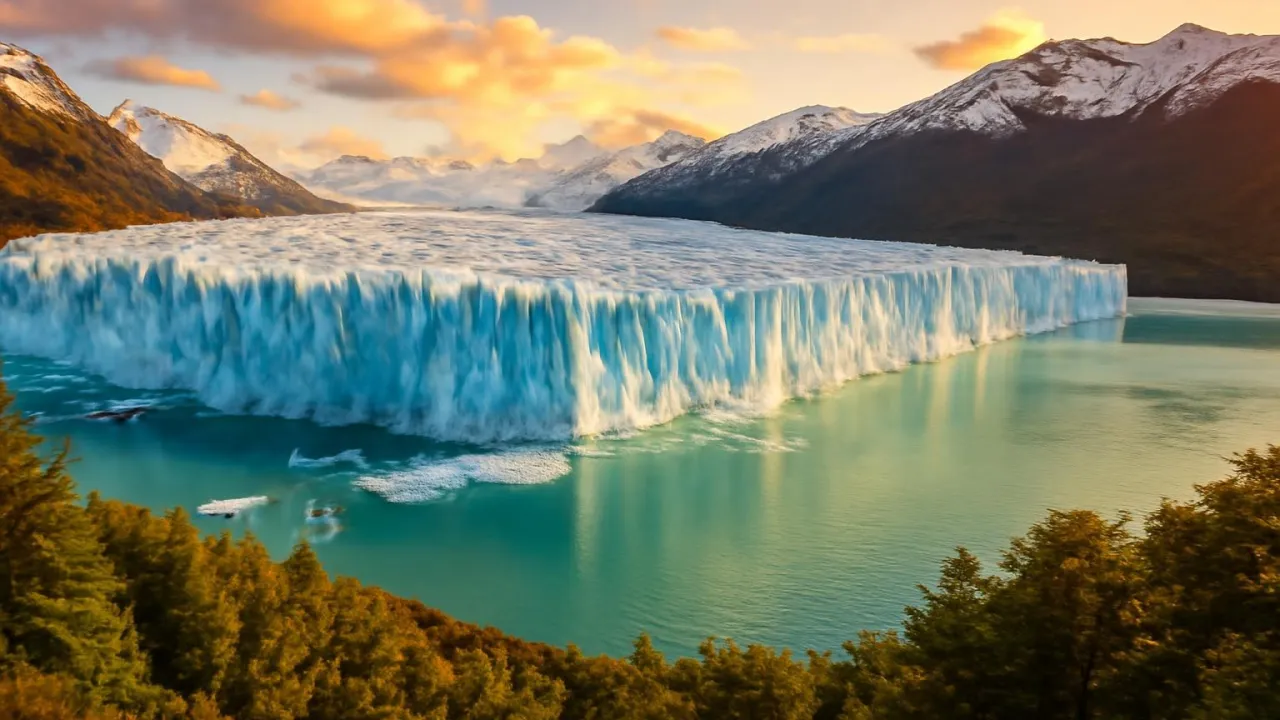
The glacier's icy wall is taller than a school bus stacked ten times!
✨ Word Sparks (Grade 2 Glossary)
Tap 🔊 to hear
iceberg
A big piece of floating ice
glacier
A slow-moving river of ice
visitor
Someone who comes to see a place
🪝
What if you saw ice falling like thunder?
1
Blue Ice in the Wild
Imagine standing by a giant wall of blue ice that sparkles in the sun. The Perito Moreno shines bright in Patagonia, Argentina, and stretches far across the lake. Its ice towers are taller than most buildings, making it a breathtaking sight.
2
Crashing Ice Shows
Sometimes, giant pieces of ice break off and crash into the water. The sound is loud, like thunder, and people cheer when they see it. These falling ice blocks are called .
3
A Place to Explore
walk on special paths to see the safely. Some people take boat rides to get even closer to the ice. The glacier is one of the most famous places in Argentina.
When Perito Moreno calves, the sound can be heard miles away!
✨ Word Sparks (Grade 3 Glossary)
Tap 🔊 to hear
calving
When big ice breaks off a glacier
crevasse
A deep crack in the ice
vibration
A shaking or moving back and forth
🪝
What would you feel standing near a roaring wall of ice?
1
Meeting the Mighty Glacier
Perito Moreno Glacier stretches across a wide lake in Patagonia, Argentina. Its bright blue ice towers above the water, sparkling in the cold sunlight. The glacier is about 240 feet tall above the lake’s surface. It is one of the few glaciers in the world that is not shrinking.
2
How Does It Move?
A glacier is a massive river of ice that moves slowly downhill. Gravity pulls the glacier forward, causing cracks called to form. Sometimes, the glacier’s edge breaks off, creating loud and splashes as icebergs fall. This process is called .
3
A Natural Wonder to Visit
People visit Perito Moreno to watch the ice shows. Special walkways let visitors safely get close to the glacier’s edge. Some even take boat rides to see the icy wall up close. The glacier’s blue color comes from how ice absorbs and scatters sunlight.
4
Why Is It Special?
Most glaciers around the world are shrinking because of climate change. Perito Moreno is stable, meaning it grows and shrinks at nearly the same rate. Scientists study its movement and acoustic sounds to learn about glacier health. It is a symbol of Patagonia’s wild beauty.
Perito Moreno’s calving ice can make waves over six feet tall!
✨ Word Sparks (Grade 4 Glossary)
Tap 🔊 to hear
acoustic
About sound and how it travels
resonance
A strong, lasting sound or echo
glaciologist
A scientist who studies glaciers
🪝
What if you stood on a boardwalk and felt the ground shake as thunderous ice crashed into the lake?
1
Thunder and Blue in Patagonia
Imagine walking along a path and hearing a booming crack echo across a turquoise lake. Before you, a wall of blue ice rises 240 feet, its jagged peaks glowing in the sunlight. The glacier’s face is always changing, with deep crevasses and icy towers sculpted by wind and snow. Each day, the scene can shift as new chunks of ice tumble into the water.
2
How the Glacier Moves and Sings
Perito Moreno Glacier flows slowly downhill, pulled by gravity and packed by layers of ancient snow. As the ice moves, tension builds and crevasses open, sometimes causing huge blocks to break off in a process called calving. When this happens, the sends a thunderous roar across the lake. The vibrations can even be felt beneath your feet on the walkways.
3
A Rarely Stable Ice Giant
Unlike most glaciers worldwide, Perito Moreno does not shrink year after year. Its size stays nearly the same because snowfall and melting are almost balanced. Scientists and study its mass balance, movement, and sound to understand why it is so stable. This makes the glacier a living laboratory for learning about climate and ice.
4
A Place for Adventure and Discovery
Thousands of people visit Los Glaciares National Park to watch the glacier’s powerful calving shows. Elevated walkways and boat tours let visitors safely get close to the icy face. The glacier’s bright blue color comes from how dense ice absorbs and scatters sunlight. Perito Moreno inspires wonder and teaches us about the science and beauty of our planet.
1. What is the process called when ice breaks off the glacier?
2. Why is Perito Moreno Glacier special to scientists?
🤯 Mind-Blowing Fact • Grade 5
Perito Moreno Glacier contains about one-third of all the fresh water in Argentina!
✨ Word Sparks (Grade 5 Glossary)
Tap 🔊 to hear
ablation
The melting or loss of glacier ice
mass balance
How much ice a glacier gains or loses
hydrology
The science of how water moves on Earth
🪝
What secrets can a roaring, ever-changing ice giant reveal about our planet’s past and future?
1
A Living Ice Giant in Patagonia
Perito Moreno Glacier dominates the southern Andes with its immense, luminous blue ice front rising 240 feet above Lake Argentino. Formed over thousands of years from compacted snowfall, the glacier spans approximately 19 miles in length and nearly 3 miles in width, making it one of the largest and most dynamic glaciers in South America. Its jagged pinnacles and deep crevasses create a constantly shifting landscape, shaped by both relentless natural forces and seasonal temperature changes. The glacier’s face is renowned for its brilliant blue hues, which result from the absorption and scattering of sunlight by dense, ancient ice.
2
Mechanics of Glacier Movement and Calving
Glaciers like Perito Moreno move under their own weight, with gravity causing the ice to deform and flow slowly downhill at rates of up to 6.6 feet (2 meters) per day. As the glacier advances toward the lake, stress builds up in the ice, generating crevasses and tension cracks. Periodically, the glacier’s terminus pushes into Lake Argentino, blocking water flow and causing dramatic ruptures or calving events. These events produce thunderous acoustic resonance, sending massive icebergs crashing into the water and generating powerful waves that can be felt and heard for miles.
3
A Rare Example of Glacier Stability
Unlike most glaciers worldwide, which are retreating due to global warming, Perito Moreno has remained remarkably stable for decades. Its unique balance between accumulation (snowfall) and (melting and calving) means that the glacier’s size fluctuates very little year to year. Scientists and glaciologists closely monitor its , ice flow rates, and calving cycles to understand why Perito Moreno defies the shrinking trend seen in most other glaciers. This stability makes it a crucial site for climate research and long-term environmental monitoring.
4
Cultural and Scientific Significance
Perito Moreno Glacier is not only a natural wonder but also a symbol of Argentina’s wild beauty and a focal point for scientific discovery. Its dramatic calving events attract thousands of visitors annually, offering a rare opportunity to witness glacial dynamics up close. Researchers use advanced acoustic sensors, satellite imagery, and ground-based measurements to study the glacier’s movement, structure, and response to climate variables. The glacier’s stability provides invaluable data for understanding the impacts of climate change on freshwater resources and polar environments.
5
Protecting a Global Treasure
Located within Los Glaciares National Park, a UNESCO World Heritage Site, Perito Moreno is carefully protected to preserve its pristine environment. Park rangers enforce strict conservation rules, while educational programs teach visitors about glacial geology, , and environmental stewardship. As climate change threatens glaciers around the world, Perito Moreno stands as a rare beacon of resilience, reminding us of the importance of protecting Earth’s natural wonders for future generations.