🇺🇸 U.S. HISTORY
🏛️ American Patriot Courier, Silversmith & Industrialist • 1734–1818
VA History & Social Science SOL K.1, 1.2, 2.4, VS.1–VS.10, USI & USII
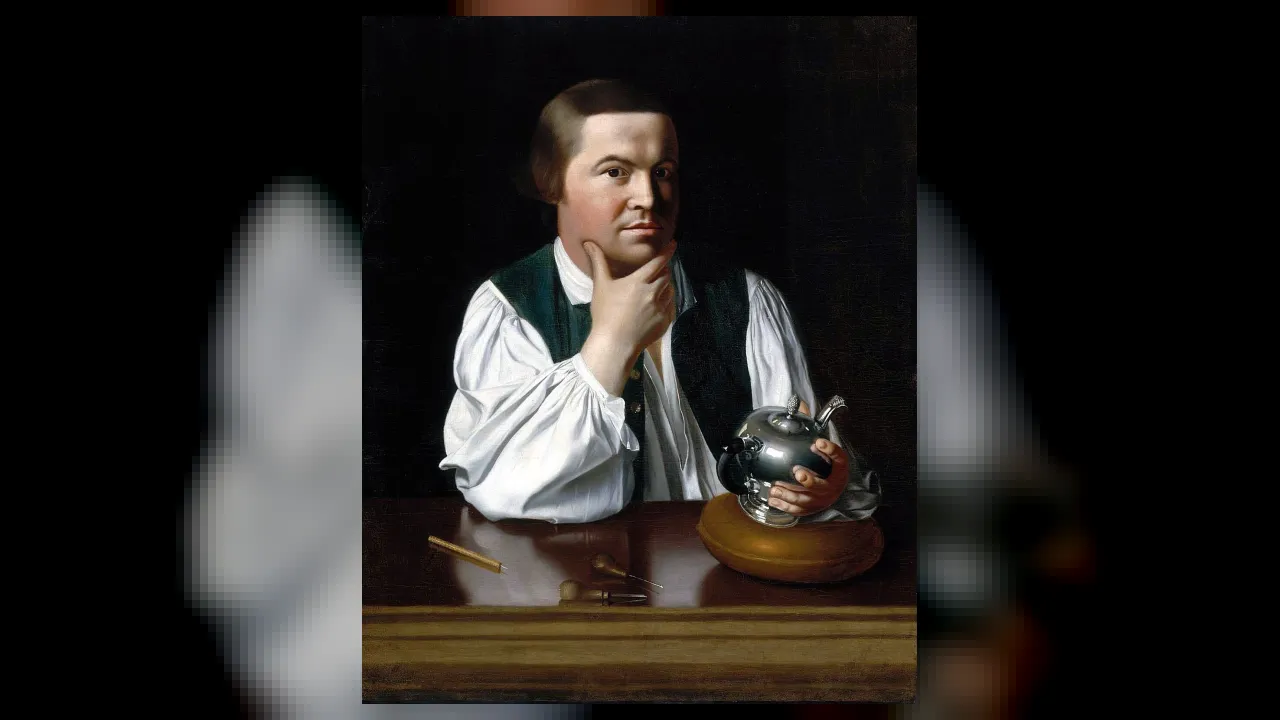
Paul Revere
Silversmith and Midnight Messenger of Liberty
Grade 1 • Early Reader • 70 words
⏳ Era / Statehood1734–1818 • American Revolution & Early Republic Era
🗺️ Region / CapitalNorth End of Boston, Lexington & Canton, Massachusetts
📜 Key MilestoneRode on April 18, 1775, to warn Patriots & opened America's first copper mill
⚡ Historical SparkOrganized the Old North Church lantern signal and midnight alarm network before Lexington and Concord
🤯 Mind-Blowing Fact • Grade 1
To keep oarlocks from squeaking as friends rowed Paul Revere silently past a British warship in Boston Harbor, they wrapped the oars in soft wool cloth!
✨ Word Sparks (Grade 1 Glossary)
Tap 🔊 to hear
steeple
A tall pointed tower on a church
Patriot
A colonist supporting American self-rule
minutemen
Citizen helpers ready in a single minute
🪝
Why did two bright lanterns shine high in a tall church tower one quiet spring night?
1
Silver Shop in Boston
By day, Paul Revere hammered shiny silver spoons, cups, and teapots in Boston. By night, he helped friends watch British soldiers.
2
Two Bright Lanterns
On an April night in 1775, British troops moved out across the water. Two lanterns shone high in the Old North Church tower to warn towns!
3
The Midnight Ride
Paul rowed across the river and rode a fast horse down moonlit roads! He woke neighbors in time to stand ready by sunrise.
1. What craft did Paul Revere make in his Boston workshop?
2. How many lanterns shone in the Old North Church tower on the night of April 18, 1775?
🤯 Mind-Blowing Fact • Grade 2
Paul Revere never actually shouted 'The British are coming!' because colonists still considered themselves British—instead, he warned that 'The Regulars are coming out!'
✨ Word Sparks (Grade 2 Glossary)
Tap 🔊 to hear
Regulars
Full-time soldiers in the British Army
courier
A fast messenger carrying urgent dispatches
sexton
A caretaker who tends a church building
🪝
Did Paul Revere really ride all alone—or was he part of a clever team of midnight riders?
1
Silversmith and Express Rider
Picture ringing hammers inside a busy North End workshop in colonial Boston! Paul Revere learned silver crafting from his father, yet he also rode fast horses carrying important news for the Sons of Liberty all the way to New York and Philadelphia.
2
'One If by Land, Two If by Sea'
On the night of April 18, 1775, Dr. Joseph Warren learned that British planned to march to Concord. Before rowing across the Charles River, Paul asked church Robert Newman to hang two lanterns in the Old North Church steeple—warning Charlestown Patriots that troops were crossing by boat.
3
Teamwork on the Road to Concord
Borrowing a swift horse named Brown Beauty, Paul galloped through Medford to Lexington alongside fellow rider William Dawes, while Dr. Samuel Prescott carried the warning all the way to Concord!
1. Why did Paul Revere say 'The Regulars are coming out!' rather than 'The British are coming!'?
2. Which two fellow riders joined Paul Revere on that famous April night to spread the alarm to Lexington and Concord?
🤯 Mind-Blowing Fact • Grade 3
More than 130 bronze bells cast in Paul Revere's foundry over two centuries ago still ring in New England churches and town halls today!
✨ Word Sparks (Grade 3 Glossary)
Tap 🔊 to hear
artisan
A skilled maker of handcrafted useful goods
foundry
A workshop melting and casting hot metal
hull
The main outer body of a ship
🪝
How did a Boston silversmith warn forty towns in one night—and later armor America's most famous wooden warship?
1
Master Artisan of Boston's North End
Step inside a timbered wooden house in Boston's North End in 1774, where silver bowls gleam beside copper engraving plates! Born in Boston at the end of 1734 to a French Huguenot immigrant silversmith, Paul Revere supported a large family through silverwork, copperplate prints, and even crafting false teeth. As a trusted organizer in the Sons of Liberty, he led Mechanics neighborhood patrols watching British troop movements.
2
Signal in the Steeple
By April 1775, Massachusetts Patriots had stored supplies at Concord, twenty miles inland. Fearing British General Thomas Gage might cut off riders leaving Boston, Revere prearranged a backup signal with Charlestown Patriots: one lantern in the Old North Church steeple if troops marched out over Boston Neck by land, or two if they rowed across the Charles River.
3
Midnight Alarm of April 18, 1775
At ten o'clock on April 18, Dr. Joseph Warren sent both William Dawes and Paul Revere toward Lexington to warn Samuel Adams and John Hancock. After friends hung two lanterns and rowed him silently past HMS Somerset, Revere borrowed Deacon John Larkin's mare, triggered subsidiary riders across Middlesex County, reached Lexington by midnight, and was briefly detained by a British patrol on the road to Concord while Dr. Samuel Prescott rode ahead!
4
Bells and Copper After Independence
After the Revolution, Revere cast hundreds of bronze church bells and opened America's first copper-rolling mill in 1801—supplying copper sheets for the of the USS Constitution ('Old Ironsides') and the dome of the Massachusetts State House!
1. Why did Paul Revere arrange the Old North Church lantern signal BEFORE rowing across the Charles River himself?
2. Which famous American naval frigate wore protective copper sheathing rolled at Paul Revere's mill?
🤯 Mind-Blowing Fact • Grade 4
Paul Revere's wooden home in Boston's North End, built around 1680, is the oldest surviving building in downtown Boston and welcomes visitors from around the world today!
✨ Word Sparks (Grade 4 Glossary)
Tap 🔊 to hear
Committee of Safety
Local colonial group organizing community defense
subsidiary
Branching out to support a main effort
frigate
A fast three-masted wooden naval warship
🪝
Why did Paul Revere's 1775 alarm succeed so rapidly that thousands of minutemen converged on Concord within hours?
1
Connector Across Colonial Boston
Listen to muffled oars dipping into the cold tidal current of the Charles River at 10:30 p.m. on April 18, 1775, just yards from the sixty-four cannons of the British warship HMS Somerset. Sitting quietly in the skiff is forty-year-old Paul Revere. Unlike wealthy merchants or Harvard lawyers alone, Revere belonged simultaneously to artisan guilds, Masonic lodges, fire societies, and the Sons of Liberty—making him the indispensable human bridge connecting Dr. Joseph Warren and Samuel Adams with Boston's working dockworkers and mechanics.
2
Building an Express Intelligence Network
Between December 1773 and April 1775, Revere logged thousands of miles on horseback as official courier for the Massachusetts Committee of Correspondence, carrying news of the Boston Tea Party and the Suffolk Resolves to New York and Philadelphia. In autumn 1774, he helped organize thirty North End artisans to patrol Boston streets nightly in pairs, spotting British troop preparations before regiments even formed ranks.
3
A Web of Riders on April 18–19, 1775
When Dr. Warren confirmed on April 18 that 700 British regulars planned to march across the Back Bay marshes to seize colonial powder at Concord, Revere asked sexton Robert Newman and Captain John Pulling to display two lanterns briefly in Christ Church (Old North Church) to alert Charlestown's . Landing in Charlestown and mounting Brown Beauty, Revere evaded two mounted British officers, galloped to Medford to wake Captain Isaac Hall's minutemen—who immediately dispatched riders in new directions—and reached Reverend Jonas Clarke's parsonage in Lexington at midnight to alert John Hancock and Samuel Adams. Joined by William Dawes and Concord physician Dr. Samuel Prescott, Revere was halted in Lincoln by a British patrol, who took his horse—yet Prescott jumped a stone wall and alerted Concord in time!
4
Pioneer of American Manufacturing
Long before Henry Wadsworth Longfellow's famous 1860 poem immortalized his ride, Revere helped launch America's Industrial Revolution—casting cannons and church bells and investing $25,000 of his own funds in 1801 to establish the nation's first successful sheet-copper rolling mill in Canton, Massachusetts.
1. How did Paul Revere's ride trigger warnings across forty towns in a single night?
2. Which nineteenth-century poet made 'Paul Revere's Ride' a household poem across the United States in 1860–1861?
🤯 Mind-Blowing Fact • Grade 5
The copper manufacturing company Paul Revere founded in Canton, Massachusetts, in 1801 still operates more than 220 years later as Revere Copper Products—one of the oldest continuously operating manufacturers in America!
✨ Word Sparks (Grade 5 Glossary)
Tap 🔊 to hear
clandestine
Kept carefully secret from watchful opponents
decentralized
Spread across many local helpers at once
metallurgy
The science of heating and shaping metals
🪝
How did social-network leadership—and later metallurgical innovation—make Paul Revere vital to both winning and building the early American Republic?
1
Huguenot Craftsmanship and Civic Networks in Colonial Boston
Examine the gleaming silver 'Sons of Liberty Bowl' hammered from forty-five ounces of coin silver in 1768 and preserved today at Boston's Museum of Fine Arts—inscribed around its rim with the names of ninety-two Massachusetts legislators who refused royal orders to rescind a circular letter against British taxation. Its maker, Paul Revere, born in Boston's North End on December 21, 1734 (Old Style), was the son of French Huguenot refugee Apollos Rivoire. Mastering rococo silversmithing, copperplate engraving, and surgical dentistry after his father's death, Revere occupied a rare sociological crossroads: respected equally in waterfront taverns by shipwrights and caulkers and in drawing rooms by John Hancock, Samuel Adams, and Dr. Joseph Warren.
2
Intelligence Logistics and the Mechanics Patrol
Between 1773 and 1775, Revere completed at least eighteen long-distance express rides—including carrying Massachusetts's Suffolk Resolves 350 miles to the First Continental Congress in Philadelphia in September 1774, spurring continental solidarity. That autumn, Revere organized roughly thirty North End tradesmen into a intelligence ring meeting at the Green Dragon Tavern to monitor British regiments garrisoning Boston. Four days before hostilities—on April 14 and April 16, 1775—Revere rode preliminary reconnaissance missions to Concord, prompting Patriots to disperse cannons, musket balls, and flour barrels before British General Thomas Gage moved.
3
Anatomy of the April 18–19, 1775 Alarm System
Summoned by Dr. Joseph Warren at 10:00 p.m. on April 18 as Lt. Col. Francis Smith's 700 grenadiers and light infantry mustered at Boston Common, Revere first instructed Robert Newman and John Pulling to hang two lanterns briefly in the 191-foot steeple of Christ Church (Old North Church), confirming an amphibious crossing of the Back Bay to Charlestown's Colonel William Conant. Rowed with muffled oars past HMS Somerset by Joshua Bentley and Thomas Richardson, Revere mounted Deacon John Larkin's swift mare in Charlestown at 11:00 p.m., outran two mounted British officers, bypassed Cambridge, and roused Captain Isaac Hall in Medford—activating a cascade of dozens of alarm riders. Reaching Lexington at midnight to alert Adams and Hancock, Revere converged with William Dawes and Concord's Dr. Samuel Prescott before encountering Major Edward Mitchell's mounted patrol in Lincoln at 1:00 a.m.; while Revere calmly bluffed his captors that 500 militia were approaching and lost his horse, Prescott vaulted a stone wall to warn Concord.
4
Foundryman and Pioneer of American Copper Rolling
Following wartime militia service, Revere transitioned seamlessly into early Republic industrialization. Opening an iron and bronze foundry in 1788, he cast bolts and spikes for the 1797 launching of the frigate USS Constitution and nearly four hundred church and civic bells with his sons. Recognizing America's strategic vulnerability in importing sheet copper from Britain, sixty-five-year-old Revere risked his personal fortune and secured a $10,000 federal Navy loan in 1801 to purchase an old gunpowder mill site along the Neponset River in Canton, Massachusetts—establishing the Western Hemisphere's first successful copper-rolling mill.
5
Historical Memory versus Longfellow's Ballad
Revere's Canton mill clad the Massachusetts State House dome (1802), resheathed the hull of USS Constitution (1803), and supplied copper boilers for Robert Fulton's steamboats. Though Henry Wadsworth Longfellow's 1860 poem 'Paul Revere's Ride' compressed collective teamwork into a solitary rider awaiting lanterns across the water, Revere's own 1798 deposition reveals an even more impressive truth: disciplined civic organization capable of mobilizing an entire countryside overnight.