1. What space neighbor does most of the pulling to make Earth's ocean tides?
2. When is the best time to peek at starfish and crabs inside rocky beach puddles?
🤯 Mind-Blowing Fact • Grade 2
Canada's Bay of Fundy has the highest tides on Earth—water rises and falls up to fifty-three feet, as tall as a five-story building!
✨ Word Sparks (Grade 2 Glossary)
Tap 🔊 to hear
Bulge
Rounded swelling of ocean water pulled outward
Rotate
Spin all the way around like a top
Coastline
Edge of land where it meets the sea
🪝
Why do most ocean beaches get two high tides every single day instead of just one?
1
Earth Spins Inside Water Bulges
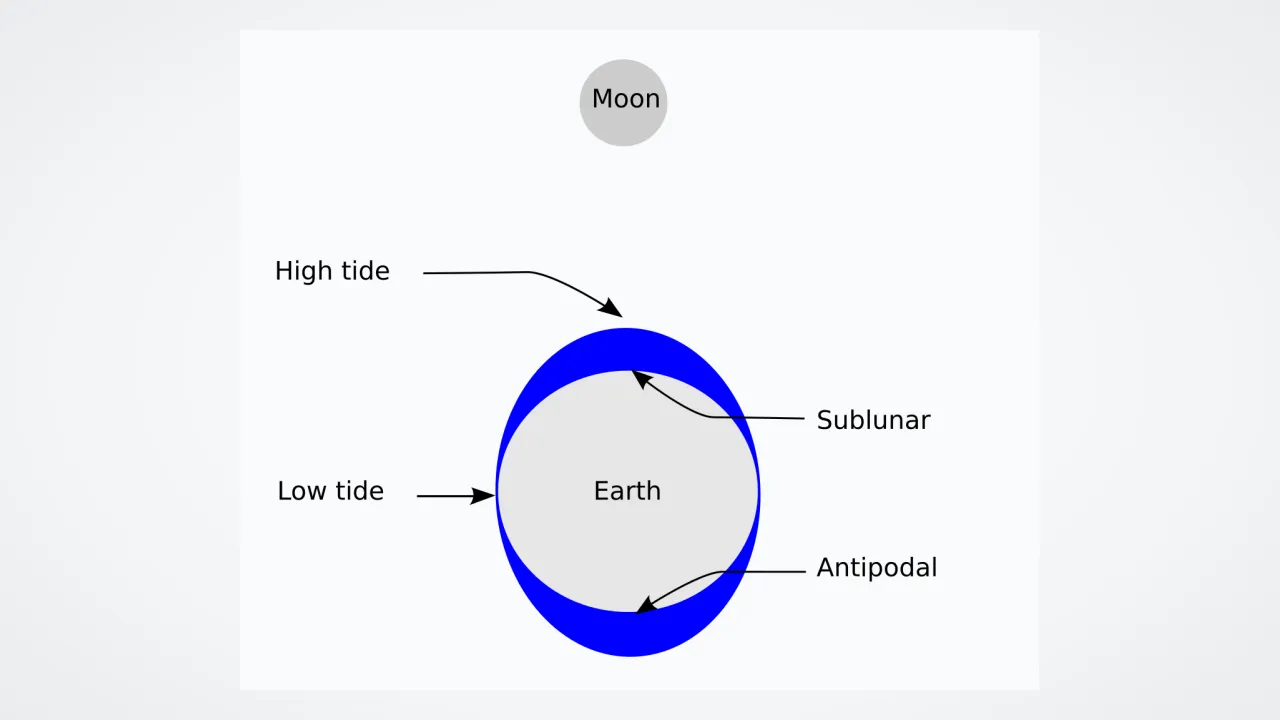
Picture Earth wearing a wide belt of blue ocean water! As the Moon circles in space, its gravity pulls ocean water into a on the side facing the Moon. Surprisingly, a second water bulge forms on the exact opposite side of Earth too!
2
Two Highs, Two Lows
Because Earth spins around once every day, most beaches through both water . That gives two high tides and two low tides roughly every twenty-five hours!
3
Helping Hands From the Sun
The giant Sun pulls on Earth's oceans too, though less strongly because it sits much farther away. When the Sun and Moon line up together, high tides climb extra high!
1. How many high tides and low tides do most ocean beaches experience each day?
2. Why does the Moon pull stronger tides on Earth than the giant Sun does?
🤯 Mind-Blowing Fact • Grade 3
Moon gravity even pulls tiny 'earth tides' in solid rock—lifting the ground beneath your feet up and down by up to twelve inches twice a day without you noticing!
✨ Word Sparks (Grade 3 Glossary)
Tap 🔊 to hear
Spring Tide
Extra-strong tide when Sun and Moon align
Neap Tide
Smaller tide when Sun and Moon pull sideways
Intertidal Zone
Shore area covered at high tide, dry low
🪝
Why do high tides arrive fifty minutes later today than they arrived yesterday?
1
Chasing a Moving Moon
Check a coastal tide chart at the pier, and you will spot a cool pattern! If high tide peaks at noon today, tomorrow's midday high tide arrives at 12:50 p.m. Why the delay? While Earth spins once in twenty-four hours, the Moon also moves forward along its orbit, so Earth needs fifty extra minutes to catch back up!
2
Spring Tides Line Up Strong
Twice each month—during a New Moon and a Full Moon—the Sun, Moon, and Earth line up in a straight row. Their combined gravity teams up to create extra-high high tides and extra-low low tides called (named for water 'springing' up, not the season!).
3
Gentle Neap Tides at Right Angles
During Quarter Moons, the Sun and Moon pull at a ninety-degree right angle to each other. Partially canceling out, they produce smaller, gentler tidal swings called .
4
Life in the Intertidal Zone
Between high-tide and low-tide lines lies the , where barnacles, mussels, and sea anemones clamp tight against crashing waves and drying air.
1. During which Moon phases do extra-strong spring tides happen?
2. Why does the tidal cycle take 24 hours and 50 minutes instead of exactly 24 hours?
🤯 Mind-Blowing Fact • Grade 4
Tidal friction between sloshing oceans and the seafloor acts like a tiny brake on Earth's spin—lengthening our day by about two milliseconds per century and nudging the Moon 1.5 inches farther away each year!
✨ Word Sparks (Grade 4 Glossary)
Tap 🔊 to hear
Tidal Range
Vertical height difference between high and low tide
Inertia
Tendency of moving matter to keep going straight
Salt Marsh
Coastal grassy wetland flooded daily by ocean tides
🪝
Why does the Bay of Fundy surge fifty feet while lakes and small seas barely have noticeable tides?
1
Mystery of the Opposite-Side Bulge
Walk along Virginia's Eastern Shore or Chesapeake Bay marshes, and tidal creeks reverse flow like clockwork twice a day! Understanding the bulge facing the Moon makes quick sense—Moon gravity pulls near-side ocean water hardest. What about the second bulge on Earth's far side? Moon gravity pulls solid Earth slightly closer than the far-side ocean water, and as Earth and Moon whirl around their shared center of balance, leaves water bulging outward on the opposite side too!
2
Tidal Range and Funnel-Shaped Bays
Out in the middle of the deep Pacific or Atlantic, a passing tidal bulge lifts sea level by less than one meter. Coastal shape changes everything! Wide continental shelves and funnel-shaped bays squeeze incoming tidal waves into tight corners. In Canada's Bay of Fundy, water sloshes at the exact natural rhythm of the bay—like water sloshing higher and higher in a bathtub—driving a fifty-three-foot .
3
Salt Marshes and Ship Captains
Along Virginia's Hampton Roads harbors, harbor pilots time huge cargo ships to ride high tide safely over deep channels, while rising tides flush oxygen and nutrients through salt-marsh cordgrass nurseries.
4
Clean Tidal Energy
Because lunar tides never run out of wind or sunshine, engineers in Scotland, France, South Korea, and Maine test underwater tidal turbines that spin like submerged windmills to generate predictable clean electricity.
1. Why does a second tidal bulge form on the side of Earth facing away from the Moon?
2. Why do funnel-shaped inlets like Canada's Bay of Fundy have much bigger tidal ranges than open ocean islands?
🤯 Mind-Blowing Fact • Grade 5
Growth bands inside 400-million-year-old fossilized Devonian corals reveal that before billions of tides slowed Earth's spin, a year on Earth had roughly 400 days—each lasting less than twenty-two hours!
✨ Word Sparks (Grade 5 Glossary)
Tap 🔊 to hear
Differential Gravity
Difference in gravity pull from near to far side
Syzygy
Straight-line alignment of Sun, Earth, and Moon
Perigee
Closest point in the Moon's oval orbit
🪝
Why Does gravitational force drop with distance squared, yet tidal force drops with distance cubed—giving the tiny Moon victory over the massive Sun?
1
Differential Gravity and the Inverse-Cube Law
Stand on a jetty watching billions of liters of seawater surge through a coastal inlet, and you are witnessing Isaac Newton's 1687 breakthrough in celestial mechanics. Tides do not depend on total gravitational pull alone; if they did, the Sun—which pulls Earth 178 times harder than the Moon—would dominate! Instead, tides arise from : the difference in pull across Earth's 12,742-kilometer diameter. Because tidal force scales inversely with the cube of distance rather than the square, the nearby Moon (384,400 kilometers away) generates more than twice the tidal-bulging force of the distant Sun (150 million kilometers away), making solar tides roughly 46 percent as strong as lunar tides.
2
Semidiurnal, Diurnal, and Mixed Amphidromic Systems
If Earth had no continents, two smooth tidal bulges would sweep westward uninterrupted. Real continents block those bulges, breaking ocean tides into giant rotating waves that pinwheel around zero-tide nodes called amphidromic points! Depending on basin geometry, coasts experience semidiurnal tides (two nearly equal highs and lows daily, as in Virginia and Europe), diurnal tides (one high and one low daily, as in parts of the Gulf of Mexico), or mixed semidiurnal tides (two unequal highs and lows daily along the U.S. Pacific Coast).
3
Syzygy, Perigee, and King Tides
When Earth, Moon, and Sun align at (New or Full Moon), constructive interference produces spring tides roughly twenty percent wider than average; quadrature at Quarter Moons yields muted neap tides. Several times a year, spring tides coincide with lunar —the Moon's closest elliptical approach at ~356,500 kilometers—producing extreme perigean spring tides, popularly called 'king tides.'
4
Angular Momentum Transfer Through Deep Time
Laser reflectors placed on the Moon by Apollo astronauts confirm that tidal friction transfers Earth's rotational angular momentum to the Moon's orbit, pushing the Moon away by 3.8 centimeters per year. Fossil coral growth rings prove that 400 million years ago during the Devonian Period, Earth spun fast enough to pack about 400 twenty-two-hour days into a single year!
5
Tidal Heating of Ocean Worlds
Beyond Earth, extreme tidal flexing kneads the interiors of Jupiter's moon Europa and Saturn's moon Enceladus, melting vast subsurface liquid water oceans beneath icy shells—making tidal physics a prime driver of habitability across the cosmos.