🇺🇸 U.S. HISTORY
🏛️ Constitutional Civic Process • Article I, Sec. 8 & 14th Amendment
VA History & Social Science SOL K.1, 1.2, 2.4, VS.1–VS.10, USI & USII
Naturalization & U.S. Citizenship
Joining the American Civic Family by Birth or Choice
Grade 1 • Early Reader • 66 words
⏳ Era / StatehoodArticle I (1787) & 14th Amendment (1868)
🗺️ Region / CapitalNationwide (Including Historic Ceremonies at Monticello, VA)
📜 Key MilestoneCitizenship by Birth or Legal Naturalization Steps
⚡ Historical SparkWelcomes newcomers from around the globe as full, equal citizens united by shared civic ideals
🤯 Mind-Blowing Fact • Grade 1
Every Fourth of July, dozens of brand-new citizens take their oath right on the front steps of Monticello in Virginia!
✨ Word Sparks (Grade 1 Glossary)
Tap 🔊 to hear
citizen
An official member of a country
oath
A serious, proud promise spoken aloud
welcome
To greet newcomers with kindness and joy
🪝
Can someone born in another country become an American citizen?
1
Two Ways to Belong
Wave a little flag and smile! Most U.S. are born right here or to American parents. People from other countries can join our team too!
2
Learning and Studying
Becoming a by choice is called naturalization. Newcomers live here, practice English, and study American history and fair rules.
3
A Happy Promise Day
At last, they stand up and make a proud promise to America. Everyone claps to our newest !
1. What do we call the process when someone from another country becomes a U.S. citizen?
2. What do newcomers study before their citizenship ceremony?
🤯 Mind-Blowing Fact • Grade 2
Famous naturalized U.S. citizens include scientist Albert Einstein, architect I. M. Pei, and over twenty astronauts!
✨ Word Sparks (Grade 2 Glossary)
Tap 🔊 to hear
naturalization
Legal steps to become a citizen by choice
civics
Study of citizens' rights, duties, and government
allegiance
Faithful loyalty to a country and its laws
🪝
What makes a Fourth of July citizenship ceremony on a Virginia hilltop so unforgettable?
1
Two Paths to Citizenship
Listen to the cheers ringing out across the lawn at Monticello in Virginia! The U.S. Constitution describes two ways a person is an American citizen: by birth—being born in the United States or to citizen parents—or by .
2
Steps Along the Way
To become naturalized, an adult lives lawfully in the United States for several years and shows good character. Applicants also practice reading, writing, and speaking basic English and answer questions about U.S. history and .
3
Rights and Responsibilities
Finally, they take the Oath of at a joyful ceremony! New citizens gain equal rights—like voting—and share civic duties like obeying laws and serving on juries.
1. What are the two constitutional paths to U.S. citizenship?
2. Which important civic right do newly naturalized citizens gain right away?
🤯 Mind-Blowing Fact • Grade 3
Since 1963, Thomas Jefferson's Monticello in Charlottesville, Virginia, has hosted an annual July 4th naturalization ceremony welcoming thousands of new citizens from over 150 countries!
✨ Word Sparks (Grade 3 Glossary)
Tap 🔊 to hear
reside
To make one's permanent home in a place
applicant
A person officially applying for something
responsibility
A duty citizens carry out for the community
🪝
Which famous sentence in the Fourteenth Amendment clearly defines who is a citizen of the United States?
1
The Fourteenth Amendment Promise
Read the opening words of the Fourteenth Amendment, added to the Constitution in 1868: 'All persons born or naturalized in the United States... are citizens of the United States and of the State wherein they .' Those clear words guarantee equal citizenship nationwide!
2
Key Requirements for Naturalization
Each year, hundreds of thousands of lawful permanent residents choose to apply for naturalization. must be at least eighteen years old, live lawfully in the country—usually for five years—and show good moral character and respect for the Constitution.
3
Passing the Civics Interview
During an interview, demonstrate basic English skills and answer questions from a pool of one hundred history and civics topics—such as naming the three branches of government or explaining the First Amendment.
4
Taking the Oath of Allegiance
At a federal court or landmark ceremony, take the Oath of Allegiance, promising to support and defend the U.S. Constitution. When parents naturalize, their young permanent-resident children under eighteen often automatically become citizens too!
1. Which constitutional amendment clearly defines U.S. citizenship by birth and naturalization?
2. How long does a lawful permanent resident usually live in the United States before applying for naturalization?
🤯 Mind-Blowing Fact • Grade 4
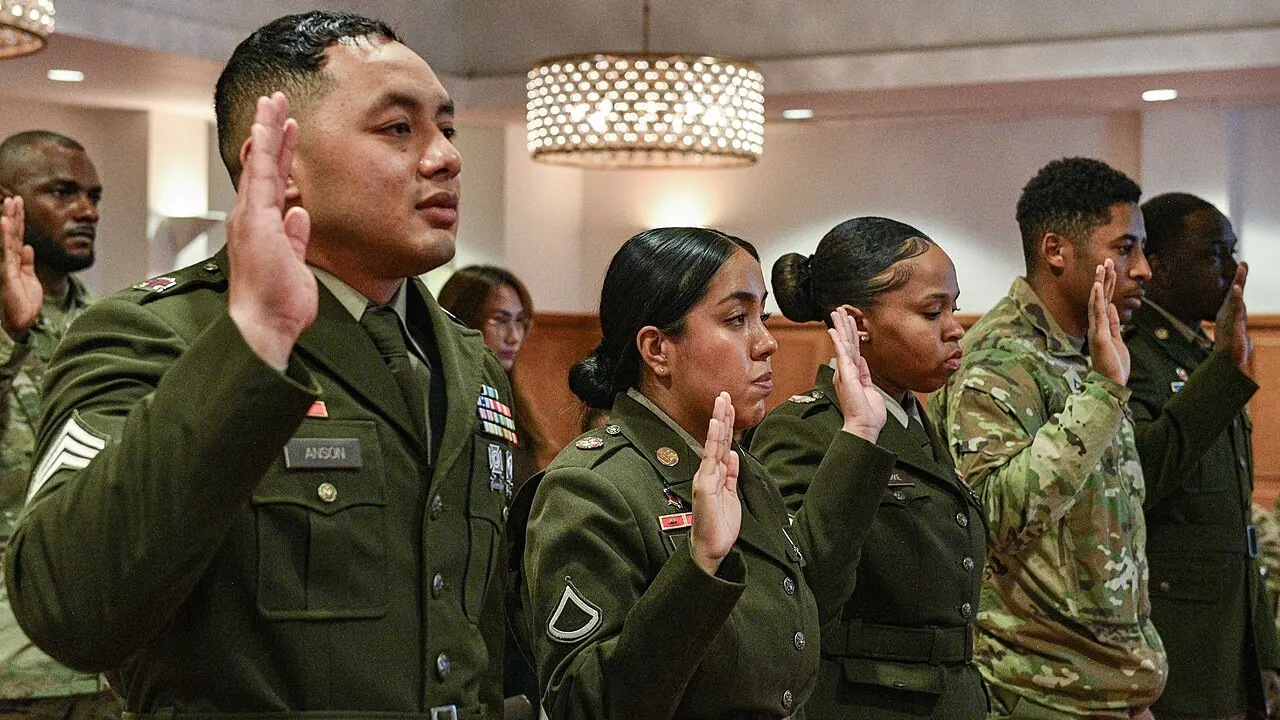
Noncitizens who serve honorably in the United States Armed Forces can qualify for expedited naturalization—sometimes taking their Oath of Allegiance while stationed at bases around the world!
✨ Word Sparks (Grade 4 Glossary)
Tap 🔊 to hear
uniform
Consistent and the same across every state
expedited
Made faster because of special service
literacy
Ability to read and write a language
🪝
Why is American citizenship built around shared constitutional ideals rather than a single ancestry?
1
A Nation United by Civic Ideals
Think about what makes the United States unusual among countries in world history! Many older nations defined belonging through royal bloodlines or a single shared ancestry. By contrast, Article I, Section 8 of the U.S. Constitution empowered Congress to establish 'an Rule of Naturalization,' uniting people from every corner of Earth around democratic principles like liberty, equality, and the rule of law.
2
Expanding Equal Access Over Time
Early naturalization laws were painfully narrow at first, excluding many groups by race until landmark milestones—including the Fourteenth Amendment (1868), the Indian Citizenship Act (1924) for Native Americans, and mid-twentieth-century reforms ending racial barriers—opened naturalization equally to qualified applicants of every background.
3
Virginia Civics: The Naturalization Steps
In Virginia Civics and Economics classrooms, students trace the path overseen by U.S. Citizenship and Immigration Services (USCIS): maintaining lawful permanent residency (a 'green card') for five years—or three years for spouses of citizens, with rules for U.S. military service—demonstrating English , passing a civics exam, and swearing the Oath of Allegiance.
4
Civic Duties vs. Civic Responsibilities
Naturalized citizens hold virtually every constitutional right of natural-born citizens (except eligibility for the Presidency and Vice Presidency under Article II). Alongside mandatory civic duties—obeying laws, paying taxes, serving on juries—thriving communities rely on voluntary responsibilities like voting, staying informed, and volunteering!
1. In civics, what is the difference between a 'civic duty' and a 'civic responsibility'?
2. What are the only two federal offices that Article II restricts to 'natural born Citizens'?
🤯 Mind-Blowing Fact • Grade 5
Unlike oaths in monarchies that pledge loyalty to a ruler or crown, the U.S. Naturalization Oath of Allegiance pledges loyalty first and foremost to an idea—supporting and defending the U.S. Constitution!
✨ Word Sparks (Grade 5 Glossary)
Tap 🔊 to hear
enshrine
To preserve and protect inside a sacred document
statutory
Created and governed by written legislative laws
culminate
To reach the highest final milestone
🪝
How did the Citizenship Clause of the Fourteenth Amendment and centuries of statutory reform forge America's modern civic identity?
1
Constitutional Foundations of Citizenship
Did you know the original 1787 Constitution mentioned 'citizens of the United States' repeatedly and granted Congress power in Article I, Section 8, Clause 4 to establish 'an uniform Rule of Naturalization,' yet never explicitly defined national citizenship? After the Civil War, Congress and the states ratified the Fourteenth Amendment on July 9, 1868. Its opening Citizenship Clause overturned the 1857 Dred Scott ruling and enshrined two foundational principles: jus soli (citizenship by birth on U.S. soil, affirmed in United States v. Wong Kim Ark in 1898) alongside jus sanguinis (citizenship through citizen parents by statute) and naturalization.
2
Removing Exclusions Across Centuries
America's journey toward universal civic inclusion unfolded over generations. Congress extended citizenship to all Native Americans born in the United States in 1924, repealed nationality exclusions during the 1940s, and eliminated all remaining racial and gender barriers to naturalization in the Immigration and Nationality Act of 1952—ensuring the process welcomes qualified permanent residents from every nation on Earth.
3
Statutory Mechanics of Naturalization Today
Administered by U.S. Citizenship and Immigration Services, adult applicants submit Form N-400 after five years of continuous lawful permanent residence (three years if married to a U.S. citizen, or expedited for honorable military service), complete background checks, demonstrate good moral character, and pass English reading, writing, and speaking evaluations alongside an oral U.S. history and civics test.
4
The Oath of Allegiance
Naturalization in a judicial or administrative ceremony where candidates pledge to 'support and defend the Constitution and laws of the United States of America against all enemies, foreign and domestic; that I will bear true faith and allegiance to the same'—loyalty pledged not to a monarch or person, but to a constitutional framework!
5
Shared Rights, Duties, and Democratic Vitality
Nearly eight hundred thousand new Americans naturalize in a typical year. Enjoying equal constitutional protections—save eligibility for the Presidency and Vice Presidency under Article II and the Twelfth Amendment—naturalized citizens enrich every profession, jury box, ballot booth, and neighborhood across the republic.