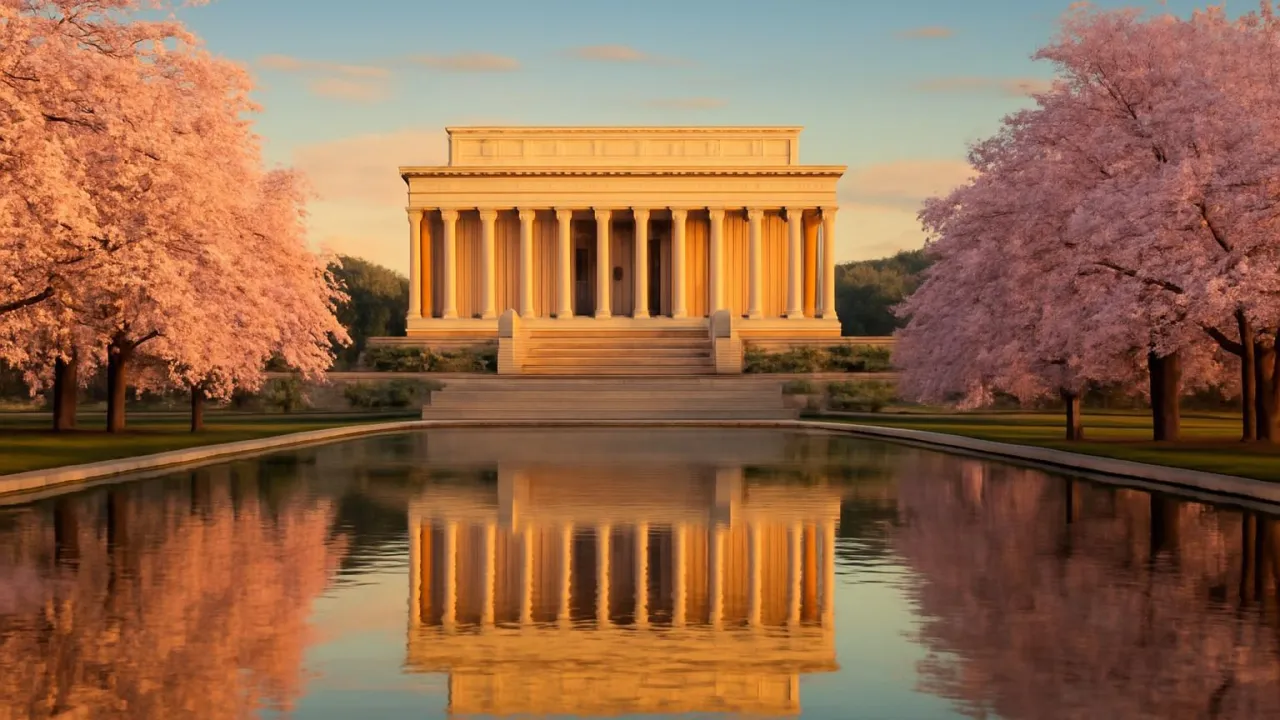
If you lined up the Lincoln Memorial’s columns, they’d stretch longer than a blue whale!
✨ Word Sparks (Grade 2 Glossary)
Tap 🔊 to hear
marble
Hard, shiny white rock for buildings
echo
A sound that bounces back to you
speech
Words spoken to many people
🪝
Can you imagine hearing your footsteps echo under giant marble columns?
1
Walking the Mall
The National Mall is a long, grassy park in Washington, D.C. People walk, picnic, and fly kites here with their friends and families. You can see many famous buildings and monuments all around the park, including the tall Washington Monument. The Mall is a place where history and fun meet every day.
2
Meet Mr. Lincoln
At one end stands the Lincoln Memorial, a huge white building with many tall columns. Inside, a giant Abraham Lincoln statue sits in a tall chair, looking out over the water. The columns stand in a big circle around him, making the space feel grand and important. People like to take photos and listen to their voices under the roof.
3
A Place for Big Moments
Many important happened here, like Martin Luther King Jr.’s dream speech for equality. Visitors come to remember history, honor heroes, and hope for a better future together. The Reflecting Pool sparkles in the sun and shows the Memorial’s reflection like a giant mirror. The National Mall is a place where everyone can learn and dream.
The Lincoln statue is so big that its hands alone are over three feet long!
✨ Word Sparks (Grade 3 Glossary)
Tap 🔊 to hear
Doric
A simple, strong style of column
acoustic
How sound moves in a space
erosion
Wearing away by wind or water
🪝
What would it feel like to stand where history changed America forever?
1
A Walk Through Time
The National Mall is a two-mile stretch lined with museums, memorials, and monuments. People stroll along the wide paths, watching ducks swim in the Reflecting Pool. The area is filled with the sounds of laughter, music, and distant speeches. Every year, millions of visitors come to explore and learn.
2
The Lincoln Memorial’s Mighty Design
The Lincoln Memorial stands tall with thirty-six columns, each representing a state from Lincoln’s era. The marble statue of Abraham Lincoln sits quietly, gazing over the Mall. The memorial’s design lets voices echo under its high ceiling. Architects used strong stone and clever engineering to make it last for generations.
3
Moments That Echo
This place has witnessed marches, celebrations, and powerful speeches, including Martin Luther King Jr.’s ‘I Have a Dream’ speech. The Memorial’s steps are a stage for people seeking justice and peace. The Reflecting Pool mirrors the sky and monuments, creating a peaceful scene. The Mall’s monuments help us remember and learn from history.
4
How It Stands Strong
The Memorial’s columns use the arch principle, spreading weight evenly to stay upright. Marble and limestone resist from wind and rain. Engineers designed the statue’s base to support its heavy weight. The National Mall’s lawns and trees are carefully cared for to keep the park beautiful.
1. Why do the Memorial’s columns use the arch principle?
2. What does the Reflecting Pool do?
🤯 Mind-Blowing Fact • Grade 4
The Lincoln Memorial’s statue is so large that if Lincoln stood up, he would be 28 feet tall!
✨ Word Sparks (Grade 4 Glossary)
Tap 🔊 to hear
neoclassical
A style that copies ancient Greek and Roman buildings
foundation
The strong base under a building
conservation
Protecting something from harm or damage
🪝
What if you could hear the echoes of history beneath the Lincoln Memorial’s marble roof?
1
A Living Canvas of American Stories
The National Mall stretches between the U.S. Capitol and the Lincoln Memorial, serving as a gathering place for millions. Its wide lawns and tree-lined paths invite people from all walks of life to reflect on America’s journey. Museums and monuments along the Mall preserve stories of invention, struggle, and hope. Each year, the Mall hosts national celebrations, peaceful protests, and moments of remembrance.
2
Monumental Engineering and Design
The Lincoln Memorial’s design features thirty-six massive Doric columns, each symbolizing a state in the Union during Lincoln’s presidency. The structure’s marble and limestone materials were chosen for their durability and timeless beauty. Engineers used deep and the arch principle to distribute the building’s immense weight. The statue of Lincoln, carved from Georgia white marble, weighs over 170 tons and sits on a pedestal designed to prevent settling.
3
A Stage for Change
The Memorial’s open design and remarkable acoustics make it a powerful site for speeches and gatherings. Martin Luther King Jr.’s iconic ‘I Have a Dream’ speech echoed across the Reflecting Pool, inspiring millions. The Mall has become a symbol of democracy, where people exercise their rights and remember those who shaped the nation. Its monuments encourage visitors to think critically about history and their role in shaping the future.
4
Preserving the Past for the Future
Architects and caretakers use science and technology to protect the Memorial from erosion and pollution. Special cleaning methods and projects keep the marble bright and strong. The National Mall’s landscape is carefully managed to balance beauty and environmental health. By preserving these landmarks, Americans ensure that future generations can experience the echoes of history firsthand.
1. Why did engineers use deep foundations for the Memorial?
2. How do caretakers protect the marble from pollution?
🤯 Mind-Blowing Fact • Grade 5
The Lincoln Memorial’s statue and base together weigh more than 320 tons—about as much as 50 elephants!
✨ Word Sparks (Grade 5 Glossary)
Tap 🔊 to hear
resonance
How sound vibrates and fills a space
micro-abrasion
A gentle way to clean stone surfaces
structural analysis
Studying how buildings stay safe and strong
🪝
Imagine standing on the Lincoln Memorial steps, where every stone and echo carries the weight of American history—what stories would you hear?
1
The National Mall: America’s Civic Heart
Stretching over two miles from the U.S. Capitol to the Lincoln Memorial, the National Mall is a living stage for democracy, remembrance, and innovation. Its meticulously planned landscape, originally designed by Pierre L’Enfant in 1791, features broad lawns, geometric pathways, and rows of American elms. The Mall’s open expanse has hosted presidential inaugurations, scientific expositions, and historic marches, making it a symbolic crossroads for American ideals and civic life.
2
Engineering the Lincoln Memorial
Constructed between 1914 and 1922, the Lincoln Memorial exemplifies neoclassical architecture, echoing the Parthenon of ancient Athens. Architect Henry Bacon selected Colorado Yule marble and Indiana limestone for their durability and luminous quality. Thirty-six fluted Doric columns, each 44 feet tall and 7.5 feet in diameter, encircle the monument, representing every state in the Union during Lincoln’s presidency. The structure’s deep concrete foundation and steel reinforcement distribute the immense 38,000-ton weight, preventing uneven settling and ensuring long-term stability.
3
Acoustics and Symbolism
The Memorial’s soaring 99-foot ceiling and open-air design create unique acoustic , allowing voices to carry powerfully across the steps and Reflecting Pool. This intentional design has amplified some of America’s most influential speeches, including Martin Luther King Jr.’s 1963 ‘I Have a Dream’ address. The statue of Lincoln, sculpted by Daniel Chester French and carved by the Piccirilli Brothers, sits 19 feet tall atop an 11-foot pedestal, symbolizing both humility and strength. Inscriptions of Lincoln’s Gettysburg Address and Second Inaugural Address flank the statue, inviting visitors to reflect on the nation’s core values.
4
Preservation and Environmental Challenges
Maintaining the Memorial and Mall requires ongoing scientific monitoring and conservation. Engineers combat marble erosion caused by acid rain and pollution using gentle , laser cleaning, and protective sealants. Landscape architects manage stormwater runoff and soil compaction to preserve the Mall’s ecological health. Preservationists use vibration sensors and to monitor the Memorial’s stability, ensuring it withstands millions of annual visitors and the test of time.
5
Legacy and Global Impact
The Lincoln Memorial and National Mall have become global symbols of freedom, equality, and peaceful protest. Their design principles have influenced civic spaces and memorials worldwide, from South Africa’s Union Buildings to Berlin’s Brandenburg Gate plaza. By blending neoclassical architecture, advanced engineering, and democratic ideals, these landmarks inspire visitors to connect with history and imagine a better future. As living monuments, they remind us that the pursuit of justice and unity is an ongoing journey, echoing through every marble column and open lawn.