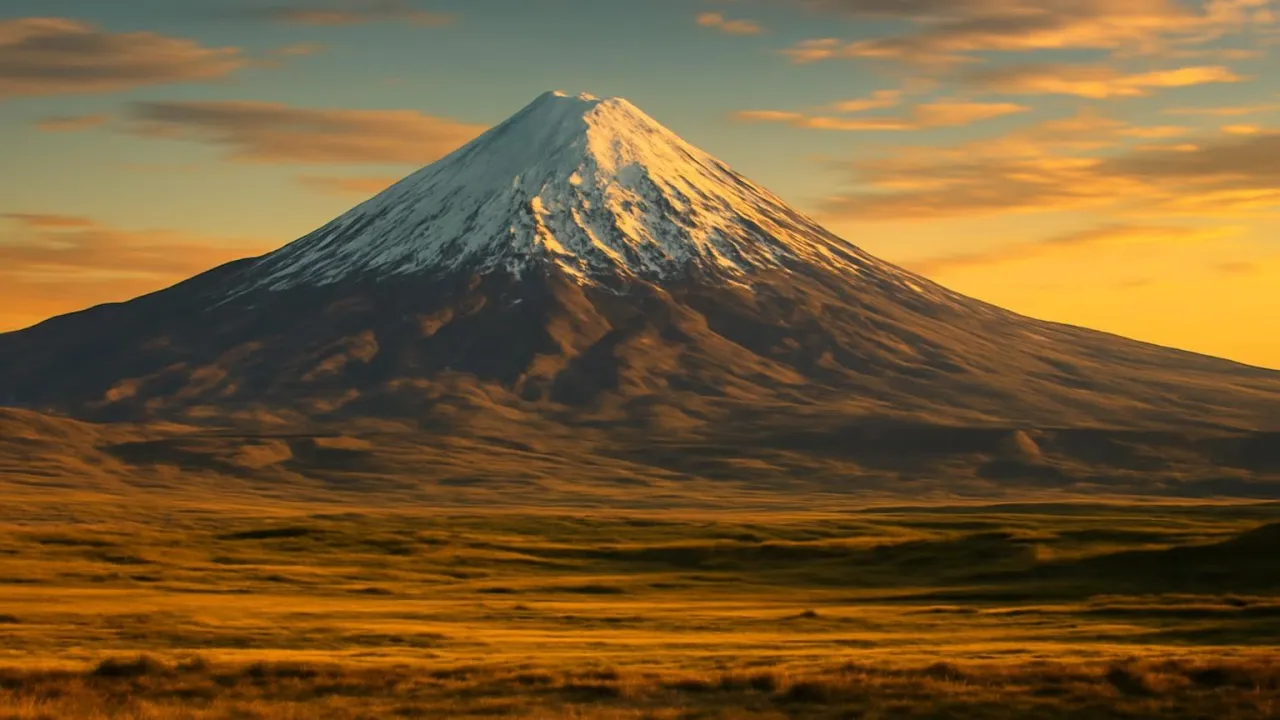
Mount Ararat’s snowy peak can be seen from over 60 miles away!
✨ Word Sparks (Grade 2 Glossary)
Tap 🔊 to hear
slope
A side of a hill or mountain
sacred
Very special and important
summit
The very top of a mountain
🪝
Have you ever seen a mountain so big it touches the clouds?
1
The Giant Near the Sky
Mount Ararat rises higher than most mountains in Turkey. Its snowy top shines bright in the sunlight, and people can spot it from many miles away. The mountain is so tall, it often looks like it is touching the clouds.
2
Stories and Adventures
Many old stories say a famous boat landed on Mount Ararat. People from Turkey and Armenia both think the mountain is special, and some even call it a place. Adventurous climbers travel far to hike its rocky paths and icy .
3
Climbing to the Summit
Climbers must wear warm clothes and strong boots to reach the top. The wind is cold and the air gets thin as they climb higher. From the , they see fields and villages far below. The view makes all the hard work worth it.
Mount Ararat’s summit is so high, climbers need to adjust to the thin air!
✨ Word Sparks (Grade 3 Glossary)
Tap 🔊 to hear
stratovolcano
A tall, layered volcano
erosion
Wearing away of rocks by wind or water
altitude
How high something is above sea level
🪝
Can you imagine standing on a mountain where ancient legends and icy winds meet?
1
A Towering Volcanic Giant
Mount Ararat is the tallest mountain in Turkey, reaching a summit of 16,854 feet. It is a dormant , which means it was formed by layers of lava and ash long ago. The mountain’s snowcap stays frozen all year, sparkling brightly in the sun. Its two peaks, called Greater Ararat and Little Ararat, rise above wide green valleys.
2
A Place of Myths and Meaning
Many cultures share legends about Mount Ararat, including the famous story of Noah’s Ark. People from Armenia and Turkey both consider it a symbol of hope and history. The mountain is sacred to Armenians, appearing in their art and stories for centuries. Visitors come to see its beauty and feel its importance.
3
Climbing the Snowy Slopes
Climbing Mount Ararat is a challenge because of its steep slopes and icy winds. Adventurers need special gear to handle the cold temperatures and thin air at high . As they climb, they see rocks shaped by and patches of wildflowers. From the summit, the view stretches across countries and distant mountains.
4
Nature and Science on the Peak
Scientists study Mount Ararat to learn about volcanoes and glaciers. They measure vibrations in the ground to watch for volcanic activity. The mountain’s snow and ice help provide water to nearby villages. Its unique shape and height make it important for both nature and people.
Mount Ararat’s summit is so cold, temperatures can drop below -20°F even in summer!
✨ Word Sparks (Grade 4 Glossary)
Tap 🔊 to hear
seismic
Related to movements or vibrations in the ground
glacier
A large, slow-moving mass of ice
pilgrimage
A special journey to a meaningful place
🪝
What secrets might you discover atop a mountain that’s inspired legends for thousands of years?
1
The Mighty Stratovolcano
Mount Ararat, rising to 16,854 feet, is a dormant stratovolcano made from countless eruptions over 1.5 million years. Its two peaks, Greater Ararat and Little Ararat, dominate the landscape between Turkey and Armenia, with the main summit often shrouded in snow and clouds. The mountain’s volcanic layers are visible in rocky outcrops and steep slopes, showing how eruptions built it up over time. Today, Ararat’s snowcap remains year-round, reflecting sunlight and creating a brilliant white crown.
2
Legends and Cultural Importance
Mount Ararat is famous for its connection to the legend of Noah’s Ark, which many cultures believe came to rest here after a great flood. The mountain is a powerful symbol for Armenians, appearing on their national emblem and in countless works of art and literature. For centuries, it has been a site of and inspiration, with people traveling from far and wide to witness its majesty. Its location near the borders of Turkey, Armenia, and Iran gives it deep historical and cultural significance.
3
Challenges of Climbing Ararat
Climbing Mount Ararat requires careful preparation due to its high altitude, steep volcanic slopes, and unpredictable weather. Climbers must acclimate to thin air and freezing temperatures, especially near the summit where winds can be fierce. The journey up passes through green meadows, rocky scree, and icy , offering a mix of natural beauty and physical challenge. Only experienced climbers with proper gear and guides are allowed to attempt the ascent.
4
Science and Nature at the Summit
Scientists study Mount Ararat’s geology to understand how stratovolcanoes form and change over time. They monitor vibrations to detect any signs of volcanic activity, even though Ararat has not erupted in modern history. The mountain’s are crucial for local water supplies, and its unique alpine habitats support rare plants and animals. By exploring Ararat, researchers learn more about Earth’s natural forces and the importance of preserving such landmarks.
1. Why is Mount Ararat important to both scientists and many cultures?
2. What makes climbing Mount Ararat difficult?
🤯 Mind-Blowing Fact • Grade 5
Mount Ararat’s glaciers are shrinking due to climate change, revealing ancient volcanic rock and new scientific clues.
✨ Word Sparks (Grade 5 Glossary)
Tap 🔊 to hear
glaciology
The study of glaciers and ice
seismograph
A tool that measures ground vibrations
ecosystem
A community of living things and their environment
🪝
What would it feel like to explore a colossal mountain where science, history, and legend all converge?
1
A Geological Marvel: The Stratovolcano’s Story
Mount Ararat stands as the highest peak in Turkey, with its snow-capped summit soaring to 16,854 feet (5,137 meters) above sea level. Classified as a dormant stratovolcano, Ararat was shaped by repeated eruptions and the accumulation of lava, ash, and volcanic rock over approximately 1.5 million years. Its two distinct volcanic cones, Greater Ararat and Little Ararat, are separated by a saddle-shaped pass called Serdarbulak. The mountain’s immense base covers more than 400 square miles, making it a dominant feature of the Eastern Anatolian landscape.
2
Legends, Literature, and National Identity
Mount Ararat holds a central place in the mythology of several cultures, most famously as the legendary resting place of Noah’s Ark after the biblical flood. For Armenians, Ararat is a cherished national symbol, depicted on their coat of arms and celebrated in poetry, music, and art for centuries. The mountain’s presence has inspired explorers, writers, and religious pilgrims from around the world. Its location at the crossroads of Turkey, Armenia, and Iran has made it a powerful symbol of both unity and division throughout history.
3
Climbing the Peak: Physical and Environmental Challenges
Reaching Mount Ararat’s summit is a formidable challenge even for experienced mountaineers. Climbers must acclimatize to high altitudes, where oxygen levels drop and temperatures can plunge below -20°F (-29°C) even during summer months. The ascent involves traversing steep volcanic scree, glacial ice fields, and unpredictable weather conditions, including sudden storms and fierce winds. Permits and local guides are required, and climbers must be prepared for rapid changes in both terrain and climate as they ascend.
4
Scientific Research and Natural Resources
Mount Ararat is a valuable site for scientific study, offering insights into volcanic processes, , and seismic activity. Researchers use to monitor ground vibrations, searching for any signs of renewed volcanic movement. The mountain’s glaciers serve as a crucial water source for nearby communities, while its slopes host unique alpine with rare plant and animal species. By studying Ararat, scientists can better understand the dynamics of stratovolcanoes and the impact of climate change on high-altitude environments.
5
A Landmark of Global Significance
Beyond its scientific and cultural importance, Mount Ararat serves as a symbol of endurance, resilience, and hope for people across the region. Its silhouette dominates the horizon, visible from over 60 miles away, and continues to inspire artists, adventurers, and scientists alike. International efforts to preserve Ararat’s natural habitats and promote peaceful cooperation reflect the mountain’s role as a bridge between nations. Whether viewed as a geological wonder, a sacred site, or a challenge to conquer, Mount Ararat remains one of the world’s most awe-inspiring landmarks.