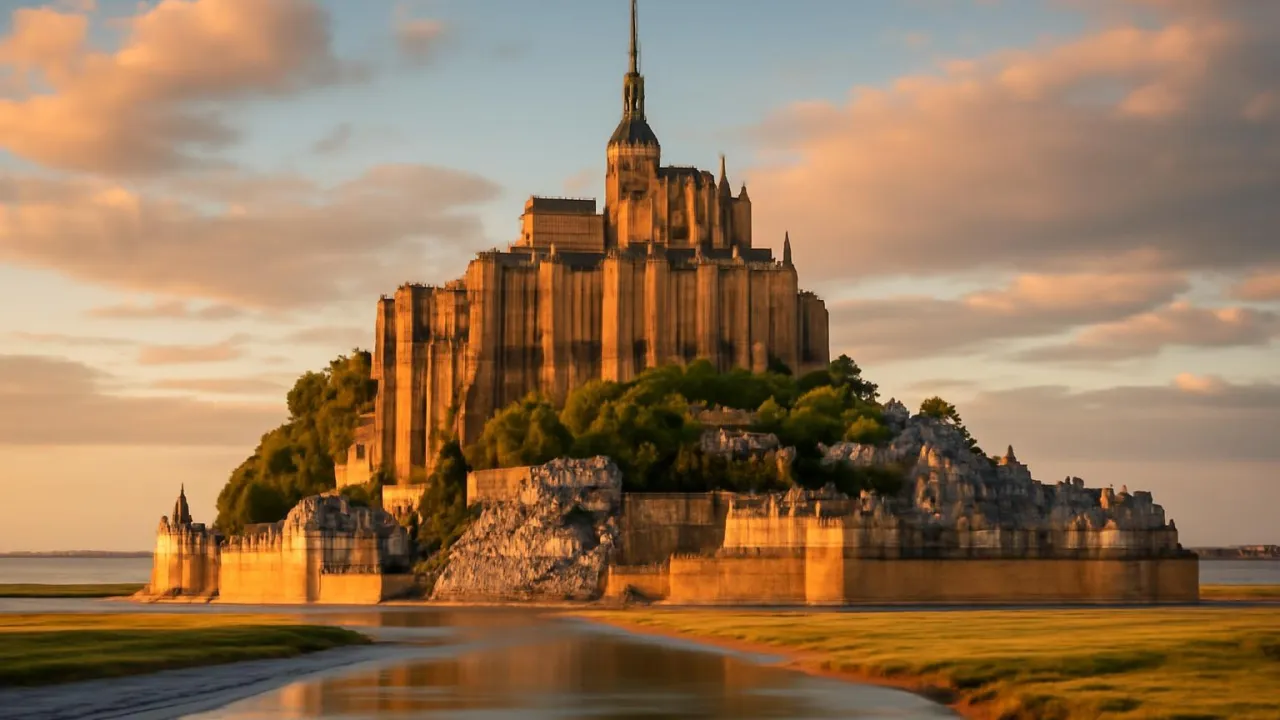
When the tide is high, Mont-Saint-Michel becomes a real island surrounded by water!
✨ Word Sparks (Grade 2 Glossary)
Tap 🔊 to hear
tide
Water moving in and out each day
rocky
Covered with lots of rocks
view
What you see from a high place
🪝
Can you imagine walking to an island, then seeing it float?
1
The Magic of Tides
Mont-Saint-Michel sits on a island in the sea. When the comes in, water covers the sand. When the tide goes out, you can walk across the sand to reach it.
2
A Castle and an Abbey
This place has tall stone walls and a grand abbey on top. People climb many steps to see the beautiful . The abbey looks like a castle from fairy tales.
3
A Place for Visitors
Many people visit Mont-Saint-Michel every year to explore its history. They walk the winding streets and look at the sea. The island is full of stories from long ago.
2. What do people like to do at Mont-Saint-Michel?
🤯 Mind-Blowing Fact • Grade 3
The tides at Mont-Saint-Michel can rise up to 46 feet (14 meters) in just a few hours!
✨ Word Sparks (Grade 3 Glossary)
Tap 🔊 to hear
tide
Water that rises and falls each day
abbey
A large church where monks lived
arch
A curved shape that holds up weight
🪝
What would it feel like to stand on an island that disappears under water?
1
An Island That Changes
Mont-Saint-Michel sits on a rocky island where the sea moves in and out. When the rises, water surrounds the island and covers the sand. At low tide, the water pulls back and people can walk across the exposed ground. This tidal movement happens twice each day.
2
A Medieval Wonder
The was built in the Middle Ages using strong granite stones. Its tall spires and thick walls were designed to last through storms and centuries. Builders used to support the heavy roofs and to make the structure stable. Today, Mont-Saint-Michel is a famous monument admired for its unique architecture.
3
How the Tides Work
The at Mont-Saint-Michel are some of the highest in Europe. They are caused by the pull of the moon on the ocean. When the moon’s gravity is strong, the water rises quickly and surrounds the island. These fast tides can move as quickly as a galloping horse.
4
A Place Full of Life
Visitors come from all over the world to see Mont-Saint-Michel. They walk up winding streets and climb hundreds of steps to reach the . From the top, you can see the sea and the land for miles around. The island is home to stories, legends, and beautiful views.
1. What makes the tides at Mont-Saint-Michel so fast?
2. Why did builders use arches in the abbey?
🤯 Mind-Blowing Fact • Grade 4
Mont-Saint-Michel’s tides can move faster than a person can walk—sometimes as quickly as 200 feet per minute!
✨ Word Sparks (Grade 4 Glossary)
Tap 🔊 to hear
erosion
Wearing away of land by water or wind
buttress
A support that keeps walls strong
gravitational pull
The force that attracts things together
🪝
Imagine hearing the rush of water as an entire island becomes surrounded by the sea—how does it happen?
1
A Marvel of Nature and Architecture
Mont-Saint-Michel rises dramatically from the tidal flats of Normandy, France, where the sea rushes in and out each day. The island’s granite base supports a medieval abbey, which was constructed over hundreds of years beginning in the eighth century. Its pointed spires and stout walls were engineered to withstand fierce storms and the constant battering of saltwater. The entire structure appears to float when the tides are at their highest.
2
The Science Behind the Tides
The tides at Mont-Saint-Michel are among the most powerful in Europe, changing the landscape several times daily. These tides are caused by the of the moon and the sun on Earth’s oceans. The difference between high and low tide can reach up to 46 feet, exposing vast sandbanks or turning the island into a fortress surrounded by water. This rapid tidal movement has shaped the island’s history and the way people visit it.
3
Engineering for Survival
Medieval builders used arches, , and thick granite walls to make the abbey strong and stable. The abbey’s design includes narrow stairways and winding streets, which helped defend against invaders and channel rainwater away. Over centuries, from wind and water threatened the island, so modern engineers built causeways and barriers to protect it. Today, Mont-Saint-Michel stands as a monument to both natural forces and human ingenuity.
4
A Cultural and Historical Icon
Mont-Saint-Michel has inspired artists, writers, and pilgrims for over a thousand years. It has been a place of worship, a fortress, and a symbol of resilience for the people of France. Each year, millions of visitors climb its steps to experience breathtaking views and learn about its legends. As a UNESCO World Heritage site, Mont-Saint-Michel is protected for future generations to explore and enjoy.
1. Why did engineers build causeways and barriers around Mont-Saint-Michel?
2. What makes Mont-Saint-Michel a UNESCO World Heritage site?
🤯 Mind-Blowing Fact • Grade 5
During the highest spring tides, Mont-Saint-Michel becomes completely surrounded by water for several hours, isolating it from the mainland.
✨ Word Sparks (Grade 5 Glossary)
Tap 🔊 to hear
flying buttress
An arch-shaped support outside a wall
tidal variation
Difference between high and low tide levels
hydraulic dam
A barrier that controls water using machines
🪝
What if you could watch an entire medieval island fortress vanish beneath the sea and reappear within hours—how would you engineer such a marvel?
1
A Tidal Fortress Through the Ages
Mont-Saint-Michel stands as a testament to the interplay between nature and human ingenuity, rising from the tidal flats of Normandy since the early medieval period. Construction began in the eighth century, with the abbey evolving through Romanesque and Gothic styles over several centuries. The island’s unique geography and the daily rhythm of the tides have shaped its architecture, defensive strategies, and cultural significance throughout history. Today, Mont-Saint-Michel is recognized as one of the most iconic and visited landmarks in France.
2
The Mechanics of Extreme Tides
The bay surrounding Mont-Saint-Michel experiences some of the world’s highest , with differences reaching up to 46 feet (14 meters) between high and low tide. These dramatic tides are caused by the gravitational forces exerted by both the moon and the sun, amplified by the funnel shape of the bay which accelerates the incoming water. During spring tides, the sea can advance across the flats at speeds of up to 200 feet per minute, temporarily transforming the island into a true fortress surrounded by water.
3
Medieval Engineering and Modern Protection
The abbey’s robust construction includes , ribbed vaults, and pointed arches, all designed to distribute weight and resist the erosive forces of wind and water. Medieval builders selected granite quarried from nearby islands for its durability and resistance to salt. Over centuries, erosion and silting threatened the island’s isolation, prompting modern engineers to construct a and a raised causeway, restoring the natural tidal flow and preserving Mont-Saint-Michel’s insular character.
4
Cultural Legacy and Global Recognition
Mont-Saint-Michel has served as a pilgrimage site, a military stronghold, and a symbol of resilience for the French people. Its silhouette inspired countless artists and writers, while its abbey hosted generations of monks and visitors seeking spiritual inspiration. Designated a UNESCO World Heritage site in 1979, Mont-Saint-Michel is now protected as a cultural treasure, drawing over three million visitors annually from around the world.
5
A Living Laboratory of Nature and History
Today, Mont-Saint-Michel remains a dynamic environment where natural forces and human intervention continue to interact. Scientists study the bay’s tidal patterns, erosion rates, and unique ecosystems, while historians and architects work to preserve the abbey’s intricate structures. The ongoing restoration efforts and environmental monitoring ensure that Mont-Saint-Michel will endure as both a scientific wonder and a historical monument for generations to come.