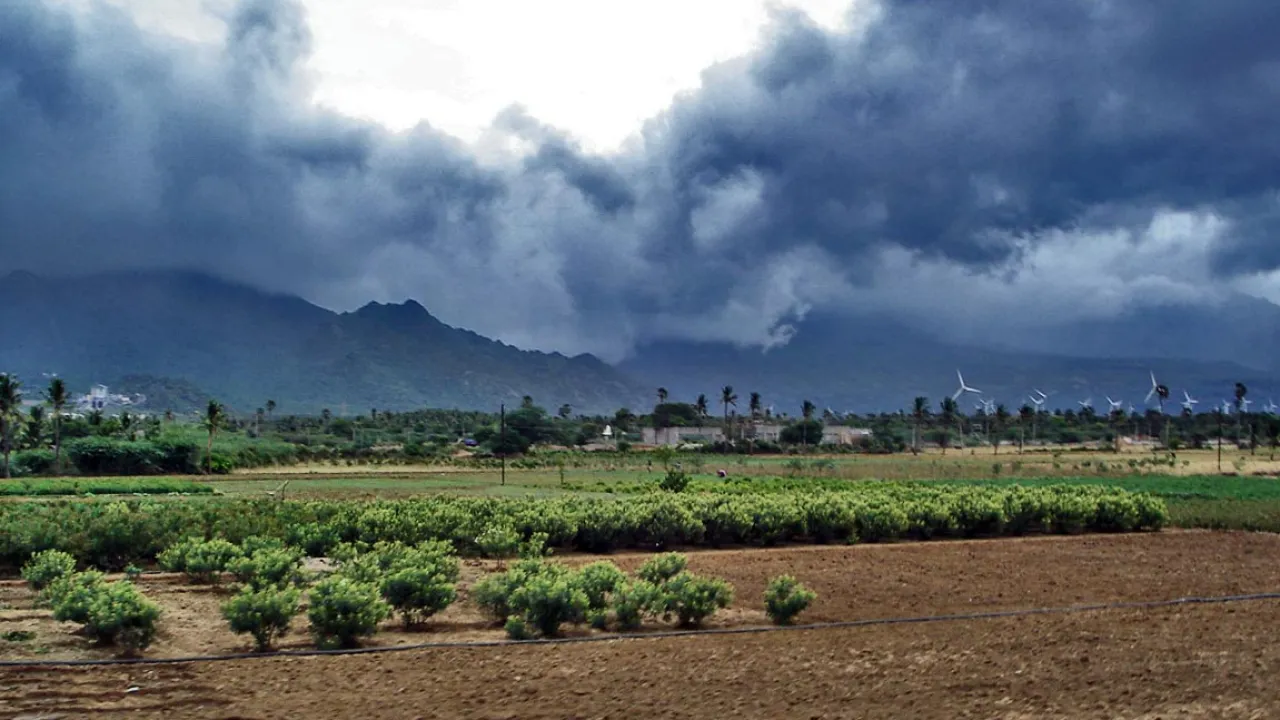
1. What does the word 'monsoon' truly describe in weather science?
2. How do summer monsoon rains help millions of families in Asia?
🤯 Mind-Blowing Fact • Grade 2
Ancient spice merchants waited months in harbor so they could sail across the Indian Ocean with winter monsoon winds and sail home on summer winds!
✨ Word Sparks (Grade 2 Glossary)
Tap 🔊 to hear
continent
One of Earth's giant main landmasses
reverse
Turn around and go the opposite way
inland
From the sea toward the middle of land
🪝
Why does land heat up so much faster than ocean water to start a monsoon?
1
Like a Giant Sea Breeze
Think about walking barefoot at the beach in July: dry sand feels hot while ocean waves stay cool! Whole and oceans act the exact same way, creating giant seasonal winds called monsoons.
2
Summer Inflow, Winter Outflow
During summer, hot air over sun-baked land rises high into the sky. Moist, cooler air from the Indian Ocean rushes to take its place, dumping heavy soaking rains. Come winter, the land cools faster than the sea, so dry winds blow back out toward the ocean.
3
Monsoons in America Too
Asia has Earth's largest monsoon, yet North America has one too! Every July and August, shifting winds bring dramatic afternoon thunderstorms to deserts in Arizona and New Mexico.
1. Which way do summer monsoon winds blow to bring heavy rainfall?
2. Which part of the United States experiences its own summer monsoon thunderstorms?
🤯 Mind-Blowing Fact • Grade 3
Nearly eighty percent of India's entire yearly rainfall arrives during just four summer monsoon months between June and September!
✨ Word Sparks (Grade 3 Glossary)
Tap 🔊 to hear
reservoir
Large lake built to store fresh water
torrential
Pouring down very fast and heavily
parched
Baked super dry from heat and sun
🪝
How did Arab sailors give monsoons their name—and how do mountains squeeze even more rain from them?
1
Named by Ocean Navigators
Centuries ago, sailors crossing the Arabian Sea noticed that steady winds blew from the northeast all winter and flipped to blow from the southwest every summer. They called this dependable pattern mawsim, the Arabic word for season, which became our English word monsoon.
2
Specific Heat and Air Pressure
Water warms up and cools down much more slowly than rock and soil. In May and June, intense sunshine bakes India and southern Asia, forming a broad region of low air pressure. Higher air pressure over the cooler Indian Ocean pushes moisture-packed air straight onto the continent.
3
The Himalayan Wall
When those humid winds strike the towering Himalaya Mountains and India's Western Ghats, the air is forced sharply upward. Rising air cools, condenses into dark cumulonimbus clouds, and unleashes downpours that turn brown fields emerald green.
4
Balancing Too Much and Too Little
Over a billion people depend on monsoon rivers and for drinking water and hydroelectricity, though forecasters watch closely to warn villages when extreme rains threaten river floods.
1. Why does low air pressure form over Asia in early summer before the wet monsoon starts?
2. What happens when humid monsoon winds slam into the tall Himalaya Mountains?
🤯 Mind-Blowing Fact • Grade 4
Australia's summer monsoon happens in December, January, and February because seasons in the Southern Hemisphere are flipped opposite to ours!
✨ Word Sparks (Grade 4 Glossary)
Tap 🔊 to hear
plateau
Wide, flat highland raised above surrounding land
migrate
Shift position gradually from season to season
radiate
Send out heat energy into surrounding air
🪝
How do shifting solar belts, the Tibetan Plateau, and ocean moisture power Earth's mightiest seasonal engine?
1
Thermal Contrast Between Land and Sea
Hold a cup of soil beside a cup of water under a bright lamp: the soil heats rapidly because sunlight warms only its thin top layer, while water mixes heat deeply and warms slowly. Across Earth, that difference in heat capacity drives monsoons. As the overhead sun north of the equator in spring, vast landmasses across Asia, West Africa, and the North American Southwest heat up intensely, lowering surface barometric pressure compared with nearby oceans.
2
The Tibetan Plateau Super-Heater
South Asia experiences Earth's most dramatic monsoon partly because the Tibetan sits nearly three miles above sea level. Acting like an elevated stove in the middle troposphere, the sun-warmed plateau strengthens rising air currents and pulls the tropical rain belt—the Intertropical Convergence Zone—far northward across India, Bangladesh, and Southeast Asia from June through September.
3
Winter Reversal
By November, shorter days let continental interiors heat into space and chill rapidly. Dense, high-pressure air builds over Siberia and Mongolia, sending crisp, dry northeast monsoon winds sweeping back across India toward the warmer Indian Ocean—except along southeastern India and Sri Lanka, where those winds pick up Bay of Bengal moisture.
4
Global Monsoon Regions
Climatologists also track vital monsoons across West Africa's Sahel, northern Australia's 'Wet' from December to March, and the North American Monsoon watering desert ecosystems from Mexico to Arizona.
1. How does the high Tibetan Plateau boost the strength of South Asia's summer monsoon?
2. Why are winter monsoon winds across most of India dry instead of rainy?
🤯 Mind-Blowing Fact • Grade 5
In 1686, astronomer Edmond Halley published the world's first meteorological map—charting trade winds and Indian Ocean monsoons to explain how solar heating drives global breezes!
✨ Word Sparks (Grade 5 Glossary)
Tap 🔊 to hear
orographic
Caused by air rising over mountain slopes
oscillation
Regular back-and-forth swing between two states
boreal
Relating to the Northern Hemisphere's seasons
🪝
How does latent heat released inside condensing clouds turbocharge global monsoon winds across entire hemispheres?
1
Beyond a Simple Land-Sea Breeze
Early meteorologists, beginning with Edmond Halley in 1686, explained monsoons purely as giant land-sea breezes driven by differential specific heat capacities—water requires roughly four times more thermal energy per kilogram than dry rock to warm by 1 degree Celsius. Modern atmospheric dynamics adds two crucial planetary drivers: the seasonal migration of the Intertropical Convergence Zone (ITCZ) following peak solar zenith angle, and a powerful positive feedback loop fueled by latent heat release inside deep convective clouds.
2
Cross-Equatorial Jets and Coriolis Turning
During summer, intense heating over northern India and the 4,500-meter Tibetan Plateau draws Southern Hemisphere southeast trade winds northward across the equator. Once those winds cross into the Northern Hemisphere, the Coriolis effect deflects them rightward into the fierce Findlater (Somali) low-level jet, screaming northeastward across the Arabian Sea at speeds topping 50 knots while evaporating immense quantities of ocean water.
3
The Latent-Heat Engine and Orographic Lift
When moisture-laden air ascends the Western Ghats and the Himalayan foothills—recording annual rainfall above 11,800 millimeters at Mawsynram, India—condensing water vapor releases vast latent heat high in the troposphere. That upper-level warming lowers surface pressure even further, pulling in still more marine air until autumn cooling shuts the engine down.
4
Active and Break Cycles
Monsoon rainfall does not fall uniformly every afternoon; intraseasonal pause downpours during 'break' weeks and intensify them during 'active' surges, linked to global patterns like El Niño and the Indian Ocean Dipole.
5
Sustaining Half of Humanity
Over sixty percent of the world's population lives within Asian, African, and American monsoon zones, making satellite soil-moisture tracking and ensemble monsoon forecasting cornerstones of global food security and flood preparedness.