💎 EARTH SCIENCE
🪨 Localized Boundary-Layer Microscale Climate Zone
VA Science SOL 1.6, 2.6, 3.7, 4.4, 4.7, 5.8 (Weather, Rocks, Oceans & Earth Systems)
Microclimates
Tiny Pockets of Weather Right Next Door
Grade 5 • Advanced • 245 words
🌍 Earth Science TypeMicroclimatology & Ecology
🌋 Where It FormsSurface Air Layer From Inches Wide to Several Miles Across
💎 Key PropertiesShaped by Shade, Slope Angle, Water, Soil, and Wind Shelter
⚡ Planet Earth SparkCreates totally different temperatures, winds, and moisture levels just steps apart in a yard, valley, or coastline
🤯 Mind-Blowing Fact • Grade 1
Snow on the shady north side of a house can last days longer than snow on the sunny south side!
✨ Word Sparks (Grade 1 Glossary)
Tap 🔊 to hear
micro
Very small in size or area
pocket
A small, separate area or spot
bask
Rest warmly in bright sunshine
🪝
Why does stepping under a big shady oak tree feel ten degrees cooler right away?
1
Weather in Tiny Spots
Step off a hot sunny sidewalk onto cool green grass under a tree! Even in the same yard, those two spots feel very different. Each small weather is a microclimate!
2
Sun, Shade, and Water
Sunny brick walls hold heat and stay warm after sunset. Shady creek banks stay damp, breezy, and cool.
3
Cozy Homes for Critters
Frogs hide under wet logs while lizards on warm rocks. Tiny microclimates help plants and animals find their favorite spot!
2. Why might snow melt faster on one side of your school than the other?
🤯 Mind-Blowing Fact • Grade 2
In San Francisco, summer temperatures can jump more than twenty degrees Fahrenheit across just four miles from foggy Ocean Beach to sunny Mission Dolores!
✨ Word Sparks (Grade 2 Glossary)
Tap 🔊 to hear
orchard
Farm grove of fruit-bearing trees
sheltered
Protected from harsh wind or weather
delicate
Easily hurt by harsh heat or cold
🪝
How can San Francisco have chilly fog at the beach while neighborhoods three miles away enjoy warm sunshine?
1
Small Spaces, Big Differences
Imagine packing a winter jacket AND shorts for a two-mile walk! Along hilly coastlines like San Francisco Bay, cool ocean fog chills beaches while nearby hills bake in warm sunshine. Those side-by-side weather zones are microclimates.
2
Hills, Lakes, and Walls
Many local features build microclimates. Deep lakes keep shoreline milder in autumn, valley bottoms collect chilly night air, and stone garden walls block cold wind while radiating stored warmth.
3
Smart Gardening Tricks
Gardeners study their own backyard microclimates before planting seeds! Sun-loving tomatoes thrive beside warm south-facing fences, while ferns love cool, damp shade.
1. Where would a gardener plant sun-loving tomatoes to use a warm backyard microclimate?
2. How does a large lake create a milder autumn microclimate along its shore?
🤯 Mind-Blowing Fact • Grade 3
Sinkholes high in the Rocky Mountains—like Peter Sinks in Utah—pool dense cold air so deeply that temperatures inside can plunge forty degrees colder than ridges half a mile away!
✨ Word Sparks (Grade 3 Glossary)
Tap 🔊 to hear
aspect
Compass direction a hillside faces
dense
Packed closely together and heavier
refuge
Safe shelter from danger or harshness
🪝
Why do Virginia apple farmers plant fruit trees halfway up a hillside instead of on the flat valley floor?
1
Cold-Air Drainage in Valleys
Stand in a quiet mountain hollow right at sunrise on a clear April morning, and you may see white frost sparkling in the bottom pasture while hillside blossoms above stay frost-free! Because cold air is denser and heavier than warm air, chilly nighttime air slides downhill like invisible syrup and pools in low spots called frost pockets.
2
The Thermal Belt
Orchardists along Virginia's Blue Ridge Mountains know this microclimate secret well. Halfway up the slope sits a milder band called a thermal belt, where displaced warm air rests safely above the frosty valley bottom and below the windy, frigid mountain crest.
3
North Slopes vs. South Slopes
Compass direction—called slope —matters too! In the Northern Hemisphere, south-facing slopes tilt directly toward the sun, growing drier oak and pine woods, while shady north-facing slopes stay cooler and moister with lush moss and hemlocks.
4
Nature's Tiny Refuges
Even a rotting nurse log or desert canyon crack forms a microclimate just inches wide, shielding salamanders and seedlings from extreme weather.
1. Why does frost often form on a low valley floor while hillside apple blossoms stay unfrozen?
2. In North America, how does a south-facing mountain slope compare to a north-facing slope?
🤯 Mind-Blowing Fact • Grade 4
Beneath a winter blanket of snow called the subnivean zone, trapped ground heat keeps tiny mouse and shrew tunnels near a cozy 32 °F even when winds howling above plunge to minus 30 °F!
✨ Word Sparks (Grade 4 Glossary)
Tap 🔊 to hear
canopy
Overhead roof formed by treetop leaves
transpiration
Water vapor released from plant leaves
moderate
Keep from getting too hot or cold
🪝
How do Great Lakes waters, Blue Ridge hollows, and forest canopies sculpt microclimates across America?
1
Where Big Weather Meets Local Ground
Regional climate maps paint broad strokes across whole states, yet living creatures actually experience the lowest two meters of air touching soil, water, leaves, and stone. Climatologists define a microclimate as any local zone—from a ten-centimeter burrow under alpine snow to a ten-mile coastal strip—where temperature, humidity, wind speed, or evaporation consistently differs from surrounding averages.
2
Forest Canopies as Living Air Conditioners
Walk beneath a mature deciduous forest in Shenandoah National Park on a ninety-degree July afternoon, and thermometers instantly drop five to ten degrees! Overhead leaves intercept eighty to ninety-five percent of incoming solar radiation, block drying winds, and cool the air through —releasing invisible water vapor from millions of leaf pores. At night, that same leafy ceiling traps warmth so forest floors chill less sharply than open meadows.
3
Water Bodies and Fruit Belts
Along Lake Michigan, New York's Finger Lakes, and Virginia's Chesapeake Bayshore, high thermal capacity in deep water spring and autumn extremes. Cool spring breezes off the water delay fruit buds from opening until killer frosts pass, while mild autumn water stretches the frost-free growing season by weeks.
4
Designing Cooler Schoolyards
Landscape architects apply microclimate science by planting shade trees, installing light-colored roofs, and building rain gardens around playgrounds and cities.
1. How do tall forest trees cool the air underneath their canopy on hot summer afternoons?
2. Why do cool spring breezes off the Great Lakes actually HELP nearby cherry and apple orchards?
🤯 Mind-Blowing Fact • Grade 5
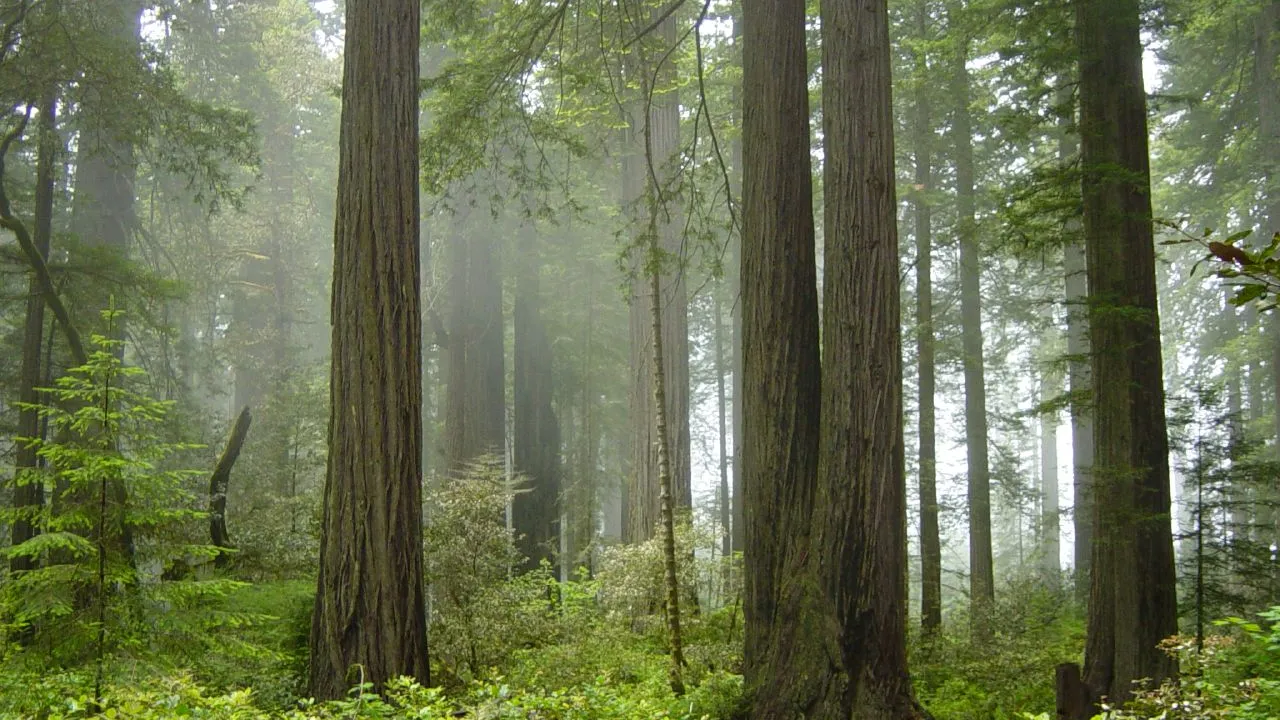
Towering California coast redwoods create and depend on a coastal fog microclimate—combing so much mist from summer ocean clouds with their needles that 'fog drip' waters the forest floor like gentle rain!
✨ Word Sparks (Grade 5 Glossary)
Tap 🔊 to hear
albedo
Fraction of sunlight a surface reflects
katabatic
Dense cold air flowing downhill by gravity
microrefugia
Tiny local habitats sheltering sensitive species
🪝
Why did German meteorologist Rudolf Geiger measure temperatures every few centimeters above soil to launch modern microclimatology?
1
The Surface Energy Balance Near the Ground
In his landmark 1927 treatise The Climate Near the Ground, meteorologist Rudolf Geiger demonstrated that atmospheric gradients are steepest within the lowest two meters above Earth's surface—well below standard weather-station thermometer shelters mounted at 1.5 to 2 meters height! Microclimates emerge from local variations in the surface energy budget: (reflectivity), soil thermal conductivity, moisture availability (dividing solar energy between sensible heating and latent evaporative cooling), aerodynamic roughness, and topographic sky-view factor.
2
Katabatic Drainage and Cold-Air Pools
On cloudless, windless nights, ground surfaces radiate longwave infrared energy directly to space and cool rapidly. Dense chilled air flows downslope as drainage winds and accumulates in enclosed karst sinkholes and mountain basins. At Peter Sinks, Utah (elevation 2,480 meters), intense nocturnal inversions dropped temperatures to $-56.3\,^{\circ}\text{C}$ ($-69.3\,^{\circ}\text{F}$) in February 1985—more than $20\,^{\circ}\text{C}$ colder than open slopes just 150 meters higher!
3
Slope Insolation Geometry
At mid-latitudes such as $38^{\circ}\text{N}$ across Virginia or California, a $30^{\circ}$ south-facing slope intercepts nearly twice as much winter solar irradiance per square meter as a $30^{\circ}$ north-facing slope, creating stark contrasts in soil moisture, snowpack persistence, and plant communities across a single narrow canyon.
4
Climate Microrefugia for Biodiversity
Ecologists map cold spring-fed ravines, coastal fog belts—vital for California coast redwoods harvesting fog drip—and north-facing talus slopes as '' capable of sheltering cold-adapted species like Virginia's Peaks of Otter salamander during regional warming.
5
Precision Agriculture and Sensor Networks
Today, vineyards and farms deploy wireless IoT micro-weather stations and thermal drones to tailor irrigation and frost fans meter by meter across rolling terrain.