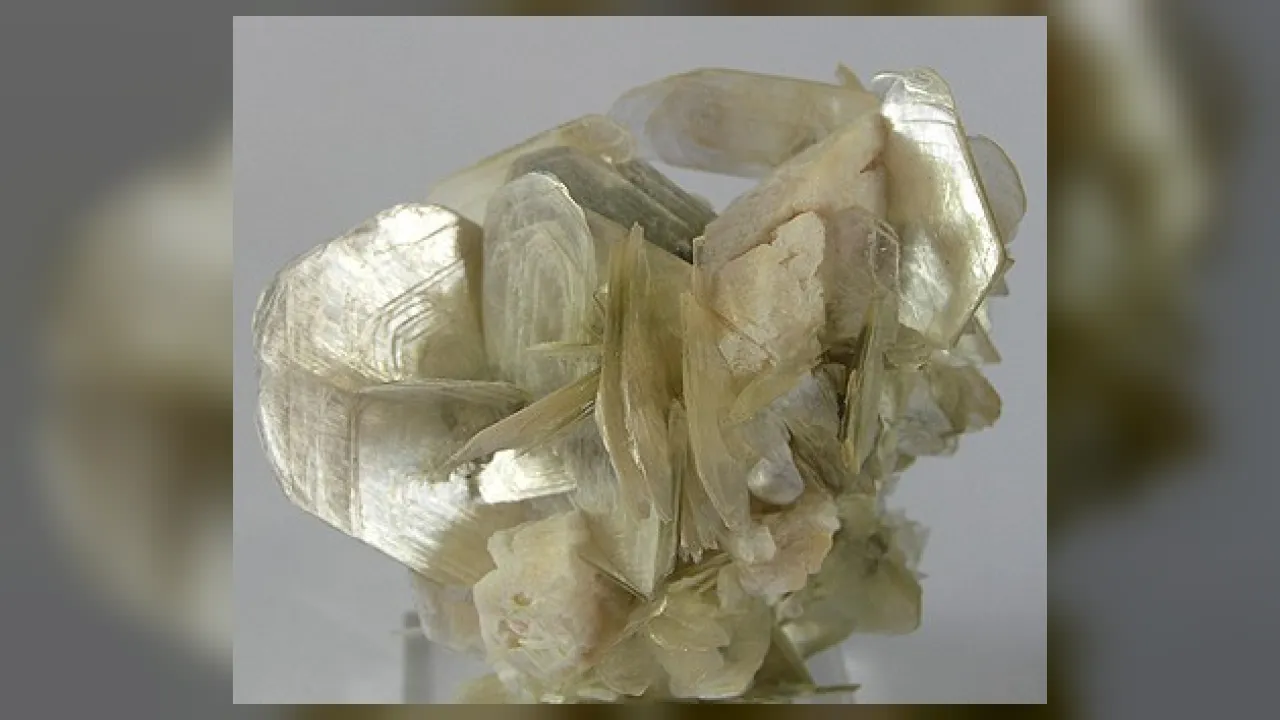
1. Why do geologists call thick stacks of mica crystals 'books'?
2. Why were clear mica sheets used as windows on old wood-burning stoves?
🤯 Mind-Blowing Fact • Grade 2
Long before modern glass factories existed, people in Russia cut large clear muscovite mica sheets to make frost-proof house windows—giving 'Muscovy glass' its name!
✨ Word Sparks (Grade 2 Glossary)
Tap 🔊 to hear
Muscovite
Light-colored or clear silvery sheet mica
Biotite
Dark black or brown iron-rich sheet mica
Elastic
Able to bend and spring back into shape
🪝
What makes a gray sidewalk rock glitter like silver confetti in the sunlight?
1
Bendy Crystal Sheets
Bend a paper-thin sheet of clear mica gently between your fingers, then let go—snap, it springs right back flat! Unlike brittle glass that shatters, thin mica sheets are surprisingly flexible and .
2
Light and Dark Twins
Two main kinds of mica sparkle inside everyday rocks. Silvery-clear mica is called , while dark brown or shiny black mica is called . Both peel along one super-smooth flat direction.
3
Natural Shimmer
Because mica resists electricity and high heat, it hides inside hair dryers and toasters to keep wires safe. Ground-up mica also puts safe natural sparkle into metallic paints, craft glitters, and shiny car finishes!
1. What happens when you gently bend a thin sheet of mica and let go?
2. What is the name for dark black or bronze-colored mica found in granite?
🤯 Mind-Blowing Fact • Grade 3
In Amelia County, Virginia, miners once uncovered single 'books' of muscovite mica larger than a classroom door and weighing hundreds of pounds!
✨ Word Sparks (Grade 3 Glossary)
Tap 🔊 to hear
Basal Cleavage
Splitting cleanly parallel to a crystal's flat base
Pegmatite
Igneous rock pocket holding extra-large mineral crystals
Insulator
Material that blocks heat or electric current
🪝
Why does mica split cleanly in one flat direction while refusing to crack cleanly from the sides?
1
One-Way Perfect Cleavage
Try peeling a crystal of muscovite with your fingernail, and wafer-thin sheets lift off smoother than polished mirrors! Geologists call this 'perfect .' Inside mica, silicon and oxygen atoms lock into tough flat sheets, while weaker potassium bonds sit between the layers like perforated tear lines.
2
Spotting Mica in Three Rock Types
Mica turns up across the rock cycle! In igneous granite and giant crystal pockets called , muscovite and biotite grow alongside quartz and feldspar. Under mountain-building pressure, tiny mica grains line up parallel to form glittering metamorphic schist. Later, rivers wash shiny mica flakes into sandy streambeds, where hikers sometimes mistake golden biotite flakes for real gold!
3
Fooling Gold Panners
Real gold is heavy and flattens under a pin, whereas golden weathered mica is super lightweight, floats in swirling creek pans, and flakes apart when poked.
4
Inside Your Toaster
Peek inside an unplugged kitchen toaster, and those glowing red heating wires are wrapped around stiff gray boards made of pressed mica! Mica blocks electricity from escaping while handling intense heat with ease.
1. How can a creek explorer tell shiny golden mica flakes apart from real gold?
2. Why are heating wires inside kitchen toasters mounted onto boards of mica?
🤯 Mind-Blowing Fact • Grade 4
The largest single muscovite mica crystal ever documented was unearthed at the Lacey Mine in Ontario, Canada—measuring 33 feet long, 14 feet wide, and weighing about 330 tons!
✨ Word Sparks (Grade 4 Glossary)
Tap 🔊 to hear
Foliation
Parallel mineral layers formed by metamorphic pressure
Schist
Glittering metamorphic rock packed with aligned mica
Pearlescent
Shimmering with shifting rainbow pearl-like colors
🪝
How do microscopic mica crystals record the exact direction mountains were squeezed millions of years ago?
1
Sheet Silicates Built Like Sandwiches
Hold a six-sided 'book' of muscovite mica up to a lamp, and you can read right through dozens of stacked crystal layers! Micas belong to the phyllosilicate (sheet silicate) family. Each tough atomic sheet pairs two silicon-aluminum-oxygen layers around a central aluminum or iron-magnesium core. Positively charged potassium ions sit between adjacent sheets like weak snaps—strong enough to make peeled sheets elastic and springy, yet weak enough along that horizontal plane to produce the most famous one-directional basal cleavage in geology.
2
Alignment Under Mountain Pressure
Across Virginia's Piedmont and Blue Ridge provinces, glittering outcrops of mica tell a dramatic story of colliding continents. When buried mudstones and shales experience intense heat and directed tectonic squeezing, clay minerals recrystallize into flat plates of muscovite and biotite. Because flat plates grow perpendicular to the squeezing force, billions of aligned mica flakes give metamorphic rocks a shimmering layered texture called .
3
Giant Pegmatite Crystals
The largest mica sheets on Earth crystallize inside granitic pegmatites—water-rich magma pockets that cool slowly deep underground. Abundant hot water lets ions migrate rapidly to growing crystal faces, building hexagonal mica books several meters wide.
4
Optics, Electronics, and Pearlescent Light
Beyond electrical insulation in high-voltage motors and hair dryers, industrial chemists coat microscopic mica platelets with ultra-thin titanium dioxide films. Light bouncing off both the coating and the mica core creates vivid interference colors that make automotive paints and weather-resistant coatings shimmer from blue to gold as cars drive past!
1. How do mica crystals create the shimmering layered foliation seen in metamorphic schist?
2. Why do mica crystals grow to gigantic sizes inside granitic pegmatites?
🤯 Mind-Blowing Fact • Grade 5
Because freshly peeled muscovite mica is literally flat to a single layer of atoms, biologists place tiny strands of human DNA onto mica sheets to photograph them with atomic force microscopes!
✨ Word Sparks (Grade 5 Glossary)
Tap 🔊 to hear
Geochronology
Measuring rock ages using radioactive element decay
Dielectric
Insulator withstanding strong electric fields without sparking
Laminae
Wafer-thin parallel layers inside a rock
🪝
How do geochronologists use radioactive potassium atoms locked inside biotite and muscovite mica as atomic stopwatches for Earth history?
1
T-O-T Layer Chemistry and Elastic Resilience
Cleave a sheet of muscovite—KAl2(AlSi3O10)(OH)2—with a scalpel blade, and you can split a surface atomically flat down to a single nanometer across square centimeters! Micas are 2:1 phyllosilicates in which one aluminum atom substitutes for every fourth silicon atom inside linked tetrahedral rings. That substitution leaves each T-O-T sheet with a net negative charge balanced by large interlayer potassium cations (K+). Unlike electrically neutral talc, which smears smoothly without springing back, mica's interlayer ionic bonds create stiff, elastic (Mohs 2.5–3) while concentrating all cleavage along the (001) basal plane.
2
Bowen's Reaction Series and Metamorphic Index Zones
Within cooling felsic magmas, iron- and magnesium-rich biotite crystallizes ahead of aluminum-rich muscovite along Bowen's Reaction Series. In regional metamorphic terrains, petrologists map 'biotite' and 'muscovite' isograds across mountain belts to measure ancient burial depths and temperatures, watching fine-grained illite clays coarsen progressively from slate to phyllite to coarse mica schist before breaking down into potassium feldspar in high-grade gneiss.
3
Potassium-Argon and Argon-Argon Geochronology
Because every mica crystal locks abundant potassium—including traces of naturally radioactive potassium-40—into its interlayer sites while rejecting noble argon gas when it forms, muscovite and biotite serve as premier radiometric clocks! As potassium-40 decays steadily into argon-40 with a half-life of 1.25 billion years, trapped argon accumulates inside the crystal once the rock cools below roughly 300°C–400°C, allowing geoscientists to date volcanic ash beds and mountain uplift events.
4
Dielectric Strength and Atomic Force Microscopy
Muscovite withstands electric fields exceeding 100 kilovolts per millimeter without arcing and remains thermally stable past 500°C, making it prized for aerospace capacitors, laser waveplates, and radiation detector windows. Meanwhile, nanotechnologists peel fresh muscovite substrates to hold individual DNA strands still under atomic force microscopes!
5
Synthetic Fluorphlogopite Innovation
To guarantee impurity-free performance and ethical sourcing for cosmetics, pearlescent pigments, and high-temperature electronics, materials scientists now crystallize synthetic mica (fluorphlogopite) in electric furnaces—substituting fluorine for hydroxyl groups to raise thermal stability past 1,000°C.