🇺🇸 U.S. HISTORY
🏛️ Ancestral Puebloan Archaeological Landmark • First U.S. Cultural National Park (1906)
VA History & Social Science SOL K.1, 1.2, 2.4, VS.1–VS.10, USI & USII
Mesa Verde Cliff Dwellings
Stone Villages Tucked Inside Canyon Cliffs
Grade 1 • Early Reader • 70 words
⏳ Era / StatehoodInhabited c. 550–1300 CE • Cliff Dwellings Built c. 1190–1280 CE
🗺️ Region / CapitalSouthwestern Colorado (Four Corners Region • Up to 8,500 ft)
📜 Key Milestone600 Sandstone Cliff Dwellings Including 150-Room Cliff Palace
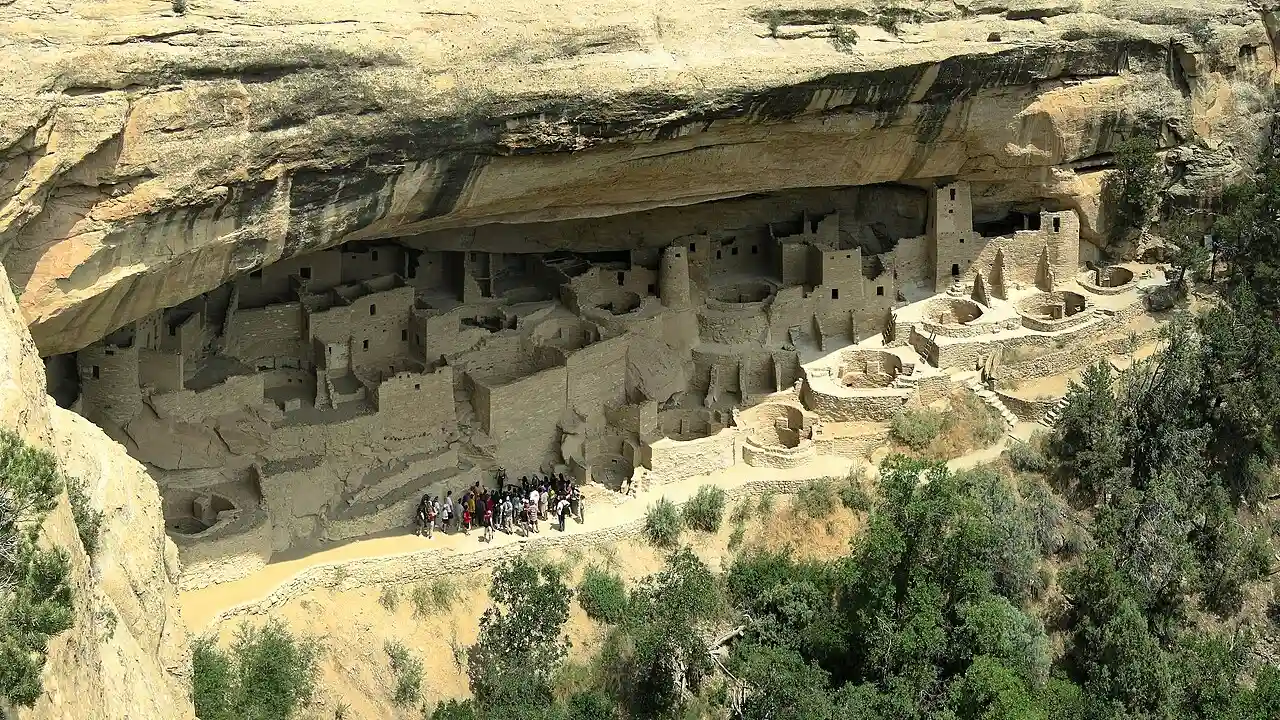
Cliff Palace at Mesa Verde has 150 stone rooms tucked beneath one giant curving sandstone overhang!
✨ Word Sparks (Grade 1 Glossary)
Tap 🔊 to hear
mesa
A high hill with a flat top
cliff
A tall, steep wall of solid rock
sandstone
Layered rock formed from pressed sand
🪝
What would it feel like to live inside a giant cave high on a canyon wall?
1
Homes in the Cliffs
Peer over the edge of a deep rocky canyon in Colorado! Eight hundred years ago, Ancestral Puebloan families built stone homes right inside giant caves.
2
Climbing Up High
Families shaped blocks and mud mortar by hand. They climbed wooden ladders and carved handholds to reach cornfields on the flat hilltop above!
3
Protected Forever
Palace is the biggest village there, with 150 rooms. Today, Verde National Park keeps these amazing stone homes safe.
1. In which U.S. state is Mesa Verde National Park located?
2. How did Ancestral Puebloan families climb from cliff homes up to their hilltop farms?
🤯 Mind-Blowing Fact • Grade 2
To enter Balcony House at Mesa Verde today, visitors still climb a thirty-two-foot wooden ladder and crawl through a twelve-foot stone tunnel!
✨ Word Sparks (Grade 2 Glossary)
Tap 🔊 to hear
alcove
A giant cave-like hollow in a cliff
mortar
Thick mud paste holding stone bricks together
plateau
High, flat land rising above nearby valleys
🪝
Why does Mesa Verde mean 'Green Table,' and why did builders move from the tabletop into canyon cliffs?
1
Living on the Green Table
Breathe in the crisp scent of juniper and pine high atop a flat in Colorado! Mesa Verde means 'Green Table' in Spanish because evergreen trees cover its flat top. For more than six hundred years, Ancestral Puebloan families lived and farmed corn, beans, and squash up on the mesa.
2
Moving Into Canyon Alcoves
Around the year 1190, families began building multi-story sandstone apartment villages inside huge canyon below the rim. Overhanging rock sheltered homes from winter snow and hot summer sun, while fresh spring water seeped through the porous sandstone walls.
3
A National Park Treasure
By 1300, families moved south to join Pueblo communities in New Mexico and Arizona, and in 1906 President Theodore Roosevelt created Mesa Verde National Park.
1. What does the Spanish name 'Mesa Verde' mean in English?
2. How did overhanging cliff alcoves help families who lived inside them?
🤯 Mind-Blowing Fact • Grade 3
Archaeologists can date the exact year a Mesa Verde room was built by counting the tree rings inside its ancient juniper and pine roof beams!
✨ Word Sparks (Grade 3 Glossary)
Tap 🔊 to hear
kiva
Round underground room for Pueblo ceremonies
megadrought
Severe dry period lasting twenty-plus years
descendant
Family member born in later generations
🪝
How did Ancestral Puebloan masons shape 600 cliff dwellings—and where did their descendants go after 1300 CE?
1
Seven Centuries of Changing Homes
Tap two river cobbles against a block of tan sandstone until it fits like a puzzle piece! Ancestral Puebloan people first settled Mesa Verde around 550 CE, building warm half-underground pit houses on the mesa top before constructing above-ground stone villages.
2
Masterpieces Beneath the Rim
Around 1190 CE, communities moved into natural sandstone alcoves along the canyon walls, building about six hundred cliff dwellings. Using stone hammers, wet soil mortar, and tiny chinking stones, masons raised towers up to four stories tall. Cliff Palace, the largest cliff dwelling in North America, held 150 rooms and twenty-three round underground chambers called .
3
What Happened Inside a Kiva?
Families gathered inside warm during cold winters to weave cotton cloth, repair tools, share ancestral stories, and hold sacred ceremonies.
4
Migration and Preservation
When a twenty-four-year struck between 1276 and 1299, families migrated south to the Rio Grande Valley, Hopi mesas, and Zuni homelands, where twenty-six Pueblo tribes thrive today. In 1906, Mesa Verde became the first U.S. national park established to preserve human cultural works.
1. What were the round underground rooms called where families held ceremonies and winter gatherings?
2. Did the people of Mesa Verde vanish, or did they move to new homes?
🤯 Mind-Blowing Fact • Grade 4
Some interior walls at Cliff Palace still preserve vibrant red, yellow, and white geometric murals painted by Ancestral Puebloan artists nearly eight hundred years ago!
✨ Word Sparks (Grade 4 Glossary)
Tap 🔊 to hear
porous
Having tiny spaces water can soak through
dendrochronology
Dating wooden beams by counting tree rings
conservationist
Person working to protect nature and landmarks
🪝
How do sandstone geology, passive solar design, and tree-ring science explain the engineering brilliance of Mesa Verde?
1
How Geology Built Natural Shelters
Look closely at the sheer canyon walls of southwestern Colorado's Four Corners region, rising 8,500 feet above sea level. Millions of years of water seeping through Cliff House Sandstone hit an impermeable layer of shale underneath, dissolving salt cements and flaking off rock slabs until curved, sunlit alcoves formed—complete with natural freshwater seep springs right at the back of the caves!
2
Passive Solar Architecture at Cliff Palace
Between 1190 and 1280 CE, Ancestral Puebloan architects turned about six hundred of these alcoves into vertical stone villages. In south- and southwest-facing alcoves like 150-room Cliff Palace and 150-room Long House, the high summer sun was blocked by the stone brow overhead, keeping rooms cool, while the low winter sun shone deep inside to warm the sandstone masonry like a giant heat battery.
3
Dry-Land Farming and the Great Drought
Above on the mesa top, farmers built stone check-dams and reservoirs to capture every drop of snowmelt and summer monsoon rain for maize, beans, squash, and domesticated turkeys. Tree-ring dating——shows a severe drought from 1276 to 1299 CE helped prompt an orderly migration south toward permanent rivers in New Mexico and Arizona.
4
Roosevelt and the Antiquities Act of 1906
Alarmed that treasure hunters were damaging ancient rooms, women led by Virginia McClurg campaigned alongside archaeologist Gustaf Nordenskiöld's findings until President Theodore Roosevelt signed both the Antiquities Act and the Mesa Verde National Park Act in June 1906.
1. How did south-facing sandstone alcoves act as natural solar climate control?
2. Which president signed the law establishing Mesa Verde National Park in June 1906?
🤯 Mind-Blowing Fact • Grade 5
Tree-ring scientists proved that the very last wooden construction beam ever cut for Cliff Palace was felled in the year 1273 CE—just three years before the Great Drought began!
✨ Word Sparks (Grade 5 Glossary)
Tap 🔊 to hear
impermeable
Solid rock layer water cannot pass through
microclimate
Local temperature and shelter in small area
Antiquities Act
1906 law protecting historic American landmarks
🪝
Why did Mesa Verde's communities build inside vertical canyon alcoves for less than a century after 600 years on the mesa top—and how did their protection reshape U.S. preservation law?
1
Seven Hundred Years on the Plateau
Stand at Sun Temple overlooking Fewkes Canyon in southwestern Colorado, where Cliff Palace gleams like a golden honeycomb inside a colossal alcove of Cretaceous sandstone. For more than seven centuries (c. 550–1300 CE), Ancestral Puebloan communities—historians and descendant tribes prefer this term over the older Navajo exonym 'Anasazi'—cultivated the 8,500-foot plateau. Early Basketmaker families built insulated pithouses and wove yucca sandals and watertight baskets before adopting pottery, the bow and arrow, and multi-story surface masonry pueblos.
2
Hydrogeology and Masonry in the Alcoves
Around 1190 CE, a dramatic architectural shift unfolded: families relocated from exposed mesa-top villages into roughly 600 canyon alcoves among Mesa Verde's nearly 5,000 documented archaeological sites. Formed where groundwater percolated through porous Cliff House Sandstone until hitting Menefee Shale, these alcoves provided sheltered , defensible ledges, and reliable seep springs. Masons pecked sandstone loaves to uniform shape, mortared joints with loess mud reinforced by chinking spalls, coated walls with polychrome plaster, and constructed Cliff Palace with 150 rooms, 23 kivas (symbolizing emergence from the ancestral underworld via a floor sipapu), and towers reaching four stories.
3
Dendrochronology and the Late-1200s Migration
Astronomer A. E. Douglass pioneered dendrochronology in the 1920s using Douglas-fir and juniper roof beams from sites across the Southwest, pinpointing the final tree-cutting date at Cliff Palace to 1273 CE and revealing the 'Great Drought' of 1276–1299 CE. Combined with depleted woodland soils and social reorganization, this climate shock prompted families to migrate purposefully southward to the Rio Grande watershed in New Mexico and to the Hopi Mesas and Zuni River in Arizona.
4
Birth of Cultural Preservation Law
After ranchers Richard Wetherill and Charlie Mason encountered Cliff Palace during a December 1888 snowstorm, unregulated looting threatened Southwest ruins. Civic reformer Virginia McClurg and Lucy Peabody rallied nationwide women's clubs, spurring Congress and President Theodore Roosevelt in June 1906 to pass both the —empowering presidents to proclaim national monuments—and the legislation establishing Mesa Verde as the first U.S. National Park dedicated to preserving cultural heritage.
5
Living Pueblo Connections
Inscribed as one of the earliest UNESCO World Heritage Sites in 1978, Mesa Verde collaborates closely today with twenty-six Consulting Pueblo and Southwestern tribes—including Hopi, Zuni, Acoma, Laguna, Taos, and Ysleta del Sur—honoring these stone dwellings as living ancestral homelands.