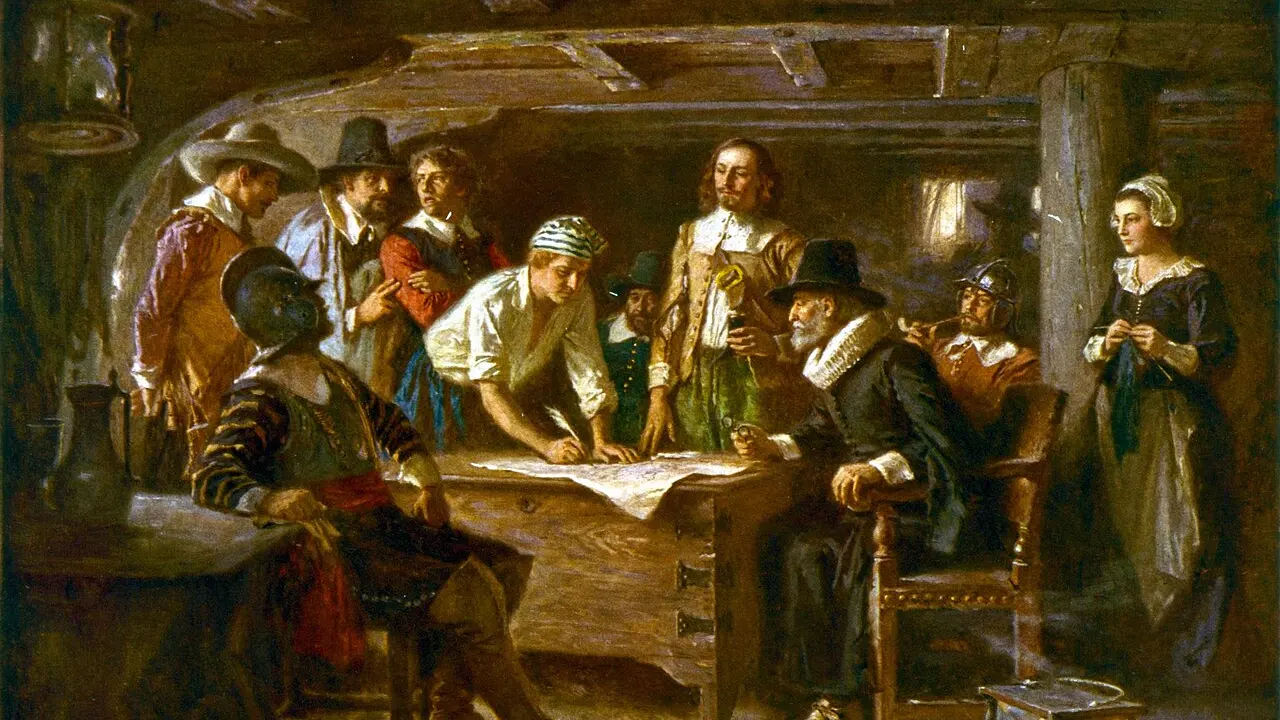
1. Where were the passengers when they signed the Mayflower Compact in 1620?
2. What did the signers promise to do in the Mayflower Compact?
🤯 Mind-Blowing Fact • Grade 2
Right after signing the Mayflower Compact, the colonists held an election and chose John Carver as Plymouth Colony's very first governor!
✨ Word Sparks (Grade 2 Glossary)
Tap 🔊 to hear
Pilgrims
Settlers who sailed for religious freedom in 1620
self-government
People making rules and choosing leaders themselves
common good
What helps and protects the whole community
🪝
Why did the Mayflower passengers write a rulebook before even stepping onto the beach?
1
Anchored Off Wintry Cape Cod
Imagine spending sixty-six stormy days tossed on the Atlantic Ocean inside a crowded wooden ship! In November 1620, the Mayflower finally dropped anchor near Cape Cod, Massachusetts, hundreds of miles north of the Virginia Colony where they had permission to settle.
2
Pilgrims and Strangers Unite
Some passengers were seeking religious freedom, while others were tradesmen hoping for new jobs. Because their royal Virginia permit did not cover Massachusetts, a few passengers claimed nobody could tell them what to do ashore.
3
Signing for the Common Good
To prevent trouble, forty-one men signed the Mayflower Compact on November 11, 1620, promising to choose leaders and obey fair, equal laws together.
1. Which colony had the Mayflower originally received permission to sail toward?
2. Why was signing the Mayflower Compact so important before landing?
🤯 Mind-Blowing Fact • Grade 3
Although the original parchment of the Mayflower Compact was lost centuries ago, Governor William Bradford copied every single word into his handwritten history book, Of Plymouth Plantation!
✨ Word Sparks (Grade 3 Glossary)
Tap 🔊 to hear
patent
Official government document granting land or rights
covenant
Solemn agreement binding people to shared duties
consent
Willing agreement given freely by the people
🪝
How did a navigation detour away from Virginia accidentally create one of America's earliest democratic documents?
1
Storms Push the Mayflower North
Cold November spray froze on the rigging as the 102 passengers aboard the Mayflower peered across Provincetown Harbor at the tip of Cape Cod in 1620. Their royal granted land in the northern territory of the Virginia Colony near the Hudson River, yet treacherous currents blocked their path south.
2
Two Groups on One Crowded Deck
About half the passengers were English Separatists—today called Pilgrims—seeking freedom to worship in their own way. The other half, whom the Pilgrims called 'Strangers,' were merchants, craftsmen, and hired hands like soldier Myles Standish and cooper John Alden.
3
Quill Pens in the Great Cabin
When several Strangers argued that landing outside Virginia meant English law no longer bound them, Pilgrim elders drafted a short . On November 11, 1620, forty-one adult male passengers gathered in the ship's cabin to sign the Mayflower Compact.
4
Consent of the Governed
Signers pledged to combine into a 'civil body politic' and enact 'just and equal laws' for the general good of Plymouth Colony, planting deep roots for future American democracy.
1. Who were the two main groups of passengers aboard the Mayflower who needed to unite?
2. How do historians today know the exact words of the Mayflower Compact?
🤯 Mind-Blowing Fact • Grade 4
One baby boy, fittingly named Oceanus Hopkins, was born aboard the Mayflower mid-voyage across the Atlantic Ocean!
✨ Word Sparks (Grade 4 Glossary)
Tap 🔊 to hear
charter
Written grant from a ruler establishing a colony
social contract
Agreement where citizens follow laws for mutual safety
legislature
Group of elected leaders who write laws
🪝
How did Virginia's 1619 House of Burgesses and Plymouth's 1620 Mayflower Compact each build a crucial half of American democracy?
1
Crisis Aboard a Storm-Battered Hull
Picture the dim Great Cabin of the Mayflower anchored off Cape Cod on November 11, 1620, after sixty-six grueling days at sea. Exhausted families had aimed for the mouth of the Hudson River—then part of the northern reaches of the Virginia Colony—where their London sponsors held a legal land patent. Dangerous sandbars at Pollock Rip forced Captain Christopher Jones to turn back into Provincetown Harbor instead.
2
Averting Lawlessness Before Landing
Without a valid royal for New England, whispers of mutiny rippled below deck. Several non-Separatist tradesmen declared that once ashore, nobody possessed legal authority to command them. Pilgrim leaders William Brewster, William Bradford, and John Carver realized survival through the approaching New England winter depended on unified self-rule.
3
Forming a Civil Body Politic
Drawing on church covenants where congregations chose their own ministers, they composed a concise two-hundred-word . Forty-one adult male passengers—Separatists and 'Strangers' alike—signed their names, pledging to form a 'civil body politic' and obey 'just and equal laws, ordinances, acts, constitutions, and offices' enacted for the colony's general good.
4
Two Pillars of Early Self-Government
One year earlier, in 1619, Virginia's General Assembly at Jamestown had established America's first elected representative . Together, Jamestown's representative lawmaking and Plymouth's written government by direct consent of the governed created enduring civic traditions that echoed in the U.S. Constitution.
1. How did the 1620 Mayflower Compact complement Virginia's 1619 General Assembly in early American history?
2. What forced Captain Christopher Jones to anchor at Cape Cod instead of sailing south to the Virginia patent?
🤯 Mind-Blowing Fact • Grade 5
Notice the word 'Constitutions' right inside the 1620 Mayflower Compact—167 years before delegates met in Philadelphia to write the U.S. Constitution!
✨ Word Sparks (Grade 5 Glossary)
Tap 🔊 to hear
jurisdiction
Geographic area where official legal authority applies
constituencies
Distinct groups of people with shared interests
deliberation
Careful discussion before making a group decision
🪝
Why did John Quincy Adams later hail a brief cabin agreement signed in Provincetown Harbor as the first pure example of government founded on popular consent?
1
Jurisdictional Vacuum off Cape Cod
When the 180-ton merchant vessel Mayflower dropped anchor inside the curved hook of Cape Cod at Provincetown Harbor on November 11, 1620 (November 21 on the modern Gregorian calendar), its 102 passengers confronted a sudden legal emergency. Their Pierce Patent, issued through the Virginia Company of London, authorized settlement near the Hudson River at the northern edge of Virginia's colonial —not along the rocky coast of New England at forty-two degrees north latitude.
2
Saints, Strangers, and the Threat of Disunity
Aboard were two distinct recruited by London merchant adventurers: roughly forty-one English Separatists from Leiden, Holland, seeking congregational religious autonomy, alongside skilled artisans, indentured servants, and non-Separatist settlers whom William Bradford termed 'Strangers.' Hearing 'discontented and mutinous speeches' asserting that no leader held lawful authority once passengers stepped onto unpatented soil, Elder William Brewster and future governors John Carver and Bradford moved swiftly to forge consensus before anyone disembarked.
3
Adapting Church Covenant Into Civic Law
Modeling political association on Separatist church covenants—where members voluntarily pledged mutual fellowship—the drafters composed a remarkably concise pledge of fewer than two hundred words. While expressing loyalty to King James I, the forty-one adult male signers solemnly covenanted to 'combine ourselves together into a civil Body Politick' empowered to 'enact, constitute, and frame, such just and equal Laws, Ordinances, Acts, Constitutions, and Offices, from time to time, as shall be thought most meet and convenient for the general Good of the Colony.'
4
Town Meetings and Early Colonial Governance
Immediately after signing, the freemen elected John Carver governor for a one-year term—establishing annual elections and New England town-meeting that endured at Plymouth until its 1691 merger with Massachusetts Bay. Though seventeenth-century voting remained restricted to adult male freemen and colonization profoundly impacted Indigenous Wampanoag homelands, the Compact proved ordinary settlers could constitute legitimate civil order without waiting for a royal decree.
5
Echoes in 1776 and 1787
Together with Virginia's 1619 House of Burgesses—the continent's first representative assembly—the Mayflower Compact anchored twin pillars of American constitutional thought: rule of law and consent of the governed. Speaking in 1802, future president John Quincy Adams praised the 1620 signers for uniting social contract theory with practical survival, foreshadowing 'We the People' in the United States Constitution.