1. Why did ordinary swinging wall clocks stop working right on ocean ships?
2. What job did John Harrison have before he built famous sea clocks?
🤯 Mind-Blowing Fact • Grade 2
When John Harrison's pocket-sized sea watch sailed from England to Jamaica in 1761, it lost only five seconds across eighty-one stormy days!
✨ Word Sparks (Grade 2 Glossary)
Tap 🔊 to hear
longitude
Distance measured east or west around Earth
gimbal
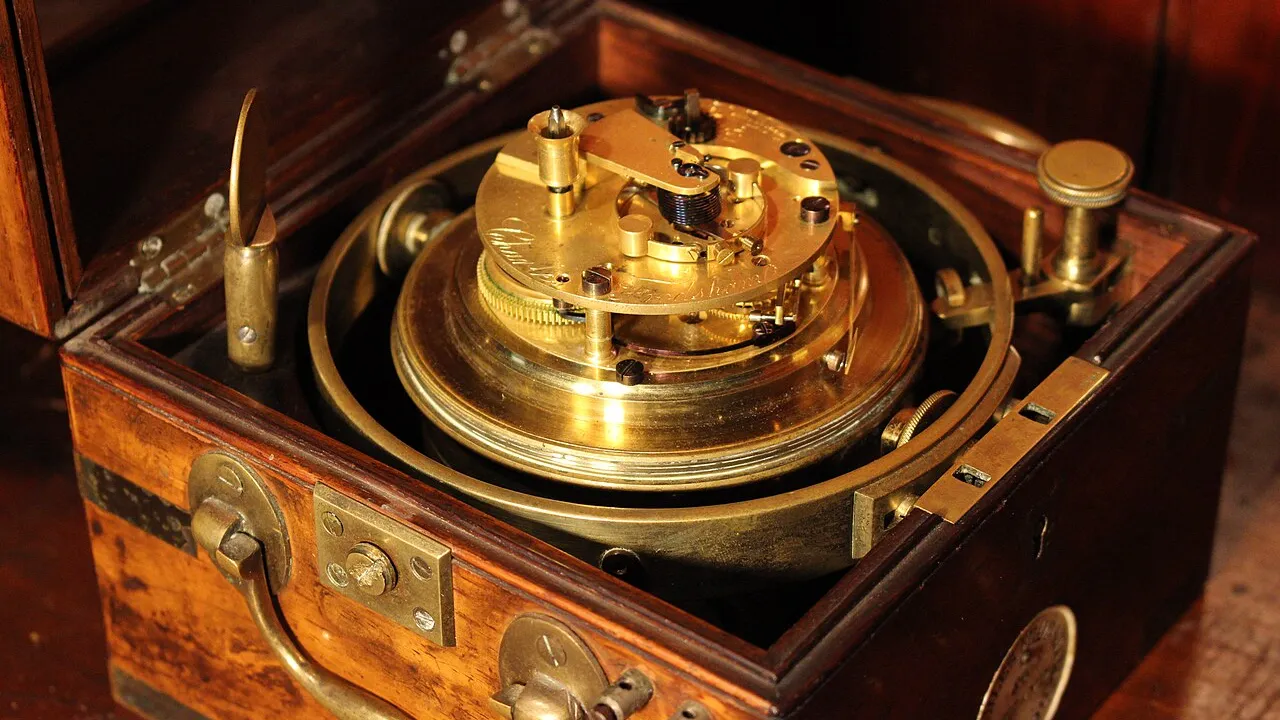
Pivoting rings that keep a clock level
voyage
A long journey across the wide sea
🪝
Why did the British government offer a giant fortune of gold to anyone who could build a better ocean clock?
1
The Great Longitude Puzzle
Crash! Centuries ago, wooden ships often slammed into rocky islands in the fog because captains could not tell how far east or west they had sailed. Finding north or south was easy, but east-west baffled everyone.
2
A Carpenter Takes the Challenge
In 1714, Britain offered a huge prize to solve the puzzle. Self-taught carpenter John Harrison spent decades building tougher and smaller sea clocks. Inside, tightly coiled springs and tiny gem bearings kept ticking smoothly even during wild storms.
3
Comparing Two Noons
The clock stayed set to home-port time in London. When sailors saw the Sun reach its highest point at sea, they checked the clock—every hour of difference meant fifteen degrees east or west around Earth!
1. Why is a ship's chronometer mounted inside pivoting brass rings called gimbals?
2. How many seconds did Harrison's winning sea watch lose on its 81-day trip to Jamaica?
🤯 Mind-Blowing Fact • Grade 3
Even Isaac Newton doubted any mechanical clock could survive ocean weather—yet a self-taught carpenter proved him wrong!
✨ Word Sparks (Grade 3 Glossary)
Tap 🔊 to hear
friction
Rubbing force that slows moving parts down
degree
A unit for measuring circles and globes
chronometer
Ultra-accurate clock built for ocean navigation
🪝
How does knowing what time it is back home tell a sailor thousands of miles away where their ship sits on the globe?
1
Why Time Equals Place
Spin a globe slowly under a desk lamp! Earth turns a full 360 in 24 hours, which equals exactly 15 degrees every single hour. If it is local noon right above your ship while a clock from London reads 2:00 p.m., you know you have sailed 30 degrees west!
2
Enemies of Every Sea Clock
That math sounded simple, yet building a clock that survived ocean voyages seemed impossible. Rolling waves ruined pendulums, sticky lubricating oil thickened in icy winds, and metal parts expanded in tropical heat, making clocks run slow.
3
Harrison's Brilliant Fixes
English craftsman John Harrison spent over thirty years conquering each problem. He joined strips of brass and steel together so temperature changes canceled out, used naturally oily tropical wood and diamond parts to cut , and shrank his fourth model, H4, into an oversized silver watch.
4
Safer Oceans for Everyone
Soon explorers like Captain James Cook carried copies of Harrison's design across the Pacific Ocean, drawing the most accurate world maps history had ever seen.
1. Since Earth spins 15 degrees per hour, how far west are you if local noon happens when London's clock says 3:00 p.m.?
2. How did John Harrison stop hot tropical weather from slowing his clock down?
🤯 Mind-Blowing Fact • Grade 4
On Captain James Cook's second voyage around the icy Southern Ocean, his copy of Harrison's watch—called K1—never stopped ticking for three straight years!
✨ Word Sparks (Grade 4 Glossary)
Tap 🔊 to hear
bimetallic
Made of two bonded metals expanding differently
escapement
Gear mechanism releasing clock energy in ticks
oscillate
Swing steadily back and forth in rhythm
🪝
What drove one determined craftsman to spend forty-five years perfecting four extraordinary clocks?
1
Disaster Off the Isles of Scilly
On a foggy October night in 1707, four British warships struck jagged rocks off the Isles of Scilly, costing nearly two thousand sailors their lives—all because navigators misjudged their east-west position. Shocked into action, Parliament passed the Longitude Act of 1714, promising 20,000 pounds to anyone who could determine longitude within half a degree.
2
Astronomers Versus the Clockmaker
Royal astronomers insisted the answer lay in complex star charts measuring the Moon's motion, dismissing clocks as hopeless toys. Undeterred, Yorkshire carpenter John Harrison built H1 in 1735—a gleaming 34-kilogram brass machine with twin counter-oscillating bars linked by springs so ship motion affected both sides equally. Dissatisfied with nothing less than perfection, he engineered H2 and H3 over the next two decades, inventing caged roller bearings and temperature strips along the way.
3
The Triumph of H4
In a bold leap, Harrison abandoned giant frames altogether and crafted H4 in 1759: a 13-centimeter silver watch beating five ticks per second. Powered by a high-speed balance wheel, diamond pallets that needed zero oil, and a tiny wind-up mechanism called a remontoire that delivered even force, H4 sailed to Barbados and Jamaica with astonishing precision.
4
Charting the Modern World
Watchmakers Pierre Le Roy and Thomas Earnshaw soon simplified chronometer for mass production, turning perilous ocean crossings into reliable global trade routes.
1. Why did Harrison switch from giant 34-kilogram frames to a fast-beating pocket watch design in H4?
2. Why were tiny diamond pallets inside H4 so important at sea?
🤯 Mind-Blowing Fact • Grade 5
Harrison's early H1, H2, and H3 sea clocks still run smoothly at the Royal Observatory in Greenwich today—more than 260 years after he built them, without needing a drop of oil on their wooden gears!
✨ Word Sparks (Grade 5 Glossary)
Tap 🔊 to hear
meridian
North-to-south line of longitude on Earth
horologist
Craftsman or scientist specializing in timepieces
remontoire
Mechanism delivering constant force to clockwork
🪝
Why does an error of just four ticking seconds at the equator shift a navigator's calculated position by an entire nautical mile?
1
Four Seconds Per Mile
Stand at Earth's equator, and the planet's rotation carries you eastward at roughly 1,670 kilometers per hour—or one nautical mile every four seconds. For Age-of-Sail mariners, measuring latitude from the Sun's noon altitude or Polaris was straightforward, yet without knowing the simultaneous reference time at a prime , east-west longitude remained a deadly guessing game.
2
The 1714 Longitude Challenge
Following the catastrophic 1707 Scilly naval wreck, Britain's Longitude Act offered 20,000 pounds for a method accurate within 30 arcminutes (half a degree) after a six-week West Indies voyage—demanding a clock that drifted fewer than three seconds per day. While Astronomer Royal Nevil Maskelyne championed arduous 'lunar distance' star calculations, self-educated Yorkshire John Harrison wagered his life's work on mechanical precision.
3
Overcoming Thermal Drift and Friction
Across forty-five years, Harrison invented technologies still used in mechanical engineering today. To eliminate sticky animal oils, he carved self-lubricating gears from tropical lignum vitae wood and devised caged roller bearings, the ancestor of modern ball bearings. Because heat lengthens a balance spring and weakens its elasticity—causing ordinary watches to lose minutes per day in the tropics—Harrison fused brass and steel into a bimetallic compensation curb that automatically shortened the active spring length as temperatures rose.
4
H4 and the Detent Escapement
Completed in 1759, Harrison's 13-centimeter H4 combined a 5-hertz high-amplitude balance wheel, jeweled diamond pallets, and an eight-second mechanical that isolated the escapement from mainspring torque variations. Tested to Jamaica in 1761, H4 erred by just 5.1 seconds—less than two kilometers of longitude! French Pierre Le Roy and Englishman Thomas Earnshaw subsequently refined the spring-detent escapement and cylindrical balance spring into rugged boxed chronometers mounted in brass gimbals.
5
Standardizing Global Time
By the nineteenth century, thousands of ships calibrated their chronometers to Greenwich Royal Observatory time balls, establishing Greenwich Mean Time as the world's universal time standard long before GPS satellites orbited overhead.