1. What does the Latin name Magna Carta mean in English?
2. What big idea did Magna Carta teach future Americans?
🤯 Mind-Blowing Fact • Grade 2
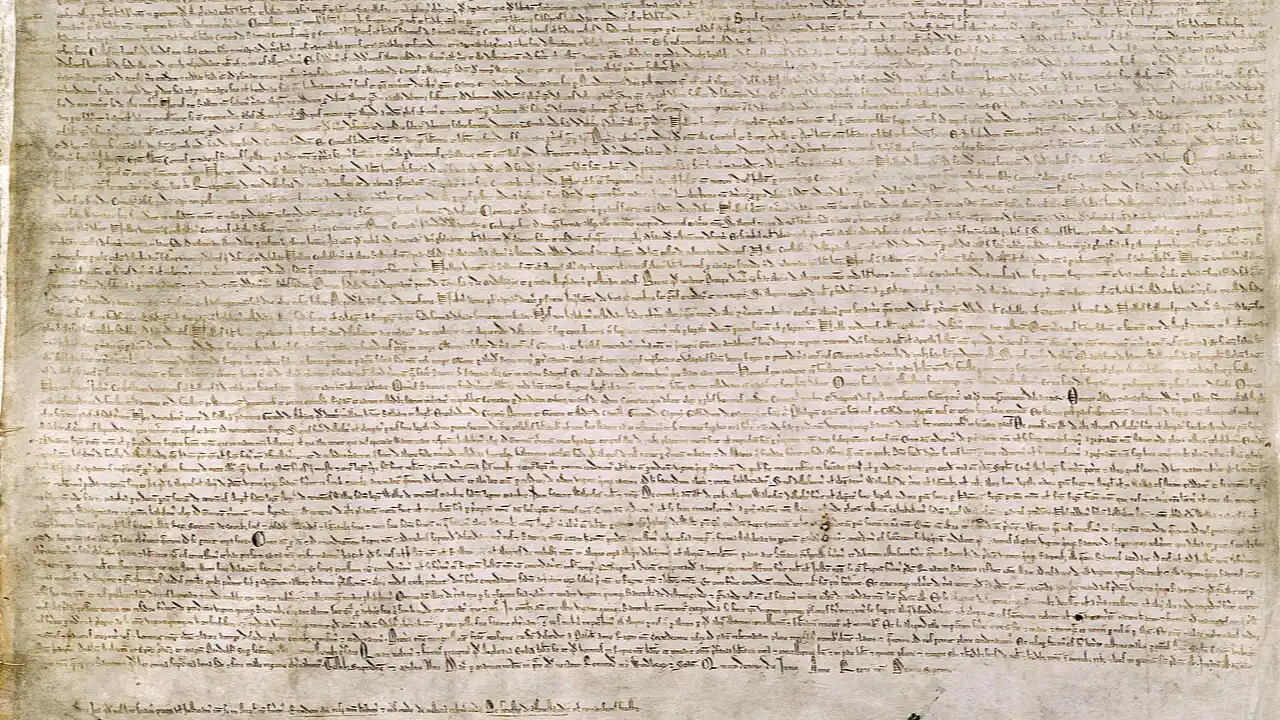
A real 1297 copy of Magna Carta sits inside a protective case at the National Archives in Washington, D.C., right near the U.S. Constitution!
✨ Word Sparks (Grade 2 Glossary)
Tap 🔊 to hear
parchment
Smooth animal skin prepared for writing long ago
monarch
A king or queen who rules a kingdom
trial
A fair court meeting to decide the truth
🪝
How did a meeting in an English meadow in 1215 help write America's laws?
1
Showdown at Runnymede Meadow
Picture armored knights gathering in a grassy field beside a river in England in 1215! King John had demanded unfair taxes and jailed people without a fair reason. The nobles insisted that the king obey written rules too.
2
What Magna Carta Promised
King John placed his royal seal on Magna Carta, written in Latin on sheepskin . It promised that free people had a right to a fair and that even the must follow the law.
3
Crossing the Ocean to America
Over five hundred years later, American colonists carried these ideas to Virginia and the other colonies. Leaders like Thomas Jefferson and James Madison wove Magna Carta's fairness into the U.S. Constitution and Bill of Rights!
1. In what year did King John put his seal on Magna Carta?
2. Where can visitors in the United States see an original 1297 Magna Carta today?
🤯 Mind-Blowing Fact • Grade 3
Massachusetts liked Magna Carta so much in 1775 that Paul Revere engraved a revolutionary seal showing a patriot holding a sword in one hand and Magna Carta in the other!
✨ Word Sparks (Grade 3 Glossary)
Tap 🔊 to hear
baron
A wealthy noble landowner in medieval England
jury
Citizens chosen to judge facts fairly in court
liberty
Freedom from unfair control by a government
🪝
Why did American colonists quote an 800-year-old English charter when arguing for their rights?
1
Limiting Royal Power in 1215
Step back to June 15, 1215, in Runnymede meadow along England's River Thames! English confronted King John because he seized property, raised heavy taxes, and punished rivals without trials. By sealing Magna Carta, the king agreed for the first time that royal power had legal limits.
2
The Rule of Law
This breakthrough created a powerful principle called the rule of law: laws govern a nation, not the sudden wishes of a ruler. Magna Carta also stated that no free person could be imprisoned without the lawful judgment of peers—an early form of trial by .
3
Colonial Charters in Virginia
When settlers sailed to Jamestown in 1607, the Charter of the Virginia Company of London promised colonists all the traditional liberties of English citizens, tracing directly back to Magna Carta.
4
Inspiring the Constitution
During the 1760s and 1770s, colonists protested taxation without consent using Magna Carta's words. Later, the Founding Fathers built due process and trials directly into the U.S. Bill of Rights.
1. What does the civic principle called the 'rule of law' mean?
2. How did the 1606 Charter of the Virginia Company connect Jamestown settlers to Magna Carta?
🤯 Mind-Blowing Fact • Grade 4
Scribes wrote all 3,500 Latin words of the 1215 Magna Carta on a single sheet of sheepskin without numbering any clauses—historians added Clause 1 through Clause 63 over five hundred years later!
✨ Word Sparks (Grade 4 Glossary)
Tap 🔊 to hear
clause
A single distinct section inside a legal document
representation
Having elected leaders speak and vote for citizens
amendment
An official addition or change to a constitution
🪝
How did Clause 39 of a medieval parchment become the backbone of the Fifth Amendment to the U.S. Constitution?
1
Crisis Along the River Thames
Imagine standing beside forty English barons at Runnymede on June 15, 1215, watching scribes inspect freshly inked Latin lines on sheepskin! After expensive military defeats and harsh tax demands by King John, rebellious nobles drafted sixty-three protecting church rights, property, and fair courts. Though written mostly for elite landowners at first, Magna Carta planted a revolutionary civic seed.
2
Clause 39 and Due Process
Its most enduring passage, 39, declared that no free person could be arrested, imprisoned, or stripped of property except by the lawful judgment of peers or by the law of the land. Over centuries, English lawyers like Sir Edward Coke interpreted 'law of the land' to mean 'due process of law' protecting every citizen.
3
From Jamestown to 1776
Sir Edward Coke also helped write the 1606 Charter of the Virginia Company of London, guaranteeing Virginia colonists English rights. When Parliament taxed colonies without in the 1760s, patriots argued their ancient charter rights were being broken.
4
Woven Into American Documents
George Mason echoed 39 in the 1776 Virginia Declaration of Rights, and James Madison adapted those protections into the Fifth and Sixth of the U.S. Bill of Rights in 1791—securing due process and speedy jury trials for all Americans.
1. Which famous legal phrase grew directly out of Magna Carta's promise to follow 'the law of the land'?
2. Which 1776 Virginia document carried Magna Carta's trial and liberty ideas forward toward the U.S. Bill of Rights?
🤯 Mind-Blowing Fact • Grade 5
Only four original 1215 exemplifications of Magna Carta survive in the world today, while a 1297 royal confirmation rests on permanent public display at the National Archives Rotunda in Washington, D.C.!
✨ Word Sparks (Grade 5 Glossary)
Tap 🔊 to hear
arbitrary
Based on sudden personal whim instead of fair law
annul
To officially cancel and declare no longer valid
constitutional
Guided and limited by a supreme written framework
🪝
Why did a medieval peace treaty that collapsed within ten weeks in 1215 endure for over eight centuries as the cornerstone of American constitutional liberty?
1
A Fragile Accord at Runnymede
Picture a damp meadow between Windsor Castle and Staines on June 15, 1215, where King John affixed his Great Seal to a Latin charter negotiated by Archbishop Stephen Langton and rebellious English barons. Ironically, the original pact lasted barely ten weeks before King John persuaded Pope Innocent III to it, sparking civil war. Yet after John's death in 1216, advisors to nine-year-old King Henry III reissued revised versions in 1216, 1217, and 1225, and King Edward I placed the 1297 Magna Carta permanently onto England's statute rolls.
2
Core Principles in Clauses 12, 39, and 40
Three provisions proved transformative for democratic thought. Clause 12 restricted certain feudal taxes unless approved by 'common counsel,' foreshadowing no taxation without representation. Clause 39 prohibited arrest or seizure except by lawful judgment of peers or the law of the land, while Clause 40 pledged: 'To no one will we sell, to no one deny or delay right or justice.'
3
Transatlantic Transmission to Colonial America
Seventeenth-century jurist Sir Edward Coke championed Magna Carta against royal absolutism and helped draft the 1606 First Charter of Virginia, which guaranteed colonists all liberties of English subjects. William Penn published the first American printing of Magna Carta in Philadelphia in 1687 so ordinary citizens could read their rights firsthand.
4
Shaping the Founding Era
During the Stamp Act crisis and Continental Congresses, American patriots invoked Magna Carta to argue that law outranked parliamentary overreach. State constitutions—beginning with George Mason's 1776 Virginia Declaration of Rights—translated medieval protections against royal abuse into universal human rights.
5
Living Legacy in the U.S. Constitution
Today, Magna Carta's DNA runs through Article I's protection of habeas corpus, the Fifth Amendment's due process clause, the Sixth Amendment's jury guarantees, and the Fourteenth Amendment's equal protection promises—Cited more than one hundred times in U.S. Supreme Court opinions.