1. What lifts a maglev train into the air above its track?
2. Why is a maglev ride so quiet and smooth?
🤯 Mind-Blowing Fact • Grade 2
Shanghai's airport maglev covers nearly nineteen miles in just over seven minutes!
✨ Word Sparks (Grade 2 Glossary)
Tap 🔊 to hear
levitation
Floating in the air without physical support
guideway
The special track channel guiding a floating train
pole
The north or south end of magnets
🪝
How can invisible magnetic pushes and pulls move a heavy passenger train without an engine?
1
What Maglev Means
Hold two toy magnets with matching facing each other and feel an invisible cushion push your hands apart! Engineers combined the words magnetic and to name maglev—trains that float above a special concrete .
2
The Track Is the Motor
Instead of carrying a heavy fuel tank or spinning axles, a maglev train rides waves of magnetism. Electric coils built into the walls switch north and south rapidly, pulling the nose forward while pushing from behind.
3
Record-Breaking Rides
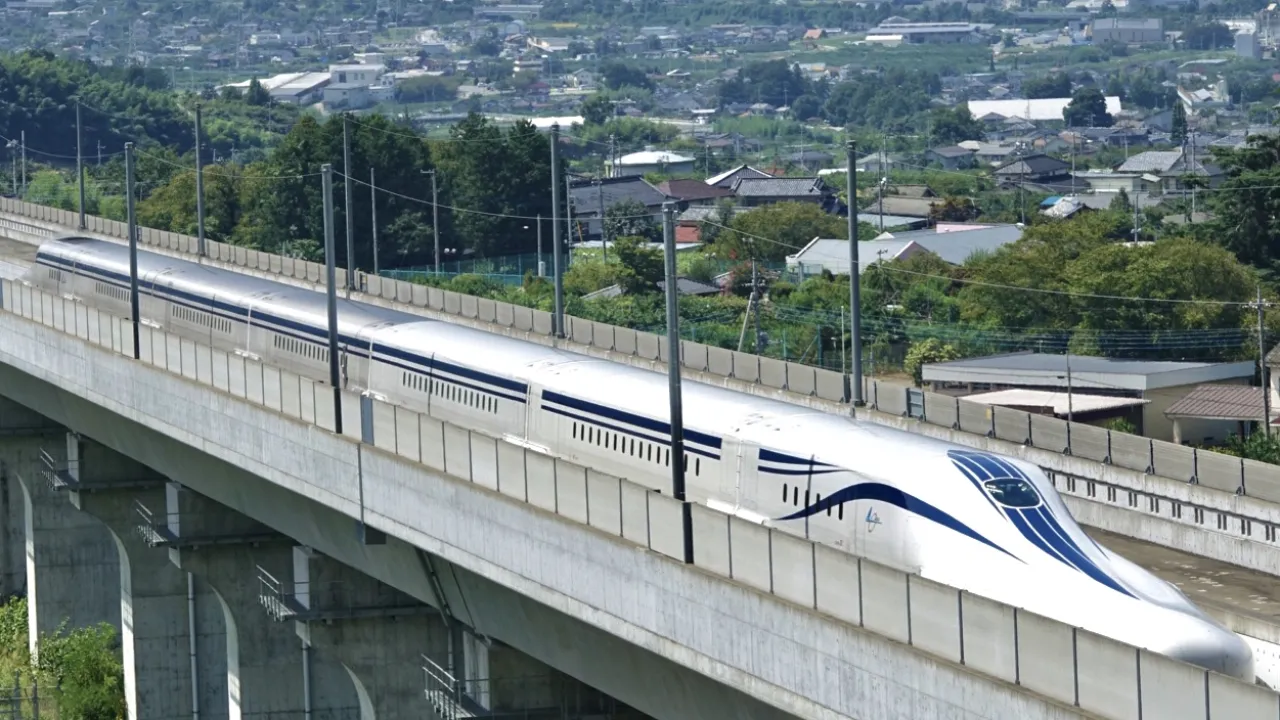
In Shanghai, China, airport travelers cruise on a commercial maglev at 268 miles per hour! Meanwhile in Japan, test trains cooled to icy temperatures have zoomed past 375 miles per hour.
1. Which two words were blended together to make the word 'maglev'?
2. How do coils in the guideway move a maglev train forward?
🤯 Mind-Blowing Fact • Grade 3
Japanese superconducting maglev trains actually roll on rubber airplane-style tires at slow station speeds before lifting off into magnetic flight around 93 miles per hour!
✨ Word Sparks (Grade 3 Glossary)
Tap 🔊 to hear
superconductor
Material carrying electricity with zero wasted energy
repel
To push away with an invisible force
propel
To drive or push something steadily forward
🪝
Why do steel train wheels reach a speed limit where floating magnets keep accelerating?
1
Escaping Wheel Friction
Above 220 miles per hour, steel train wheels struggle for grip, vibrate fiercely, and wear down tracks. By hovering one to four inches above a U-shaped or T-shaped guideway, magnetic levitation completely eliminates mechanical rolling friction.
2
Inventors Who Dreamed of Floating
German engineer Hermann Kemper patented magnetic train levitation in 1934. Three decades later, American physicists James Powell and Gordon Danby conceived superconducting maglev after sitting in a frustrating New York traffic jam!
3
Two Ways to Hover
German-designed EMS trains wrap arms under a steel guideway so upward-pulling electromagnets lift the cars by a tiny computer-controlled gap. Japanese EDS trains use ultra-cold superconducting magnets that coils in the guideway walls once rolling past 93 miles per hour.
4
Unrolling an Electric Motor
Imagine slicing a round electric motor open and laying it flat along miles of track! That linear motor sends traveling magnetic waves down the guideway, propelling the floating train swiftly and silently.
1. Why do Japanese EDS maglev trains carry rubber tires underneath the cars?
2. What inspired physicists James Powell and Gordon Danby to invent superconducting maglev in the 1960s?
🤯 Mind-Blowing Fact • Grade 4
Because trains in the same guideway power block ride the exact same traveling magnetic wave, two maglev trains in that block physically cannot travel at different speeds to bump into each other!
✨ Word Sparks (Grade 4 Glossary)
Tap 🔊 to hear
induce
To create electric current using moving magnetism
synchronous
Locked in step at matching wave speeds
architecture
The overall engineering design of a system
🪝
What happens when you chill magnets near absolute zero and unroll an electric motor across the countryside?
1
Breaking the Steel-Wheel Barrier
Picture hurtling through a mountain valley at 375 miles per hour—nearly two-thirds the cruising speed of a passenger jet—without a single wheel touching metal! Conventional high-speed trains lose traction and pound rails violently at extreme speeds, whereas maglev trains touch nothing except the air ahead of them.
2
Attraction Versus Repulsion
Engineers developed two rival levitation . Electromagnetic Suspension (EMS), pioneered by Germany's Transrapid and operating commercially in Shanghai since 2004, uses feedback sensors checking gap distance 100,000 times per second to hold electromagnets 10 millimeters below an iron rail. Electrodynamic Suspension (EDS), developed from Powell and Danby's 1968 patent, uses superconducting magnets to repulsive currents across a wider 10-centimeter hover gap.
3
Linear Synchronous Propulsion
Both systems rely on a linear motor embedded directly in the concrete guideway. Alternating three-phase current creates a traveling magnetic wave whose frequency controls exact train speed—making head-on collisions or rear-end crashes between trains in the same electrical zone physically impossible.
4
World Records and Future Corridors
On April 21, 2015, Japan's L0 Series superconducting maglev set a manned rail record of 603 km/h (375 mph) near Mount Fuji. Construction is now advancing on the Chuo Shinkansen tunnel corridor to link Tokyo and Nagoya in just forty minutes.
1. How does Shanghai's EMS maglev keep its magnets from snapping up against the steel track?
2. What sets the exact speed of a maglev train riding a linear synchronous motor?
🤯 Mind-Blowing Fact • Grade 5
At 375 miles per hour, touching an overhead power wire would spark and shred metal—so Japan's L0 maglev beams cabin electricity wirelessly into the floating cars through magnetic induction!
✨ Word Sparks (Grade 5 Glossary)
Tap 🔊 to hear
cryogenic
Involving ultra-cold temperatures far below freezing
induction
Generating electric current from changing magnetic fields
stator
The stationary coil section of an electric motor
🪝
How do figure-eight null-flux coils and liquid-helium superconductors overcome Earnshaw's theorem to levitate a 400-ton train?
1
Outsmarting Earnshaw's Theorem
In 1842, British mathematician Samuel Earnshaw proved mathematically that static permanent magnets alone can never achieve stable levitation in open space. Modern maglev engineers overcome Earnshaw's theorem through two dynamic designs: millisecond-fast active electronic gap control in Electromagnetic Suspension (EMS) or motion-induced opposing currents inside figure-eight coils in Electrodynamic Suspension (EDS).
2
Cryogenic Superconductors and Null-Flux Coils
On Japan's L0 Series SCMaglev, onboard niobium-titanium alloy coils chilled to minus 269 degrees Celsius (4.2 Kelvin) by closed-cycle liquid helium carry persistent currents of hundreds of kiloamperes with zero electrical resistance. Sweeping past unpowered figure-eight aluminum coils mounted along the U-shaped concrete guideway, Faraday generates upward repulsion in the lower loop and upward pull in the upper loop—passively centering the train 10 centimeters high.
3
Linear Synchronous Propulsion and Inductive Power
Separate three-phase propulsion windings energized only beneath occupied guideway blocks act as an unrolled motor , while the train's superconducting magnets serve as the moving rotor. Because mechanical pantographs would spark and disintegrate at 600 kilometers per hour, wireless inductive coils harvest onboard electricity for lighting, ventilation, and cryocoolers directly from harmonic magnetic fields.
4
Commercial Milestones From Birmingham to Yamanashi
Following Hermann Kemper's 1934 German patent, Birmingham Airport's 1984 shuttle, and Powell and Danby's superconducting inventions, Shanghai opened its 431-km/h Transrapid EMS airport line in 2004, joined by urban low-speed maglevs in Japan, South Korea, and China. On April 21, 2015, Japan's seven-car L0 Series achieved a manned world rail record of 603 km/h (375 mph) near Mount Fuji.
5
Aerodynamic Tunnels and High-Temperature Horizons
At 500 km/h in regular service, air resistance accounts for virtually all energy consumption, prompting engineers along Japan's Tokyo-to-Nagoya Chuo Shinkansen corridor to bore deep mountain tunnels immune to snowstorms and crosswinds. Meanwhile, yttrium-barium-copper-oxide (YBCO) high-temperature superconducting tapes cooled by inexpensive liquid nitrogen promise lighter, more economical magnetic flight.