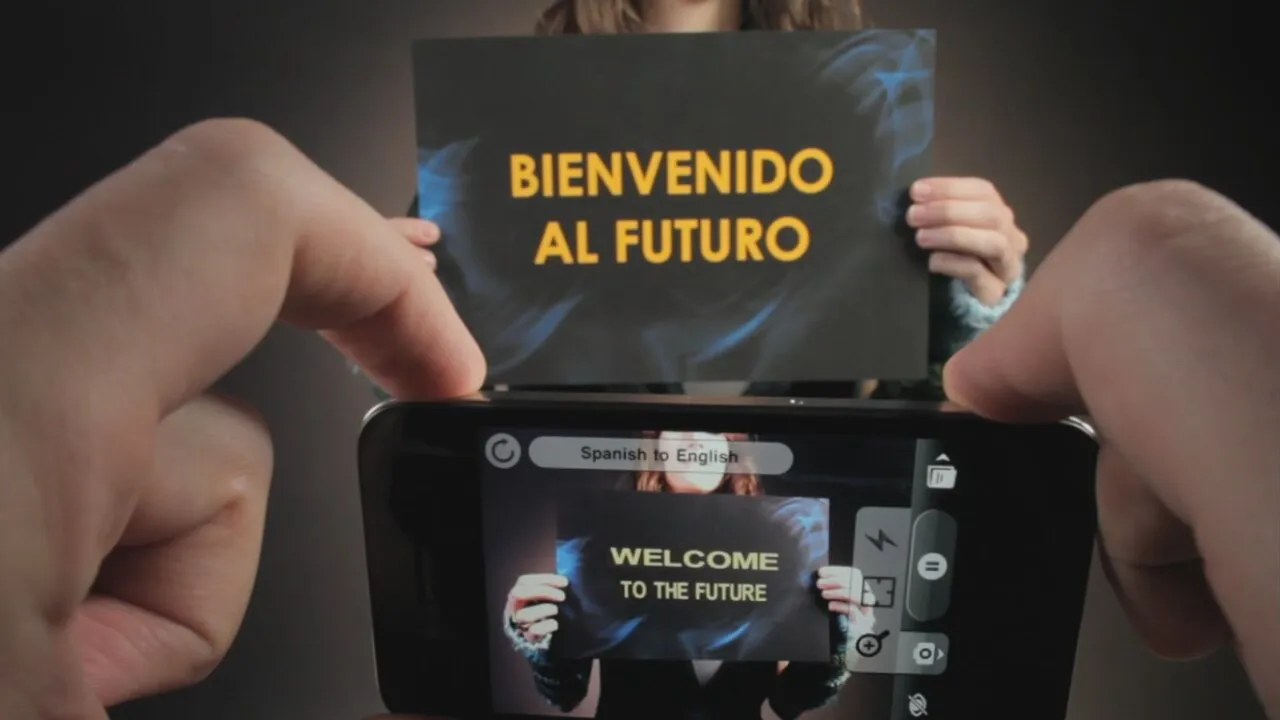
1. What happens when you point a camera translation app at a menu written in another language?
2. Why is it better for a translator computer to read a whole sentence instead of just one word at a time?
🤯 Mind-Blowing Fact • Grade 2
The giant IBM 701 computer used in the famous 1954 translation demonstration knew only 250 Russian words and 6 grammar rules—yet it made front-page newspaper headlines around the world!
✨ Word Sparks (Grade 2 Glossary)
Tap 🔊 to hear
idiom
Playful phrase with non-literal cultural meaning
grammar
Rules for putting words into clear sentences
bilingual
Written or spoken in two languages
🪝
Why does translating 'It is raining cats and dogs!' word by word confuse a listener in another country?
1
Funny Phrases and Word Puzzles
Imagine telling a friend in Tokyo, 'Break a leg!' before a school play. If a machine swapped each word one by one, your poor friend would think you wished them an injury instead of good luck!
2
The 1954 Mainframe Surprise
In 1949, scientist Warren Weaver wondered if computers could decode foreign languages like secret ciphers. Five years later, Georgetown University and IBM fed 60 Russian sentences on punch cards into a room-sized computer, and out printed clear English!
3
Learning Whole Ideas
Languages turned out to be much trickier than codebooks because and shift everywhere. Modern translation apps study millions of real books and conversations so they translate true meanings smoothly across continents.
1. Why is an idiom like 'raining cats and dogs' tricky for simple word-by-word translation?
2. How were Russian sentences entered into the giant IBM 701 computer during the first 1954 translation demo?
🤯 Mind-Blowing Fact • Grade 3
Archaeologists decoded ancient Egyptian hieroglyphs using the Rosetta Stone—which carried the same royal message in three scripts—and modern computers learn languages from digital 'Rosetta Stones' of parallel books!
✨ Word Sparks (Grade 3 Glossary)
Tap 🔊 to hear
parallel text
Same document written in two matching languages
ambiguity
Having two or more possible meanings
linguist
Scientist who studies how human languages work
🪝
How did United Nations transcripts and parallel books teach computers to speak dozens of languages?
1
When Rulebooks Hit a Wall
Try writing down every single rule of your favorite language—and every exception! For thirty years after the 1954 Georgetown–IBM demo, typed thousands of hand-written grammar rules into computers, yet tricky words like 'bank' (a river edge OR a money building!) still tripped machines up.
2
Learning From Parallel Texts
In the late 1980s and 1990s, IBM researchers tried a brand-new strategy called statistical machine translation. Instead of hand-coding rules, they fed computers millions of sentences already translated by human experts at the United Nations and Canadian Parliament!
3
Flipping Word Order Smoothly
Different languages arrange ideas differently: English says 'the blue house' (Subject-Verb-Object), while Spanish says 'la casa azul' ('the house blue') and Japanese places the verb at the very end! Comparing revealed how phrases move.
4
Neural Networks Take the Stage
Around 2016, neural machine translation leaped forward again—reading whole sentences at once to capture tone, politeness, and context across more than a hundred languages.
1. Why is the English word 'bat' an example of ambiguity for a translation computer?
2. What real-world documents acted like giant digital Rosetta Stones for statistical translation computers?
🤯 Mind-Blowing Fact • Grade 4
The famous 2017 research paper 'Attention Is All You Need'—originally written just to make English-to-German and English-to-French machine translation faster and smarter—ended up sparking the entire modern generative AI revolution!
✨ Word Sparks (Grade 4 Glossary)
Tap 🔊 to hear
attention mechanism
Neural method linking related words across sentences
word embedding
Numeric coordinates capturing a word's meaning
syntax
Structural arrangement of words forming grammatical sentences
🪝
Why did inventing 'self-attention' in 2017 make machine translations suddenly read like fluent human writing?
1
The Long-Sentence Memory Problem
Read this famous Winograd puzzle closely: 'The trophy didn't fit into the brown suitcase because it was too big.' Your brain instantly knows 'it' refers to the trophy—whereas changing the final word to 'small' flips 'it' to the suitcase! In languages like French, Spanish, or German where 'trophy' and 'suitcase' carry different grammatical genders, a translator cannot choose the right pronoun without grasping real-world cause and effect across the entire sentence.
2
Three Generations of Translation
Inspired by Warren Weaver's 1949 cryptography memo and the 1954 Georgetown–IBM mainframe demonstration, early Rule-Based Machine Translation relied on hand-coded dictionaries that stumbled over idioms and slang. Statistical phrase-based systems of the 1990s and 2000s improved fluency by scanning millions of bilingual United Nations transcripts, yet still stitched awkward fragments together whenever verbs sat twenty words away from their subjects.
3
Vector Space and the 2017 Transformer
Neural Machine Translation (NMT) transformed the field by mapping words into mathematical coordinates called embeddings, where related ideas cluster together across languages. In 2017, researchers unveiled the Transformer architecture, whose 'self-attention' mechanism allows every word in a sentence to weigh its connection to every other word simultaneously—resolving tricky context and reordering grammar gracefully in milliseconds.
4
Saving Low-Resource Languages
Today, massively multilingual neural models share grammatical patterns across more than two hundred languages at once, helping communities document, revitalize, and translate low-resource Indigenous and regional languages even when relatively few printed parallel books exist.
1. In the sentence 'The trophy didn't fit into the suitcase because it was too small,' why must a translator figure out what 'it' refers to?
2. What breakthrough computer architecture was originally invented in 2017 to improve neural machine translation?
🤯 Mind-Blowing Fact • Grade 5
When scientists mapped the internal math of multilingual neural translators, they discovered the network had spontaneously organized concepts into a shared 'interlingua' map—allowing direct Korean-to-Spanish translation even if it only trained on Korean-English and English-Spanish!
✨ Word Sparks (Grade 5 Glossary)
Tap 🔊 to hear
zero-shot translation
Translating directly between un-paired training languages
tokenization
Splitting text into word and subword pieces
encoder-decoder
Two-part network mapping input meaning to output
🪝
How do multidimensional vector spaces allow a single neural model to translate directly between two languages it never saw paired together?
1
Warren Weaver's Information-Theory Gamble
Fresh from World War II codebreaking triumphs, mathematician Warren Weaver circulated a provocative 1949 memorandum proposing that a Russian scientific article is 'really written in English, but it has been coded in some strange symbols.' Although the 1954 Georgetown–IBM 701 mainframe demonstration sparked headline-grabbing optimism, linguists like Yehoshua Bar-Hillel soon demonstrated that natural human language defies simple cipher lookup because everyday sentences rely on vast unspoken world knowledge, cultural idioms, and pragmatic context.
2
From Noisy-Channel Statistics to Sequence-to-Sequence
Late-1980s IBM researchers revived machine translation empirically via Claude Shannon's noisy-channel theorem, computing alignment probabilities P(source | target) × P(target) across million-sentence Europarl and United Nations parallel corpora. In 2014, recurrent neural networks replaced brittle phrase tables with continuous mathematical representations, though early architectures struggled to compress forty-word sentences into a single fixed-length vector bottleneck without forgetting opening clauses.
3
Multi-Head Self-Attention and Transformers
Pioneered by Dzmitry Bahdanau's alignment mechanism in 2014 and crystallized in Vaswani et al.'s landmark 2017 Transformer paper, multi-head self-attention computes scaled dot-product weights across every subword token in parallel. Whether translating Turkish agglutinative word endings, German separable verbs waiting at clause boundaries, or Japanese honorific registers, the decoder attends dynamically to every relevant source token regardless of sentence length.
4
Shared Semantic Geometry and Zero-Shot Bridging
When massive multilingual models train jointly across more than 200 languages, something remarkable emerges inside their high-dimensional vector space: semantically equivalent sentences—such as 'Where is the nearest clinic?' in Swahili, Korean, Arabic, and Quechua—cluster spontaneously into shared geometric neighborhoods! This emergent interlingual map enables directly between rare language pairs that lacked side-by-side training books.
5
Speech-to-Speech and Cultural Nuance
While direct audio-to-audio neural models now translate spoken conversations in real time while preserving vocal cadence and emotional prosody, literary poetry, diplomatic treaties, medical precision, and subtle cultural idioms keep skilled human translators essential creative partners alongside artificial intelligence.