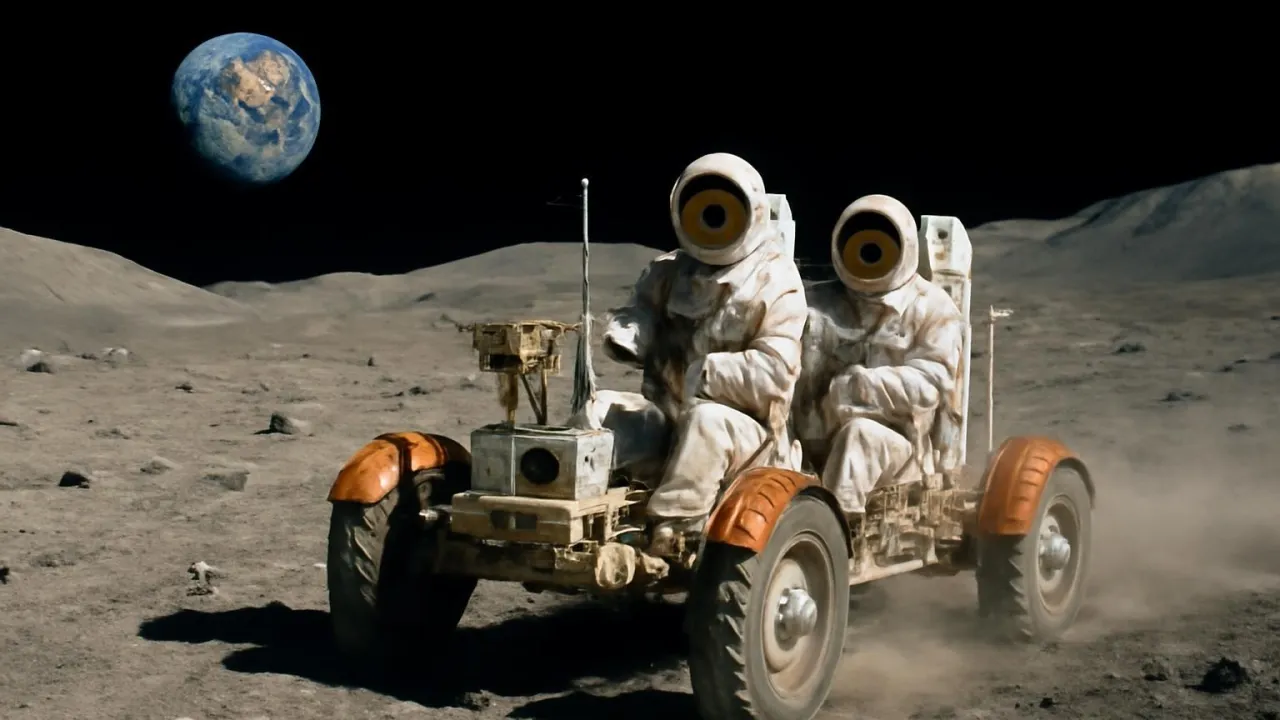
The Lunar Rover could drive almost as fast as a bicycle!
✨ Word Sparks (Grade 2 Glossary)
Tap 🔊 to hear
crater
A big hole on the Moon
sample
A small piece to study
lander
The part that lands on the Moon
🪝
Have you ever wondered how astronauts explore far on the Moon?
1
Rolling Over Moon Rocks
The Lunar Rover has big wheels that roll over bumpy rocks and dust. Astronauts drive it while wearing bulky white suits. The Moon is quiet, but the wheels crunch softly.
2
A Special Space Car
This car is made for space, so it has no roof or doors. Two astronauts ride together, steering with special handles. The rover helps them carry tools and Moon rocks.
3
Exploring Far and Wide
The Lunar Rover lets astronauts travel far from their . They can visit new and hills to collect . The Earth looks small and blue above them.
The Lunar Rover’s wheels are made of woven metal wires, not rubber!
✨ Word Sparks (Grade 3 Glossary)
Tap 🔊 to hear
vibration
A tiny shake or movement
erosion
Wearing away by wind or water
prototype
A first model to test ideas
🪝
Can you imagine steering a car where there’s no air or roads?
1
Driving on Another World
When astronauts landed on the Moon, they needed a way to travel farther. The Lunar Rover was built to roll over powdery dust and sharp rocks. Its large wire-mesh wheels gripped the ground without slipping. Every drive left deep tracks in the gray lunar soil.
2
Building a Space Vehicle
Engineers designed the rover to fold up and fit inside the lunar lander. The rover’s frame was made from lightweight metal, so it could be carried easily. Electric motors powered the wheels, using batteries instead of gasoline. Astronauts used special controls because gloves made steering tricky.
3
Exploring with Science Tools
The Lunar Rover had racks for tools, cameras, and rock samples. Astronauts collected rocks, dust, and even measured from Moonquakes. They drove up to 4.7 miles away from their lander. This let them study craters, hills, and the effects of .
4
Making History on the Moon
The first Lunar Rover was used in 1971 during Apollo 15. Three missions used rovers to explore more of the Moon. Their discoveries helped scientists understand the Moon’s surface and history. The rovers are still there today, silent and covered in dust.
1. Why did the rover use batteries instead of gasoline?
2. What did astronauts collect with the rover?
🤯 Mind-Blowing Fact • Grade 4
The Lunar Rover’s steering and speed controls worked even while astronauts wore thick gloves!
✨ Word Sparks (Grade 4 Glossary)
Tap 🔊 to hear
regolith
The layer of loose Moon soil and rocks
traction
How well wheels grip the ground
meteorite
A rock from space that hits the Moon
🪝
What if you could invent a vehicle to explore a world with no air, roads, or weather?
1
Inventing a Car for the Moon
NASA engineers faced a unique challenge: how could astronauts travel far across the Moon’s rough, dusty surface? They designed the Lunar Rover with four large, flexible wheels made of woven titanium mesh, which provided excellent on powdery . The vehicle’s lightweight aluminum frame allowed it to be folded and packed tightly into the lunar lander. Once on the Moon, astronauts quickly unfolded and assembled the rover for their journeys.
2
How the Rover Works
The Lunar Rover was powered by two silver-zinc batteries and four independent electric motors—one for each wheel. Because there’s no air on the Moon, gasoline engines would not work, so the rover relied on electricity. Astronauts steered with a T-shaped handle, even while wearing thick gloves and bulky suits. The rover could travel up to 8 miles per hour and carry over 1,000 pounds of equipment and samples.
3
Science on the Lunar Surface
With the rover, astronauts could explore craters, hills, and valleys much farther from their lander. They used special racks to carry cameras, drills, and scientific instruments, collecting rocks and measuring vibrations from moonquakes. The rover’s travels helped scientists discover how erosion, , and ancient volcanoes shaped the Moon. Each mission mapped new areas and brought back priceless samples.
4
A Lasting Legacy
Three Apollo missions—15, 16, and 17—used Lunar Rovers between 1971 and 1972, covering a total of over 56 miles. These robotic vehicles expanded the reach of human exploration beyond what was possible on foot. Today, the rovers remain on the Moon, silent reminders of human creativity and our quest to understand other worlds. Their design inspires new rovers for Mars and beyond.
1. Why did the Lunar Rover need special mesh wheels?
2. How did the rover help science on the Moon?
🤯 Mind-Blowing Fact • Grade 5
The Lunar Rover’s mesh wheels left tracks that may last for millions of years, since there’s no wind or rain on the Moon!
✨ Word Sparks (Grade 5 Glossary)
Tap 🔊 to hear
alloy
A metal made by mixing other metals
redundant
Extra systems for safety or backup
panoramic
Showing a wide, all-around view
🪝
Imagine engineering a vehicle to survive and explore in a place with no air, wild temperature swings, and gravity much weaker than Earth’s—how would you do it?
1
Engineering the Lunar Rover: NASA’s Space-Age Solution
When NASA set its sights on extended lunar exploration, engineers faced daunting design challenges. The Moon’s surface is covered in abrasive regolith, with temperatures ranging from -280°F at night to 260°F in sunlight. To address these extremes, the Lunar Rover’s frame was built from lightweight aluminum , and its four wheels were constructed from woven titanium mesh with chevron treads for maximum traction and dust-shedding. The entire vehicle weighed just 460 pounds on Earth, but only about 77 pounds in the Moon’s lower gravity, allowing astronauts to deploy and assemble it quickly after landing.
2
How It Works: Power, Steering, and Mobility
The Lunar Rover was powered by two non-rechargeable silver-zinc potassium hydroxide batteries, each supplying 36 volts, which fed four separate 0.25-horsepower electric motors—one for each wheel. Steering was achieved via a T-bar control, which operated both front and rear wheel steering systems for tight turns. The rover’s suspension system absorbed shocks from rocks and craters, while its open design prevented dust buildup and overheating. With a top speed of 8 mph, the rover could travel up to 22 miles per battery charge, vastly increasing the range of lunar exploration.
3
Scientific Impact: Expanding the Reach of Apollo
The addition of the Lunar Rover to Apollo missions 15, 16, and 17 revolutionized lunar science. Astronauts could collect over 211 pounds of rock and soil samples per mission, transport seismic and magnetic instruments, and document distant geological features with cameras. The rover’s mobility allowed scientists to study the effects of meteorite impacts, volcanic activity, and erosion across a variety of lunar terrains, providing crucial data about the Moon’s formation and history.
4
Legacy and Influence on Future Exploration
The Lunar Rover’s robust design and engineering innovations have influenced every planetary rover since, including those sent to Mars. Its folding chassis, electrical systems, and dust-resistant components set new standards for extraterrestrial vehicles. Even after more than 50 years, the original rovers remain on the Moon, preserved by the lack of atmosphere and weather. Their success demonstrated that humans could design machines to operate reliably in the harshest environments known.
5
Looking Ahead: Rovers Beyond the Moon
Today’s engineers build on the Lunar Rover’s legacy, creating advanced robotic vehicles for Mars, asteroids, and future lunar missions. Modern rovers use solar panels, advanced navigation, and autonomous driving, but still rely on principles first proven on the Moon. The Lunar Rover’s journey reminds us that creative engineering can open up new worlds for discovery, inspiring future explorers to reach even farther into the solar system.