🇺🇸 U.S. HISTORY
🏛️ Territorial Expansion Milestone • Treaty of Paris (April 30, 1803)
VA History & Social Science SOL K.1, 1.2, 2.4, VS.1–VS.10, USI & USII
Louisiana Purchase (1803)
How Four Cents an Acre Doubled Young America
Grade 1 • Early Reader • 59 words
⏳ Era / StatehoodTreaty Signed: April 30, 1803
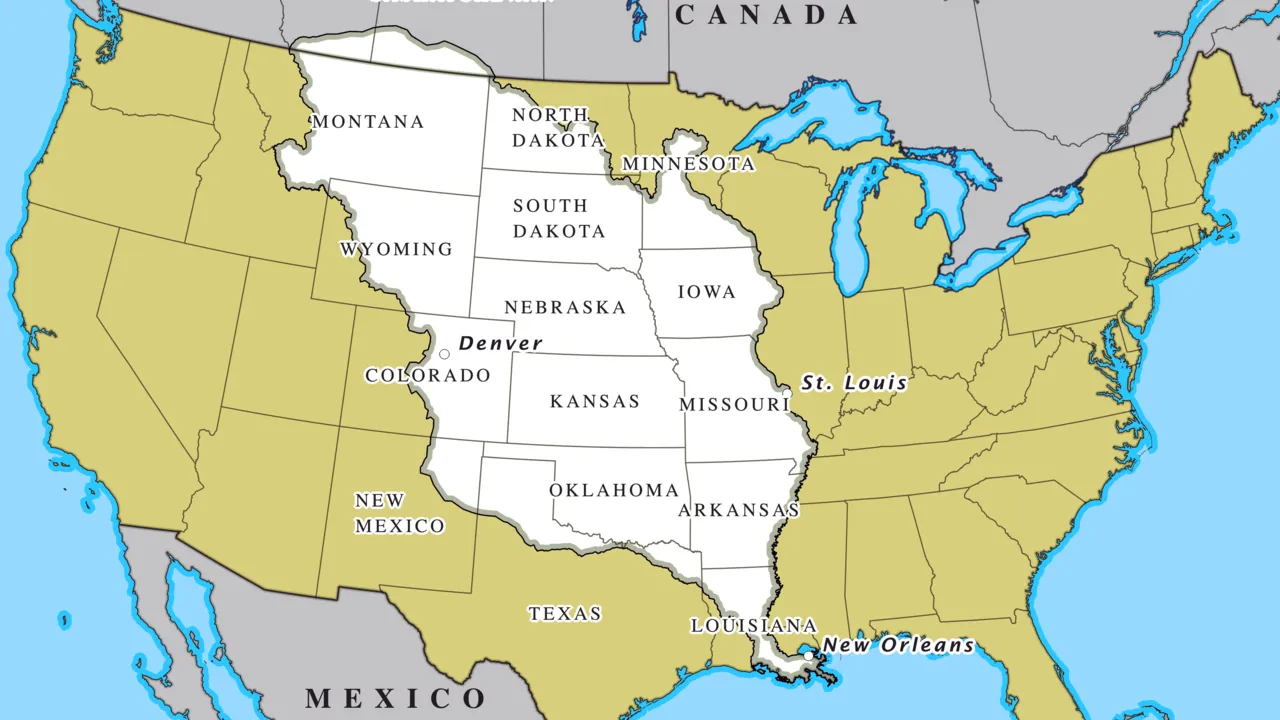
🗺️ Region / CapitalMississippi River to the Rocky Mountains (828,000 Square Miles)
📜 Key MilestonePeacefully Doubled the Geographic Size of the United States for $15 Million
⚡ Historical SparkTurned a quest for one harbor into fifteen future U.S. states
🤯 Mind-Blowing Fact • Grade 1
The land inside the 1803 Louisiana Purchase cost less than four pennies for every acre—cheaper than a piece of bubble gum today!
✨ Word Sparks (Grade 1 Glossary)
Tap 🔊 to hear
port
Harbor city where boats load and unload goods
territory
Large region of land belonging to a country
acre
Land measurement almost as big as a football field
🪝
Could a country grow twice as big in a single day without a battle?
1
Unrolling a Giant New Map
Rustle goes the big paper map on the table! Wide rivers, tall grass plains, and snowy peaks appear. Young America is about to grow!
2
A Surprise Offer From France
In 1803, President Thomas Jefferson wanted to buy one busy city, New Orleans. Instead, France offered to sell the huge Louisiana !
3
Doubling the Country
America paid fifteen million dollars. Overnight, the United States became twice as big!
1. Which U.S. president approved the Louisiana Purchase in 1803?
2. How much did the Louisiana Purchase change the size of the United States?
🤯 Mind-Blowing Fact • Grade 2
Land from the 1803 Louisiana Purchase eventually formed all or part of fifteen different U.S. states across the Midwest and Great Plains!
✨ Word Sparks (Grade 2 Glossary)
Tap 🔊 to hear
flatboat
Wooden river raft floating farm goods downstream
treaty
Official written agreement signed between countries
prairie
Wide, rolling grassland across central North America
🪝
What if you went shopping for one front yard and came home with the whole neighborhood?
1
Busy Boats on the Mississippi
Splash go carrying wheat and corn down the wide Mississippi River! In 1803, American farmers west of the Appalachian Mountains needed the busy port of New Orleans so cargo ships could carry their crops out to sea.
2
An Astonishing Bargain in Paris
President Thomas Jefferson sent James Monroe and Robert Livingston to Paris to offer France up to ten million dollars just for New Orleans. Surprisingly, French leader Napoleon needed money quickly and offered all 828,000 square miles of Louisiana for fifteen million dollars!
3
Fifteen Future States
Signed on April 30, 1803, the Louisiana Purchase peacefully doubled the United States from the Mississippi River to the Rocky Mountains.
1. Which port city did President Jefferson originally hope to buy so farmers could ship crops?
2. From which European country did the United States buy the Louisiana Territory in 1803?
🤯 Mind-Blowing Fact • Grade 3
Because transatlantic sailing ships took weeks to carry letters, Monroe and Livingston had to decide to buy the entire territory on their own without waiting for a reply from President Jefferson!
✨ Word Sparks (Grade 3 Glossary)
Tap 🔊 to hear
diplomat
Representative sent to negotiate peacefully with another country
envoy
Official messenger sent on a special government mission
frontier
Outer edge of mapped or settled territory
🪝
Why did French ruler Napoleon Bonaparte suddenly decide to sell half a continent for four cents an acre?
1
Lifeline of Western Farmers
In the early 1800s, rough mountain trails made hauling heavy barrels of flour overland nearly impossible. Pioneer farmers in Kentucky, Tennessee, and Ohio floated goods down the Ohio and Mississippi Rivers to New Orleans, making free access to that Gulf port vital for America's economy.
2
Monroe and Livingston Get a Shock
When Spain secretly transferred Louisiana back to powerful France, President Thomas Jefferson worried French ruler Napoleon Bonaparte might close New Orleans to American boats. Jefferson dispatched fellow Virginian James Monroe to join Robert Livingston in Paris with approval to spend up to ten million dollars for New Orleans and West Florida.
3
Fifteen Million Dollars for an Empire
Facing war with Great Britain and losses in Haiti, Napoleon abandoned plans for a North American empire. On April 11, 1803, France stunned the American by offering the entire 828,000-square-mile Louisiana Territory for just fifteen million dollars!
4
Exploring Unknown Horizons
Once the Senate ratified the April 30 treaty, America stretched west to the Rocky Mountains, prompting Jefferson to launch the Lewis and Clark Expedition.
1. Which two American diplomats negotiated the Louisiana Purchase in Paris?
2. Why couldn't Monroe and Livingston ask President Jefferson before accepting France's surprise offer?
🤯 Mind-Blowing Fact • Grade 4
When flags were officially changed in New Orleans in late 1803, France actually took formal handover from Spain on November 30—only to lower the French flag and raise the Stars and Stripes just twenty days later on December 20!
✨ Word Sparks (Grade 4 Glossary)
Tap 🔊 to hear
levee
Raised riverbank built to hold back floodwaters
dilemma
Tough choice between two important competing ideas
strict interpretation
Using only powers written word-for-word in the Constitution
🪝
Why did Thomas Jefferson wrestle with his own beliefs about the Constitution before approving the biggest real-estate bargain in U.S. history?
1
Chokepoint at the Mouth of the Mississippi
Stand on the busy wooden of New Orleans in 1802, where three-eighths of all American farm produce passed from river flatboats onto ocean-going merchant vessels. When Spain transferred the vast Louisiana region back to Napoleon Bonaparte's France—and officials briefly suspended Americans' right to store cargo at New Orleans—western settlers demanded action while President Thomas Jefferson sought a peaceful diplomatic solution.
2
Global Events Reshape North America
Jefferson instructed Minister Robert R. Livingston and special envoy James Monroe to offer up to $10 million solely for the island of New Orleans and nearby coastal land. Across the Atlantic, however, yellow fever and fierce resistance in Saint-Domingue (soon independent Haiti) shattered Napoleon's Caribbean plans just as renewed war loomed with Great Britain. Needing treasury funds and unwilling to let Britain's Royal Navy seize Louisiana, French minister Talleyrand asked what America would pay for the whole territory.
3
Constitutional Question and Senate Approval
Signed on April 30, 1803, the $15 million treaty—roughly three to four cents per acre across 530 million acres—posed a for Jefferson, who favored of the Constitution and noted no clause explicitly mentioned buying foreign territory. Concluding that the President's treaty-making power with two-thirds Senate consent covered the agreement, Jefferson submitted the treaty, winning Senate ratification 24 to 7 in October 1803.
4
Reshaping a Continent
While dramatically expanding U.S. farmland, trade, and global standing, westward expansion also brought profound consequences for dozens of sovereign Native American nations already living across the Great Plains.
1. Which constitutional power allowed President Jefferson and Congress to complete the Louisiana Purchase?
2. Roughly how many acres of land entered the United States map through the 1803 treaty?
🤯 Mind-Blowing Fact • Grade 5
Even though Britain and France were resuming war in 1803, London's Baring Brothers bank helped finance U.S. bonds to pay Napoleon for Louisiana—knowing an American-owned Mississippi Valley was far safer for British trade than a French one!
✨ Word Sparks (Grade 5 Glossary)
Tap 🔊 to hear
retrocede
To return territory back to its previous owner
liquidation
Turning property or land quickly into cash
sectional
Relating to competing regions within one country
🪝
How did Caribbean geopolitics, European finance, and Virginia diplomacy converge in April 1803 to transform the United States into a continental republic?
1
The Mississippi Artery and the Treaty of San Ildefonso
At the dawn of the nineteenth century, hundreds of thousands of American settlers west of the Appalachians depended upon the Ohio-Mississippi river system to float flour, pork, tobacco, and timber to ocean vessels at New Orleans. When Napoleon Bonaparte compelled Spain in the secret Treaty of San Ildefonso (1800) to Louisiana to France, President Thomas Jefferson warned that French control of New Orleans would turn a natural ally into an obstacle blocking three-eighths of American commerce.
2
Haitian Resistance Alters Napoleon's Strategy
Napoleon had envisioned Louisiana as the agricultural breadbasket supplying France's lucrative Caribbean sugar colony of Saint-Domingue. Yet Toussaint Louverture's revolutionary forces, aided by devastating yellow fever outbreaks, defeated French expeditionary armies in Saint-Domingue—leading to independent Haiti in 1804—even as war between France and Great Britain resumed in spring 1803. Recognizing Britain's Royal Navy could easily blockade or seize New Orleans, Napoleon pivoted overnight from empire-building to cash .
3
Negotiations in Paris
Authorized by Congress to spend up to $2 million—and carrying cabinet instructions allowing $10 million for New Orleans and the Floridas—Virginian special envoy James Monroe arrived in Paris on April 12, 1803, the day after Foreign Minister Charles-Maurice de Talleyrand stunned Minister Robert R. Livingston by offering all of Louisiana. Bargaining with Treasury Minister François Barbé-Marbois, Livingston and Monroe signed the treaty on April 30, 1803, setting the price at $11.25 million directly to France plus $3.75 million in assumed American citizen claims—$15 million total, financed largely through London's Baring Brothers bank and Amsterdam's Hope & Co.
4
Constitutional Principle and Geographic Scope
Encompassing approximately 828,000 square miles (530 million acres at roughly three cents per acre) between the Mississippi River and the Continental Divide of the Rocky Mountains, the acquisition tested Jefferson's philosophy of strict constitutional construction. Setting aside draft amendment language lest delay cause Napoleon to reconsider, the Senate ratified the treaty 24–7 on October 20, 1803, followed by formal flag transfers at New Orleans' Cabildo on December 20.
5
Complex Continental Legacy
While peacefully doubling U.S. territory, securing internal waterways, and spawning all or parts of fifteen states—from Louisiana and Missouri to Montana and Minnesota—France had actually sold imperial claim rather than unoccupied land. Dozens of sovereign Indigenous nations inhabited the Missouri and Platte basins, and debates over whether slavery would expand into Louisiana Purchase territories later culminated in the Missouri Compromise of 1820 and the Kansas-Nebraska Act of 1854.