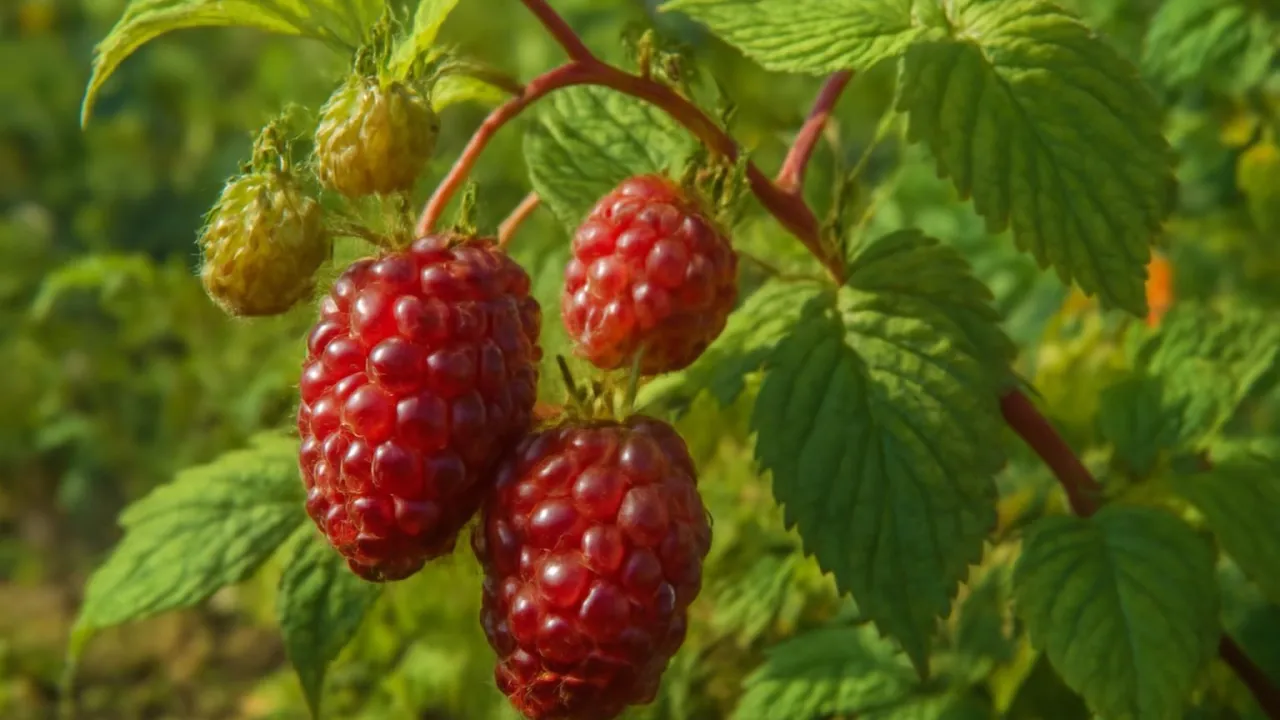
Loganberries were first created by crossing a blackberry and a raspberry in 1881!
✨ Word Sparks (Grade 2 Glossary)
Tap 🔊 to hear
hybrid
A mix of two different plants or animals.
ripe
When fruit is ready to eat.
seeds
Tiny parts inside fruit that grow new plants.
🪝
Have you ever tasted a berry that is part raspberry and part blackberry?
1
What Does a Loganberry Look Like?
Loganberries look like big, red raspberries with shiny skin. They grow on thorny bushes that need sunlight. The berries are juicy and have many tiny inside.
2
Where Do Loganberries Grow Best?
These berries grow best in warm, sunny places with good soil. They need moderate water to stay healthy and produce fruit. Birds often visit the bushes to eat the berries.
3
Why Are Loganberries Special?
Loganberries are special because they are a of two berries. They taste both sweet and sour, making them great for jams and desserts. People enjoy their rich flavor and bright color.
Loganberries were first bred in California in 1881 by Judge J. H. Logan!
✨ Word Sparks (Grade 3 Glossary)
Tap 🔊 to hear
hybrid
A plant made by mixing two different plants.
predator
An animal that eats other animals or plants.
pollinator
An insect that helps flowers make fruit.
🪝
Can you guess why loganberries taste both sweet and sour?
1
A Berry Made by Nature
Loganberries are a of blackberry and raspberry plants. They have bright red skin and many tiny seeds. Their juicy flesh tastes both sweet and tart. This helps attract animals to eat and spread seeds.
2
How Loganberries Protect Themselves
The bushes have sharp thorns to keep animals away. They grow on strong canes that climb over other plants. Full sunlight helps the berries grow big and sweet. The roots hold the plant steady in many soils.
3
Helping Other Living Things
Birds and small animals eat the berries and spread seeds far away. Bees visit the flowers to help pollinate and make fruit. This helps plants grow in new areas. Loganberries support many parts of their ecosystem.
4
How People Use Loganberries
People make jams, pies, and juices from the berries. They have vitamin C that keeps people healthy. Farmers grow them in gardens and farms. Loganberries are tasty and good for you.
1. What helps protect loganberry bushes from animals?
2. Which animals help spread loganberry seeds?
🤯 Mind-Blowing Fact • Grade 4
Loganberries help support pollinators and wildlife, making them important in many food webs.
✨ Word Sparks (Grade 4 Glossary)
Tap 🔊 to hear
symbiotic
A helpful relationship between two living things.
biodiversity
Many different kinds of plants and animals living together.
pollination
When pollen moves to help flowers make fruit.
🪝
How does the loganberry’s hybrid nature affect its role in ecosystems worldwide?
1
Origin and Growth Habits
The loganberry was first bred in California in 1881 by Judge J. H. Logan, combining blackberry and raspberry genetics. It thrives in temperate climates with full sun exposure and well-drained soils, adapting well to various environments. Its thorny canes help protect the plant, allowing it to spread and climb efficiently. These growth habits enable the loganberry to compete successfully within its ecosystem.
2
Ecological Roles and Relationships
Loganberries serve as a food source for many birds and small mammals, which in turn disperse seeds across wide areas, aiding plant reproduction. Pollinators such as bees are attracted to the flowers, facilitating and fruit production. This relationship supports and contributes to healthy food webs. The berries’ nutritional content also benefits wildlife during scarce food periods.
3
Human Uses and Agricultural Impact
Humans cultivate loganberries primarily for fresh consumption and processing into jams, juices, and desserts, thanks to their unique sweet-tart flavor. Farming practices influence local ecosystems by altering soil and water use, but sustainable methods help maintain environmental balance. Loganberries also contribute economically to regional agriculture in North America and parts of Europe. Their cultivation encourages by supporting pollinators and wildlife habitats.
4
Geographic Distribution and Environmental Adaptations
Originally bred in North America, loganberries are now grown in temperate regions worldwide, including Europe and New Zealand. Their adaptability to different soils and climates allows them to thrive beyond their native range. The plant’s ability to resist certain pests and diseases helps maintain healthy crops. Environmental factors such as temperature and rainfall influence berry size and sweetness, demonstrating the plant’s responsive adaptations.
Loganberries contain more vitamin C than many common berries, supporting immune health naturally.
✨ Word Sparks (Grade 5 Glossary)
Tap 🔊 to hear
hybridization
Mixing two plants to make a new kind of plant.
photosynthesis
How plants use sunlight to make food.
genetic
Related to the traits passed from parents to babies.
🪝
What makes the loganberry a fascinating example of hybridization and ecological adaptation?
1
Taxonomy and Scientific Background
The loganberry (Rubus × loganobaccus) is a hybrid species resulting from crossing the blackberry (Rubus ursinus) and raspberry (Rubus idaeus). This was first achieved in 1881 by Judge James Harvey Logan in California, combining traits from both parent species. The plant belongs to the Rosaceae family, which includes many important fruit crops. Its unique makeup gives it distinct physical and flavor characteristics.
2
Physiological Mechanics and Growth
Loganberry plants produce thorny canes that grow vigorously and climb over other vegetation for sunlight access. Their leaves are compound with serrated edges, aiding efficiency. The plant’s flowers attract pollinators such as bees, which transfer pollen to enable fertilization and fruit development. The berries develop over several weeks, accumulating sugars and acids that create their signature tart-sweet flavor.
3
Ecological and Agricultural Significance
Ecologically, loganberries provide essential food for birds and mammals, which aid seed dispersal and promote diversity. Agriculturally, they are cultivated in temperate regions for fresh markets and processed products like jams and juices. Sustainable farming practices help minimize environmental impacts while maintaining soil health and water quality. Loganberries also support pollinator populations, essential for ecosystem services.
4
Conservation and Botanical History
While not endangered, loganberries represent an important botanical hybrid with historical significance in horticulture. Their development expanded fruit diversity and introduced new flavors to markets. Conservation efforts focus on preserving heirloom varieties and resources. Botanical gardens and research institutions study their genetics to improve disease resistance and crop yields.
5
Quantitative Comparisons and Adaptations
Loganberries typically measure about one inch (2.5 cm) long and weigh roughly two grams each. They grow best in temperatures between 60 and 80 degrees Fahrenheit (16 to 27 degrees Celsius). Their thorny canes can reach lengths of up to 10 feet (3 meters), enabling vigorous growth. Compared to blackberries and raspberries, loganberries have higher vitamin C content, making them a nutritious choice.