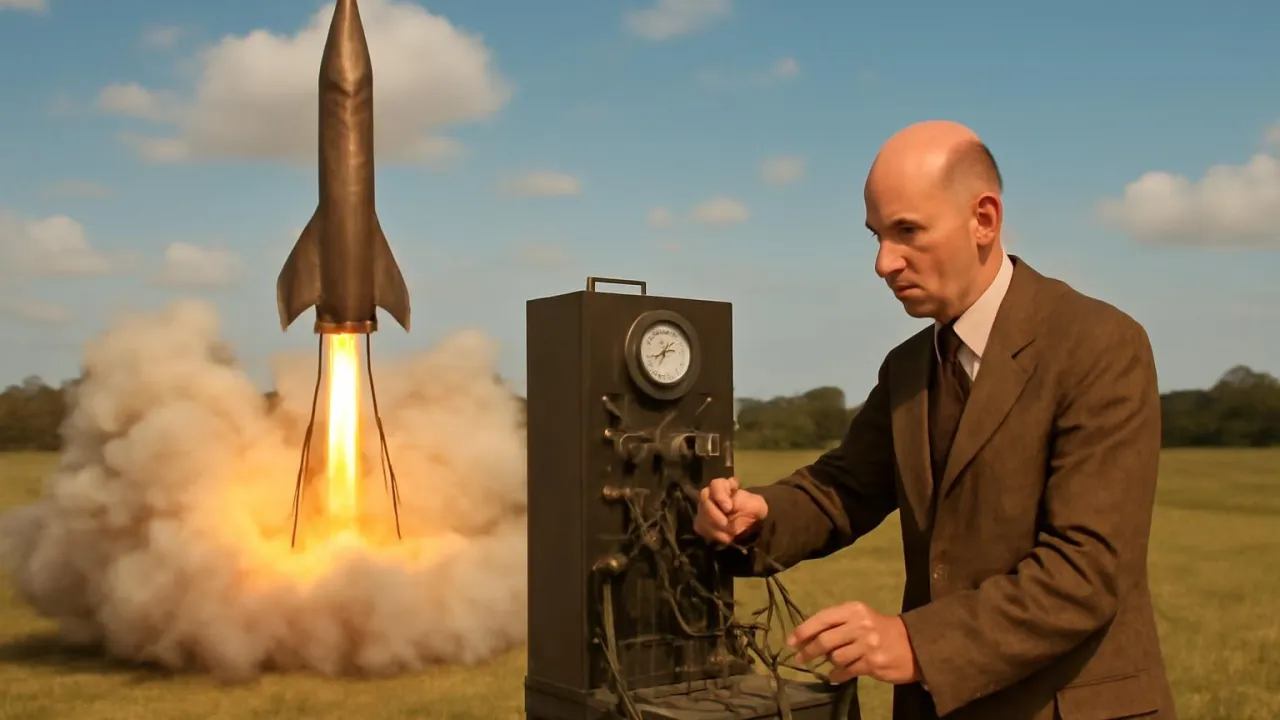
The first liquid-fueled rocket only flew for two and a half seconds.
✨ Word Sparks (Grade 2 Glossary)
Tap 🔊 to hear
inventor
A person who makes new things
liquid
Something that flows, like water
gas
Air that can push things
🪝
Can you imagine seeing fire shoot from a rocket?
1
The First Rocket Launch
Long ago, people watched a rocket blast off with a huge roar. It was the first time a rocket used fuel, which burned hot and bright. The , Dr. Goddard, wanted to reach the sky.
2
How Liquid Fuel Works
fuel is poured inside the rocket, and then it is set on fire. The burning fuel makes hot that pushes the rocket up. This helps the rocket go much higher than before.
3
Exploring New Worlds
Rockets help us send things into space, like satellites and astronauts. We can learn about planets and stars far away. Rockets changed how people explore our universe.
Goddard’s first rocket only flew 41 feet high—about as tall as a four-story building!
✨ Word Sparks (Grade 3 Glossary)
Tap 🔊 to hear
prototype
A first test model of something
thrust
A strong push that moves things
combustion
Burning that makes heat and gas
🪝
What would it feel like to stand near a roaring rocket launch?
1
A New Kind of Rocket
On a cold day in 1926, Dr. Robert Goddard launched a rocket that changed history. Instead of using black powder, his rocket used liquid fuel, which created a powerful blast. People nearby could feel the ground shake and hear the thunderous sound. This was the first step toward modern space travel.
2
How Liquid Fuel Rockets Work
Inside the rocket, two liquids—fuel and oxidizer—mix together. When they meet, a chemical reaction makes hot gas that rushes out the nozzle. This force, called , pushes the rocket upward against gravity. The process uses important science words like and propulsion.
3
From Prototypes to Spacecraft
Goddard’s early rockets were small , but they proved liquid fuel worked. Later, engineers made much bigger rockets using the same principle. These new rockets could carry satellites and people far into space.
4
Changing Our World
Liquid-fueled rockets opened the door to exploring the Moon, Mars, and beyond. They helped launch satellites that send us weather reports and phone signals. This invention made the Space Age possible for everyone on Earth.
1. What two things mix inside a liquid-fueled rocket?
2. Why are liquid-fueled rockets important for space travel?
🤯 Mind-Blowing Fact • Grade 4
The Saturn V rocket, powered by liquid fuel, stood 363 feet tall and took astronauts to the Moon.
✨ Word Sparks (Grade 4 Glossary)
Tap 🔊 to hear
oxidizer
A chemical that helps things burn
combustion chamber
Where fuel burns inside a rocket
Newton’s Third Law
For every push, there’s a push back
🪝
What powerful science lets rockets break free from Earth's gravity?
1
The Dawn of Rocket Science
On March 16, 1926, Dr. Robert Goddard launched the world’s first liquid-fueled rocket in Massachusetts. Instead of using solid powder, he combined gasoline and liquid oxygen to create a controlled explosion. This breakthrough allowed rockets to be much more powerful and adjustable. Goddard’s invention marked the true beginning of modern rocketry.
2
The Physics Behind the Blast
Liquid-fueled rockets work by mixing a fuel with an inside a . When ignited, this mixture undergoes rapid combustion, producing hot gases that expand quickly. The gases escape through a nozzle, creating thrust that propels the rocket upward. This process demonstrates : for every action, there is an equal and opposite reaction.
3
From Prototype to Space Exploration
Goddard’s early prototypes were small, but they proved liquid fuel could lift rockets. Over time, engineers built larger rockets using the same principles, capable of reaching orbit. These rockets launched satellites, astronauts, and probes to the Moon, Mars, and beyond.
4
A World Changed by Rockets
Liquid-fueled rockets sparked the Space Age, making global communication and space exploration possible. Satellites launched by these rockets help us forecast weather, navigate with GPS, and study our planet from above. The invention continues to inspire engineers and explorers around the world.
1. What chemical did Goddard use as the oxidizer in his rocket?
2. Why are liquid-fueled rockets better than solid-fueled ones for space travel?
🤯 Mind-Blowing Fact • Grade 5
Modern liquid-fueled rockets can lift over 100,000 kilograms—about the weight of a blue whale—into space.
✨ Word Sparks (Grade 5 Glossary)
Tap 🔊 to hear
oxidizer
A substance that helps fuel burn in rockets
thrust
The strong force that pushes rockets upward
payload
The cargo or people a rocket carries
🪝
How did a backyard experiment spark the age of interplanetary travel?
1
A Fiery Leap Into the Future
On a chilly March morning in 1926, Dr. Robert H. Goddard’s experimental rocket thundered skyward from a snowy field in Auburn, Massachusetts. Unlike earlier fireworks or solid-fuel rockets, Goddard’s design relied on gasoline and liquid oxygen, which mixed and combusted in a pressurized chamber. This controlled reaction produced a powerful jet of hot gas that blasted from the nozzle, propelling the rocket upward. The launch, which lasted just 2.5 seconds and reached an altitude of 41 feet, marked the first successful flight of a liquid-fueled rocket in human history. Goddard’s invention would forever alter the course of science and exploration.
2
Engineering Marvels: How Liquid Rockets Work
Liquid-fueled rockets store their fuel and in separate pressurized tanks, which are pumped into a combustion chamber at precise rates. When ignited, the fuel and oxidizer react chemically, producing superheated gases that expand rapidly and escape through a narrow nozzle. This process generates enormous , measured in kilonewtons, which can be adjusted mid-flight by regulating the flow of liquids. The rocket’s structure must withstand intense heat, vibration, and pressure during launch, requiring advanced materials and engineering solutions. This technology enables rockets to carry heavy and travel far beyond Earth’s atmosphere.
3
From Backyard Prototype to Moon Landings
Although Goddard’s first rocket was only ten feet tall, his pioneering work inspired engineers worldwide. By the 1960s, liquid-fueled rockets like the Saturn V, which stood 363 feet tall and generated 7.5 million pounds of , made it possible for humans to reach the Moon. These rockets used multiple stages and sophisticated guidance systems to escape Earth’s gravity and travel through space. Today, liquid-fueled engines power most major space missions, from launching satellites to sending robotic explorers to Mars and beyond.
4
Global Impact and the Space Age
The invention of the liquid-fueled rocket transformed not only science but also global society. Satellites launched by these rockets have revolutionized communication, weather forecasting, navigation, and environmental monitoring. Space exploration has expanded our knowledge of the universe, inspired international cooperation, and driven technological innovation in countless fields. Goddard’s vision laid the foundation for the modern space industry and continues to inspire new generations of scientists and engineers.
5
The Science Behind the Spectacle
The physics of liquid-fueled rockets is rooted in Newton’s Third Law: for every action, there is an equal and opposite reaction. As hot gases rush out of the rocket’s nozzle at velocities exceeding 2,500 meters per second, the rocket is in the opposite direction. Engineers must calculate fuel ratios, combustion temperatures, and nozzle shapes to maximize efficiency and stability. Advances in materials science, computer modeling, and automation have made today’s rockets safer, more reliable, and capable of reaching farther than ever before.