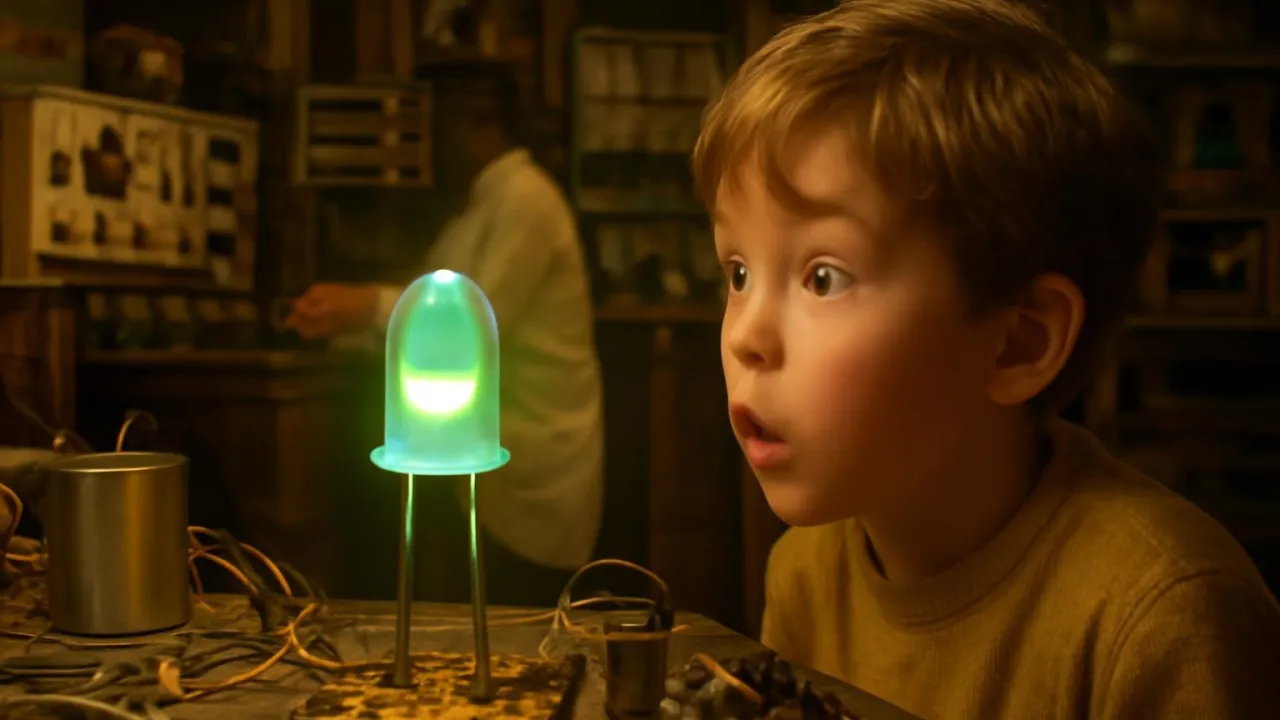
The first visible LED glowed red and was invented in 1962!
✨ Word Sparks (Grade 2 Glossary)
Tap 🔊 to hear
semiconductor
A special material that controls electricity
signal
A sign or light that tells you something
energy
Power that makes things work
🪝
Have you ever wondered how tiny lights can shine in so many colors?
1
Tiny Lights, Big Jobs
LEDs are small, bright lights that use very little . You can find them in clocks, toys, and even traffic . These special lights can glow red, green, blue, or white. They help people see in the dark and make things look colorful.
2
How Do LEDs Work?
An LED has a tiny chip that glows when electricity passes through it. The chip is made from special materials called . When the electricity moves, the chip makes a bright, colorful light. This light is cool to the touch and lasts a long time.
3
LEDs All Around Us
LEDs are used in flashlights, TV screens, and even Christmas lights. They help save because they do not get hot or burn out quickly. Many people use LEDs to light their homes and schools. These lights make our world brighter and more fun.
Some blue LEDs are so bright they can be seen from over a mile away!
✨ Word Sparks (Grade 3 Glossary)
Tap 🔊 to hear
electroluminescence
Light made when electricity moves through a material
semiconductor
Material that lets electricity flow in special ways
efficient
Works well using little energy
🪝
Imagine a world where tiny lights make giant screens and city streets glow!
1
A Bright New Invention
In 1962, Nick Holonyak Jr. invented the first visible LED. This tiny light could glow red, and it was much more than old bulbs. LEDs use a chip to make light, not heat. That means they last much longer and save lots of energy.
2
How Does an LED Shine?
LED stands for light-emitting diode, a special electronic part. When electricity flows through the , it causes vibration of tiny particles called electrons. These vibrations release energy as light, a process called . That’s why LEDs can glow in many colors.
3
LEDs in Everyday Life
You see LEDs in traffic lights, TV screens, and even tiny flashlights. Because they use so little power, LEDs are used in solar lights and battery-powered toys. Some Christmas lights and signs use hundreds of LEDs to make bright displays. Their long life means less waste and lower costs.
4
Changing the World with Light
LEDs have made lighting safer, cheaper, and more colorful all over the globe. They help save electricity in homes, schools, and cities. Scientists keep improving LEDs to make them brighter and more . Today, LEDs light up everything from giant stadiums to tiny computer screens.
1. What makes an LED different from an old light bulb?
2. Why do cities like using LED streetlights?
🤯 Mind-Blowing Fact • Grade 4
A single LED can last up to 50,000 hours—over five years of nonstop glowing!
✨ Word Sparks (Grade 4 Glossary)
Tap 🔊 to hear
photon
A tiny particle of light
electroluminescence
Making light by moving electricity through a material
indicator
A small light that shows something is working
🪝
Can you picture a single, tiny light that could brighten up a whole city?
1
The Spark of a Bright Idea
In 1962, engineer Nick Holonyak Jr. created the first visible-spectrum LED, which glowed a vivid red. Before this breakthrough, light bulbs used filaments that wasted energy as heat. Holonyak’s invention used a semiconductor crystal, which produced light through a process called . This made LEDs much more efficient and long-lasting than traditional bulbs.
2
How LEDs Make Light
An LED, or light-emitting diode, works by moving electricity through a semiconductor material. When electrons move through the diode, they drop to a lower energy state and release energy as , which we see as light. The color of the light depends on the materials used in the semiconductor. Unlike old bulbs, LEDs do not get hot, making them safer and more energy-efficient.
3
Everyday Uses and Global Impact
LEDs have transformed how we light our world, from tiny lights to massive stadium displays. They are found in traffic signals, smart TVs, and even underwater flashlights. Because they use so little electricity and last for tens of thousands of hours, LEDs help reduce pollution and save money. Cities and countries around the world have switched to LED streetlights to save energy and protect the environment.
4
The Future of Lighting
Scientists continue to improve LEDs, making them brighter, more colorful, and even more efficient. New research has led to white LEDs that can light entire homes and schools. Some LEDs can even be used in medical devices and plant-growing lamps. As technology advances, LEDs will keep lighting up our world in exciting new ways.
Modern LEDs can convert over 80% of their electrical energy directly into visible light—far more than any traditional bulb.
✨ Word Sparks (Grade 5 Glossary)
Tap 🔊 to hear
semiconductor
A material that controls how electricity flows
phosphor
A coating that changes LED light color
quantum dot
A tiny crystal that glows with special colors
🪝
What if the world’s brightest billboards, most efficient lamps, and tiniest screens all relied on one invention?
1
The Dawn of Solid-State Lighting
In 1962, Nick Holonyak Jr. engineered the first visible-spectrum LED while working at General Electric, sparking a revolution in lighting technology. Unlike incandescent bulbs, which generate light by heating a metal filament, LEDs use solid-state materials to produce light directly. This innovation marked the beginning of a new era, enabling lighting that was not only more energy-efficient but also more durable and versatile than ever before.
2
How LEDs Emit Light: The Science of Electroluminescence
An LED, or light-emitting diode, is constructed from layers of materials such as gallium arsenide or gallium nitride. When a voltage is applied, electrons move across the junction between these layers, dropping to lower energy levels and releasing photons in a process called electroluminescence. The wavelength—and thus the color—of the emitted light depends on the specific materials and atomic structure of the semiconductor. Unlike traditional bulbs, LEDs convert most of their electrical energy directly into visible light, minimizing wasted heat.
3
From Indicators to Illuminators: The Evolution of LEDs
Early LEDs could only emit red light and were mainly used as indicator lights in electronics. Over decades, advances in chemistry led to the development of green, yellow, and, eventually, blue LEDs. The invention of blue LEDs in the 1990s enabled the creation of white LEDs by combining different colors or using coatings. Today, LEDs can produce nearly every color of the rainbow and are used in everything from traffic signals and car headlights to smartphone screens and medical devices.
4
Global Impact and Environmental Benefits
LEDs have dramatically reduced global electricity consumption for lighting, as they are up to 80% more efficient than incandescent bulbs. Their long lifespan—often exceeding 50,000 hours—means fewer replacements and less waste, helping to protect the environment. Cities worldwide have adopted LED streetlights to cut costs and lower carbon emissions, while households benefit from cooler, safer, and more reliable lighting. LEDs are also crucial in reducing light pollution and enabling new technologies like energy-saving smart lighting systems.
5
The Future: Smart, Sustainable, and Beyond
Ongoing research continues to push the boundaries of what LEDs can achieve, from ultra-efficient organic LEDs (OLEDs) for flexible displays to specialized LEDs for growing plants and purifying water. Scientists are exploring LEDs for even richer colors and higher efficiency. As the world seeks sustainable solutions, LEDs remain at the forefront, lighting the way toward a brighter, cleaner, and more innovative future for everyone.