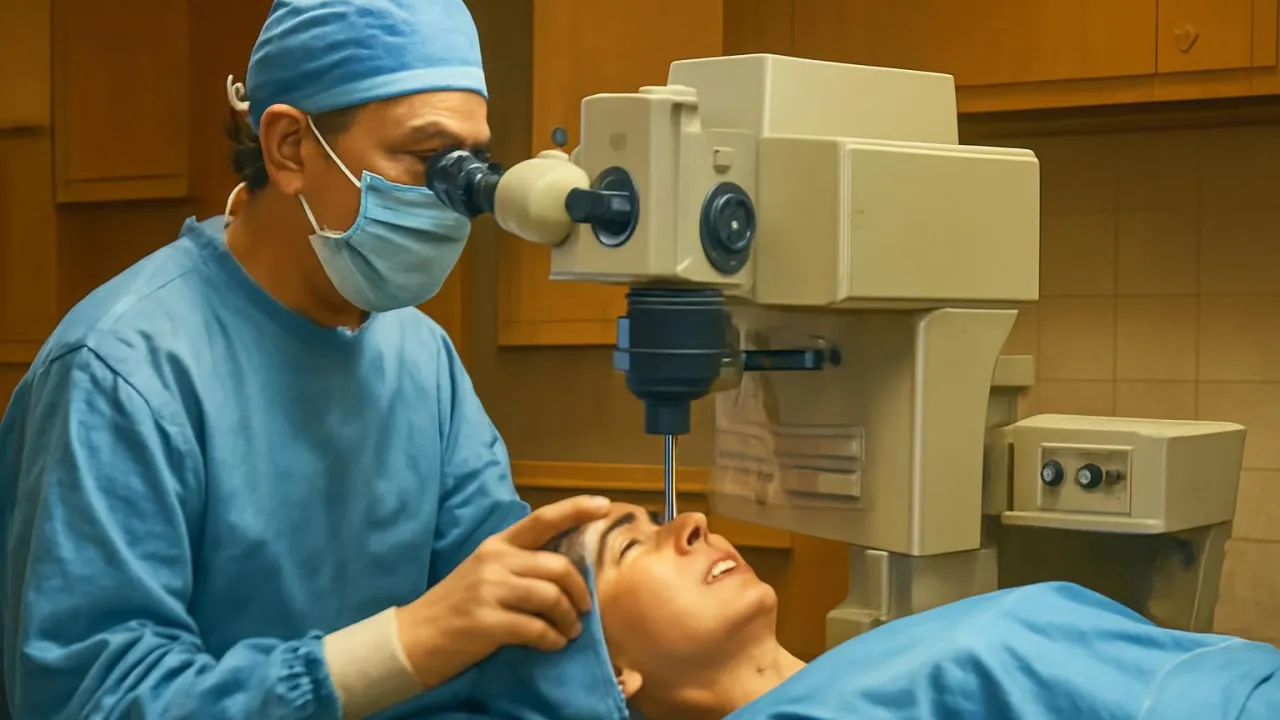
Laser eye surgery can take less than 15 minutes for each eye!
✨ Word Sparks (Grade 2 Glossary)
Tap 🔊 to hear
vision
How well you can see
surgery
A doctor fixing a body part
focus
To see something clearly
🪝
Have you ever wondered how light can help you see better?
1
A Magic Light in the Eye
Doctors use a special laser light to help people see. The light is cool and does not hurt. It can fix blurry and help eyes .
2
How the Machine Works
The doctor uses a big laser machine in a clean room. The machine makes quick beeping sounds as it works. The laser gently changes the shape of the eye’s surface.
3
Clearer Sight for Many
After , many people can see clearly without glasses. They feel happy and surprised by the quick change. Laser eye surgery helps millions of people every year.
The excimer laser can remove tissue thinner than a human hair!
✨ Word Sparks (Grade 3 Glossary)
Tap 🔊 to hear
cornea
The clear front part of your eye
ablation
Taking away tiny bits of tissue
retina
The part in your eye that senses light
🪝
Can you imagine a beam of light gently fixing your eyesight?
1
A Laser’s Gentle Touch
In a quiet room, a doctor points a cool, focused laser at the eye. The laser makes soft clicking sounds as it moves. This special light is called an excimer laser, and it does not burn or hurt. Instead, it carefully reshapes the , which is the clear front part of your eye.
2
How Does It Work?
The laser uses pulses of ultraviolet light to remove tiny bits of tissue. This process is called , and it changes the curve of the . By changing the shape, the eye can focus light better onto the . After surgery, many people no longer need glasses or contact lenses.
3
A Modern Medical Marvel
Laser eye surgery was first performed in the late 1980s. Doctors and scientists worked for years to make the procedure safe and fast. Today, millions of people around the world choose this surgery every year. It is now one of the most common vision correction methods.
4
Safe and Quick Recovery
Most surgeries take less than 30 minutes for both eyes. Patients often notice clearer vision within a day or two. Doctors use numbing drops so there is little pain during the procedure. Many people say it feels like magic to wake up and see clearly.
Some lasers used in eye surgery can make over 1,000 pulses every second!
✨ Word Sparks (Grade 4 Glossary)
Tap 🔊 to hear
ultraviolet
A type of light we cannot see
refractive error
When your eye cannot focus light well
photoablation
Using light to gently remove tissue
🪝
What if a surgeon could use light, not a blade, to fix your vision forever?
1
The Science of Precision Light
Inside a high-tech clinic, a surgeon uses an excimer laser, which emits cool light, to reshape the cornea with incredible precision. This process, known as , removes microscopic layers of tissue without harming the surrounding eye. The laser’s energy is absorbed only by the cornea, preventing heat or damage to other parts. Each pulse of light is carefully controlled by a computer to ensure accuracy.
2
How Laser Eye Surgery Changes Vision
The cornea acts like a window, focusing light onto the retina at the back of the eye. If the cornea is too curved or too flat, vision becomes blurry, a problem called . By reshaping the cornea’s surface, the laser corrects these errors, allowing light to focus perfectly. This means people can often see clearly without glasses or contact lenses.
3
A Modern Invention with Global Impact
Laser eye surgery was first performed in 1987 by Dr. Ioannis Pallikaris in Greece. Since then, the technology has spread worldwide, helping over 40 million people improve their vision. The invention has made a huge difference in everyday life, letting people swim, play sports, and work without worrying about glasses. It is now considered one of the safest and most effective elective surgeries.
4
Safe, Fast, and Ever-Improving
Most procedures last less than 15 minutes per eye, with very little discomfort. Surgeons use numbing drops, and patients are awake during the surgery. Recovery is quick, and most people notice better vision within a day. New laser technologies continue to make the surgery even safer and more precise each year.
1. Why is the excimer laser safer than a blade for eye surgery?
2. What problem does laser eye surgery fix?
🤯 Mind-Blowing Fact • Grade 5
Excimer lasers used in LASIK can deliver up to 500 millionths-of-a-second pulses per second with pinpoint accuracy!
✨ Word Sparks (Grade 5 Glossary)
Tap 🔊 to hear
nanometer
A tiny unit for measuring light waves
myopia
Trouble seeing things far away
femtosecond
A millionth of a billionth of a second
🪝
Imagine if a surgeon could use invisible energy to sculpt your eye and give you perfect vision—how does it work?
1
Harnessing Light: The Physics Behind Laser Eye Surgery
Laser eye surgery relies on the excimer laser, which emits ultraviolet light at a wavelength of 193 . This specific wavelength is absorbed by corneal tissue, breaking molecular bonds through a process called photoablation without generating damaging heat. Each laser pulse removes only about 0.25 microns of tissue—less than one-thousandth the thickness of a human hair—allowing for extreme precision. Advanced computer guidance systems track even the slightest eye movement, ensuring the laser reshapes the cornea exactly as planned. This precise sculpting corrects refractive errors such as , hyperopia, and astigmatism.
2
Engineering a Medical Revolution
The first successful laser eye surgery on a human was performed in 1987 by Dr. Ioannis Pallikaris in Greece, building on decades of research in optics and laser physics. Early prototypes required manual adjustments, but modern systems use sophisticated eye-tracking and mapping technology. The procedure, known as LASIK (Laser-Assisted In Situ Keratomileusis), involves creating a thin corneal flap, reshaping the underlying tissue with the laser, and then repositioning the flap. This method allows for rapid healing and minimal discomfort.
3
From Laboratory to Worldwide Impact
Laser eye surgery has transformed vision care for over 40 million people worldwide. It enables athletes, pilots, and everyday people to live without dependence on glasses or contact lenses. The technique’s safety and effectiveness have made it one of the most popular elective surgeries globally. Ongoing innovations, such as lasers and wavefront-guided treatments, continue to improve outcomes and expand eligibility for more patients.
4
Safety, Recovery, and Future Directions
LASIK is typically performed in under 15 minutes per eye, with most patients experiencing improved vision within 24 hours. Numbing drops eliminate pain, and complications are rare due to advanced safety protocols. Researchers are now developing even more precise lasers and exploring non-invasive procedures that may one day correct vision without surgery at all. The future of laser eye surgery promises even greater accuracy and accessibility.
5
A Lasting Legacy in Medical Science
The invention of laser eye surgery represents a remarkable intersection of physics, engineering, and medicine. It has given millions the freedom to see the world clearly and has inspired further innovation in medical laser technology. As scientists continue to refine these tools, laser-based procedures are likely to revolutionize other areas of healthcare, from cancer treatment to delicate brain surgery. The story of laser eye surgery is a shining example of how science and imagination can change lives.