🇺🇸 U.S. HISTORY
🏛️ NASA Aerospace Mathematicians • Hampton, Virginia
VA History & Social Science SOL K.1, 1.2, 2.4, VS.1–VS.10, USI & USII
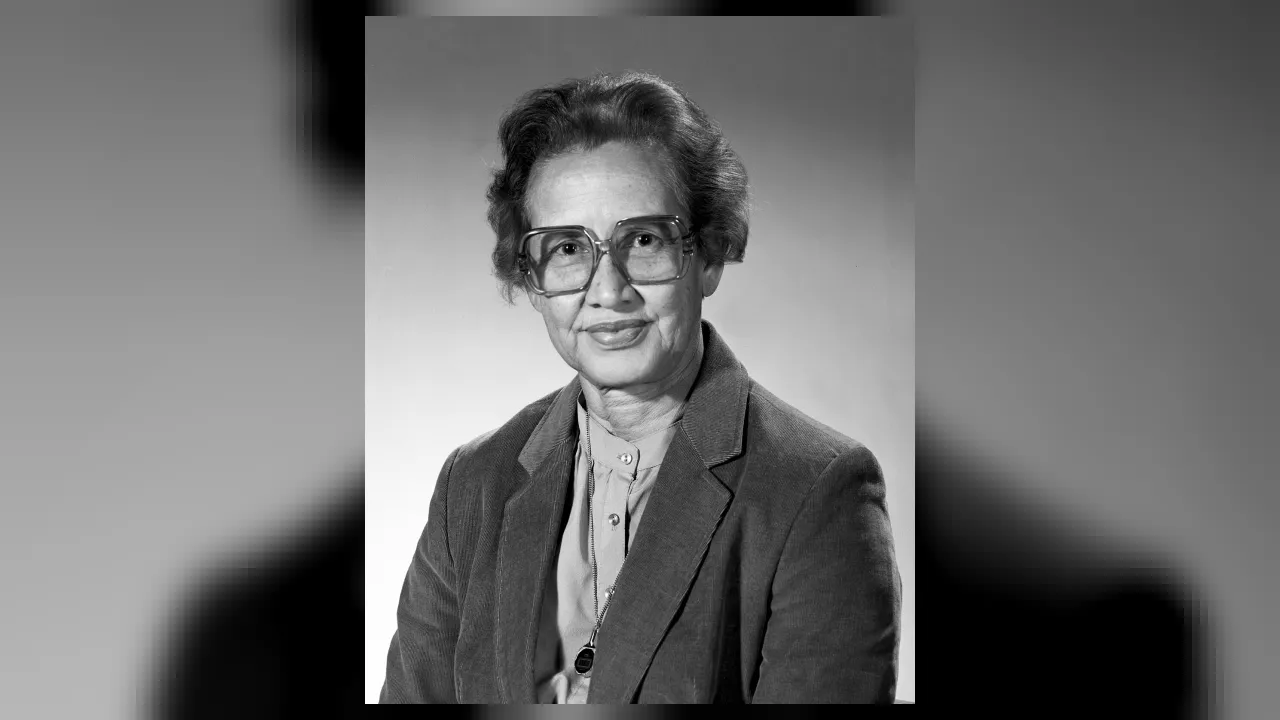
Katherine Goble & Hidden Figures of Langley
Virginia Math Genius Who Guided Astronauts Home
Grade 1 • Early Reader • 62 words
⏳ Era / StatehoodSpace Race Era: 1940s–1970s (Mercury & Apollo)
🗺️ Region / CapitalLangley Research Center, Hampton, Virginia
📜 Key MilestoneCalculated Flight Paths for Friendship 7 and Apollo 11
⚡ Historical SparkUsed pencil-and-paper math to launch astronauts safely into space
🤯 Mind-Blowing Fact • Grade 1
Katherine loved learning so much that she started high school when she was only ten years old!
✨ Word Sparks (Grade 1 Glossary)
Tap 🔊 to hear
mathematician
An expert who solves problems using numbers
orbit
A curved path circling around a planet
astronaut
A trained explorer who travels into space
🪝
How can a sharp pencil and smart math send a rocket to space?
1
Counting Everything in Sight
One, two, three, four! Young Katherine loved counting steps, dishes, and bright stars. Numbers were her best friends.
2
Human Computers in Virginia
Before big electronic machines existed, people solved rocket math by hand. Katherine Goble worked with brilliant Black women at Langley in Hampton, Virginia.
3
Bringing Astronauts Home Safe
Katherine checked the flight numbers for John Glenn. Her exact math helped rockets Earth and reach the Moon!
1. In which state did Katherine Goble and the Hidden Figures do their famous space math?
2. What was a 'human computer' at Langley?
🤯 Mind-Blowing Fact • Grade 2
Katherine Johnson graduated from college with highest honors in mathematics and French when she was just eighteen years old!
✨ Word Sparks (Grade 2 Glossary)
Tap 🔊 to hear
trajectory
The exact curved flight path of a spacecraft
engineer
A builder who uses science to design machines
accurate
Completely right and free from any mistakes
🪝
Why did astronaut John Glenn trust one mathematician in Virginia more than a giant room-sized computer?
1
Check the Numbers!
Three, two, one—wait! In 1962, astronaut John Glenn prepared to become the first American to orbit Earth, yet NASA's brand-new electronic computers sometimes glitched. Before climbing aboard Friendship 7, Glenn asked to have Katherine Goble Johnson check every single number by hand.
2
The Hidden Figures of Hampton
At Langley Research Center in Hampton, Virginia, Katherine worked alongside trailblazers Dorothy Vaughan and Mary Jackson. Even when unfair segregation laws placed them in a separate West Area office, their teamwork solved NASA's hardest flight puzzles.
3
From Earth Orbit to the Moon
Katherine's math matched perfectly, John Glenn orbited safely, and later her calculations helped Apollo 11 astronauts land on the Moon and return home.
1. Which astronaut asked Katherine to double-check the computer numbers before orbiting Earth in 1962?
2. Who were two of Katherine's famous teammates at Langley Research Center?
🤯 Mind-Blowing Fact • Grade 3
NASA named a brand-new 37,000-square-foot Computational Research Facility in Hampton, Virginia, after Katherine G. Johnson in 2017!
✨ Word Sparks (Grade 3 Glossary)
Tap 🔊 to hear
geometry
Math studying shapes, angles, sizes, and positions
petitioned
Formally asked a court or leader for permission
rendezvous
A planned meeting between two spacecraft in orbit
🪝
How did a group of segregated women mathematicians in Hampton, Virginia, help win the Space Race?
1
Chalk Dust and Rocket Paths
Inside a bustling research hangar in Hampton, Virginia, chalk clicked rapidly across a blackboard covered in formulas. Long before pocket calculators existed, African American women hired as 'human computers' at Langley Research Center turned rows of raw wind-tunnel numbers into safe skies and spaceflight.
2
Three Trailblazers at West Computing
Because of Virginia segregation laws in the 1940s and 1950s, Black mathematicians worked in Langley's separate West Area Computing unit. Dorothy Vaughan became the agency's first Black supervisor and taught her staff FORTRAN computer coding, while Mary Jackson a Hampton judge to attend night classes and became NASA's first Black female engineer.
3
Katherine Goble Plots Space
Katherine Goble—later Katherine Johnson—possessed extraordinary skill in analytic . Assigned to the Flight Research Division, she asked thoughtful questions until managers invited her into engineering briefings once closed to women, where she calculated Alan Shepard's 1961 spaceflight trajectory.
4
Honored Across the Nation
After verifying John Glenn's 1962 orbital flight and computing moon-orbit paths for Apollo 11 in 1969, these once-hidden Virginia pioneers finally received national recognition, inspiring future scientists everywhere.
1. How did Dorothy Vaughan prepare her team when huge electronic computers arrived at NASA?
2. What historic milestone did Mary Jackson achieve at NASA?
🤯 Mind-Blowing Fact • Grade 4
NASA eventually renamed its main headquarters street in Washington, D.C., 'Hidden Figures Way' and named its Washington headquarters building after Mary W. Jackson!
✨ Word Sparks (Grade 4 Glossary)
Tap 🔊 to hear
aeronautics
The science of designing and flying aircraft
supersonic
Traveling faster than the speed of sound
synchronized
Timed to happen together at the exact moment
🪝
Why did Virginia's Langley Research Center become the secret brainpower hub of America's earliest space missions?
1
Wartime Opportunity in Hampton Roads
Imagine arriving at the National Advisory Committee for —known as NACA—in Hampton, Virginia, during World War II, when thousands of new airplanes needed wind-tunnel testing. Facing a shortage of mathematicians, NACA began recruiting talented women with college math degrees, including African American graduates from historically Black colleges who formed the West Area Computing pool.
2
Breaking Barriers When NACA Became NASA
Even while segregated signs separated dining tables and offices in Virginia, West Computing women delivered flawless calculations. Dorothy Vaughan became NACA's first African American manager in 1949 and mastered IBM mainframe programming. Mary Jackson studied wind tunnels and won court approval to take graduate engineering courses at segregated Hampton High School, becoming NASA's first Black female engineer in 1958, the very year NACA transformed into NASA and ended segregated facilities.
3
Precision Trajectories for Project Mercury
West Virginia native Katherine Goble joined Langley in 1953 and soon transferred to the elite Space Task Group. Knowing exactly where Alan Shepard's Freedom 7 capsule would splash down in the Atlantic Ocean allowed naval recovery ships to wait in position. Before Friendship 7 launched in February 1962, astronaut John Glenn requested that Katherine personally verify the IBM 7090 orbital equations to many decimal places.
4
Hidden Figures Step Into the Light
Katherine later the Apollo 11 Lunar Module's ascent from the Moon with the orbiting Command Module and helped craft backup navigation charts used to rescue Apollo 13. Awarded the Presidential Medal of Freedom in 2015, she and her Langley colleagues stand among Virginia's greatest scientific heroes.
1. What earlier aviation agency at Langley transformed into NASA in 1958?
2. How did Katherine Johnson's calculations help rescue the Apollo 13 crew?
🤯 Mind-Blowing Fact • Grade 5
In 1960, Katherine Johnson co-authored Report TN D-233 with engineer Ted Skopinski, becoming the very first woman in Langley's Flight Research Division ever named as an author on an official research report!
✨ Word Sparks (Grade 5 Glossary)
Tap 🔊 to hear
parabolic
Shaped like a smooth, symmetrical upward arch
summa cum laude
Graduating from college with the highest academic honors
abolished
Officially ended a rule, system, or practice
🪝
How did analytic geometry calculated on mechanical desk machines in Hampton, Virginia, bridge the leap from propeller airplanes to lunar landings?
1
The Human Computers of West Area
Step inside the brick laboratories of Langley Memorial Aeronautical Laboratory in Hampton, Virginia, in 1953, where rhythmic clacks of Friden mechanical calculators echoed beside supersonic wind tunnels. After President Franklin D. Roosevelt's Executive Order 8802 prohibited racial discrimination in defense hiring in 1941, the National Advisory Committee for Aeronautics (NACA) recruited accomplished African American female mathematicians—yet state Jim Crow statutes initially confined them to the segregated West Area Computing unit.
2
Prodigy From White Sulphur Springs
Born in White Sulphur Springs, West Virginia, in 1918, Katherine Coleman Goble demonstrated mathematical brilliance so early that her parents moved 120 miles so she could attend school past eighth grade. Graduating from West Virginia State College at age eighteen under mentor Dr. William Waldron Schieffelin Claytor—who created advanced analytic geometry courses specifically for her—she taught school before joining Dorothy Vaughan's West Computing pool at Langley in June 1953.
3
Shattering Gender and Racial Ceilings
Temporarily detailed within two weeks to the all-male Flight Research Division, Goble analyzed wake-turbulence data from a crashed aircraft and never returned to the general pool. When NACA reorganized into NASA in October 1958 to lead America's Space Task Group, segregated facilities were . In 1960, Katherine Goble Johnson became the first woman in the Flight Research Division credited as co-author of a technical spaceflight report, establishing equations specifying orbital injection and precise landing coordinates.
4
Mercury, Apollo, and Three Virginia Pioneers
Johnson plotted the suborbital path for Alan Shepard's May 1961 Freedom 7 flight and spent a day and a half verifying IBM 7090 orbital trajectories to eight decimal places at John Glenn's personal request prior to Friendship 7's three-orbit mission on February 20, 1962. Alongside Dorothy Vaughan—who led Langley's transition to FORTRAN digital computing—and Mary Jackson—who conducted wind-tunnel experiments up to twice the speed of sound before championing women in STEM—Johnson computed lunar-orbit rendezvous timing for Apollo 11 in 1969.
5
From Unsung Calculators to Congressional Gold
Following thirty-three years at Langley, Katherine Johnson received the Presidential Medal of Freedom in 2015 and lived to age 101. In 2019, Congress awarded Congressional Gold Medals to Johnson, Vaughan, Jackson, Dr. Christine Darden, and all women computers of NACA and NASA, enshrining Hampton, Virginia's 'Hidden Figures' permanently in American scientific history.