1. What does the name Haudenosaunee mean in English?
2. What did the bundle of five arrows tied together teach the nations?
🤯 Mind-Blowing Fact • Grade 2
The sport of lacrosse was invented centuries ago by the Haudenosaunee, who called it the 'Creator's Game'!
✨ Word Sparks (Grade 2 Glossary)
Tap 🔊 to hear
confederacy
Independent nations joined together for peace
wampum
Polished purple and white shell beads
Clan Mother
Respected female elder who chooses council leaders
🪝
How did a wise Peacemaker bring five warring nations together under a giant white pine tree?
1
Planting the Tree of Peace
Picture five leaders burying their weapons beneath the roots of a tall eastern white pine tree! Centuries ago across what is now New York State, the Peacemaker, Hiawatha, and Jigonhsasee united five nations under the Great Law of Peace.
2
Five Nations Become Six
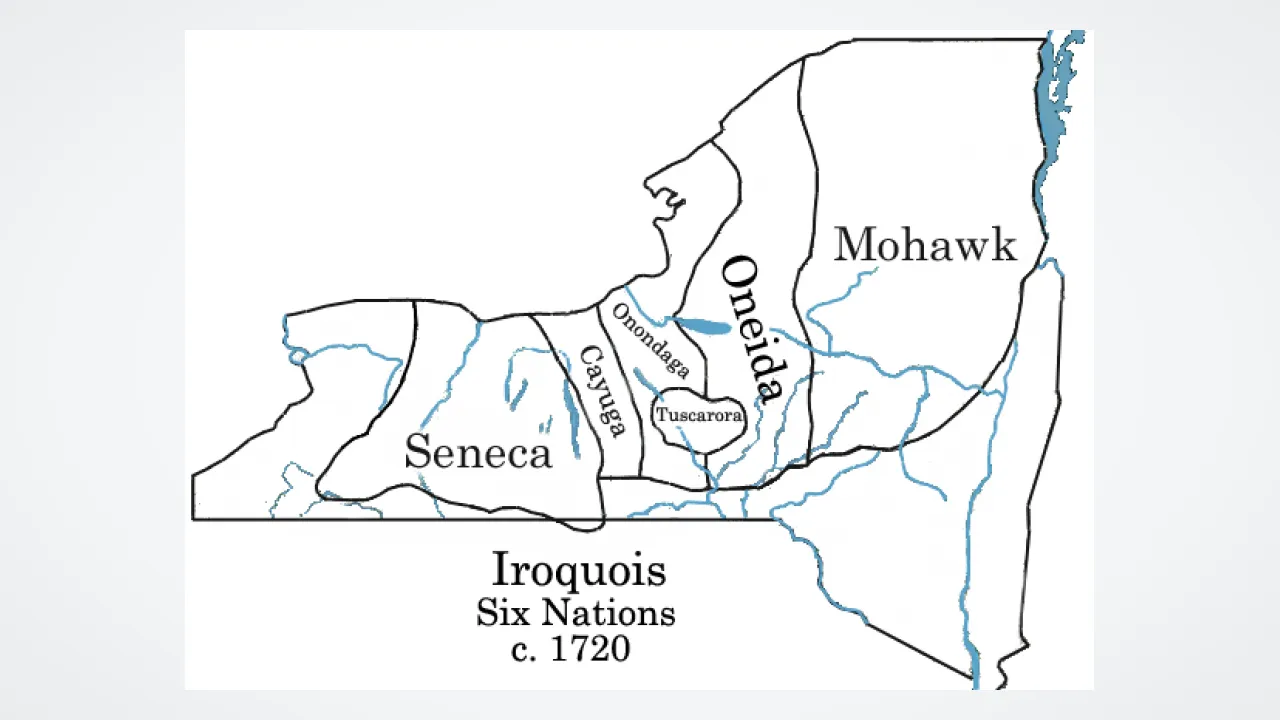
From east to west, the Mohawk, Oneida, Onondaga, Cayuga, and Seneca formed the Iroquois , calling themselves the Haudenosaunee. Around 1722, the Tuscarora moved north and joined them as the sixth nation.
3
Clan Mothers and Wampum Belts
Respected women called chose wise leaders for the Grand Council, and purple-and-white shell belts recorded their sacred laws.
1. Who had the important responsibility of choosing council leaders in Haudenosaunee communities?
2. Which nation joined around 1722 to make the Five Nations into the Six Nations?
🤯 Mind-Blowing Fact • Grade 3
The eagle perched atop the Great Seal of the United States holds a bundle of thirteen arrows—echoing the bundled-arrow symbol of unity taught by the Haudenosaunee Peacemaker!
✨ Word Sparks (Grade 3 Glossary)
Tap 🔊 to hear
consensus
Agreement reached together by the whole council
constitution
Fundamental laws explaining how a government works
matrilineal
Tracing family clan membership through mothers
🪝
How did shell wampum belts, Clan Mothers, and a fifty-leader council create one of Earth's oldest democracies?
1
A Metaphor Across New York
Run your fingers across polished purple quahog clam and white whelk shell beads woven into the famous Hiawatha Belt! For the Haudenosaunee, their entire homeland across upstate New York worked like one giant symbolic longhouse: the Mohawk guarded the Eastern Door near the Hudson River, the Seneca guarded the Western Door near Lake Erie, and the Onondaga tended the central council fire.
2
The Great Law of Peace
Guided by the Peacemaker, orator Hiawatha, and peacemaking leader Jigonhsasee, the Mohawk, Oneida, Onondaga, Cayuga, and Seneca adopted the Great Law of Peace—an oral passed down from generation to generation. Around 1722, the Iroquoian-speaking Tuscarora arrived from North Carolina and became the sixth nation.
3
Consensus and Balanced Power
Clan Mothers nominated fifty male chiefs, called hoyaneh, to represent the clans at the Grand Council in Onondaga. Instead of simple majority rule, council members debated calmly until reaching , and Clan Mothers could remove any chief who ignored the public good.
4
Inspiring Early American Thinkers
Colonial diplomats like Benjamin Franklin studied how the Six Nations stayed united while keeping local self-rule, admiring their model when urging the thirteen American colonies to unite.
1. Which nation kept the central council fire at the heart of the Haudenosaunee homeland?
2. Which early American statesman admired the unity of the Six Nations when urging the colonies to work together?
🤯 Mind-Blowing Fact • Grade 4
Onondaga leader Canassatego directly advised Virginia, Maryland, and Pennsylvania officials at the 1744 Treaty of Lancaster to form one strong union just as the Haudenosaunee had done!
✨ Word Sparks (Grade 4 Glossary)
Tap 🔊 to hear
federalism
Sharing power between local and central governments
impeach
To remove an official who breaks trust
orator
A skilled, persuasive public speaker
🪝
How did the Great Law of Peace divide checks and balances among fifty chiefs, Clan Mothers, and six sovereign nations?
1
Geography of the Symbolic Longhouse
Stand beside Onondaga Lake in central New York and imagine an invisible elm-bark longhouse stretching three hundred miles from the Mohawk Valley to the Genesee River. Long before European ships crossed the Atlantic, five Iroquoian-speaking nations—Mohawk, Oneida, Onondaga, Cayuga, and Seneca—ended cycles of blood feuds by adopting Kaianere'ko:wa, the Great Law of Peace, later welcoming their southern linguistic relatives, the Tuscarora, around 1722.
2
Checks and Balances in the Grand Council
Inside the fifty-seat Grand Council, governance worked like a three-step system of checks and balances. First, the 'Older Brothers' (Mohawk and Seneca) discussed a proposal until they agreed; next, they passed the issue across the council fire to the 'Younger Brothers' (Oneida and Cayuga) for independent debate; finally, the Onondaga 'Firekeepers' verified that both sides agreed and ensured the decision honored the Great Law.
3
Women's Leadership and Seven Generations
Haudenosaunee society was matrilineal: children belonged to their mother's clan—such as Turtle, Wolf, or Bear—and women oversaw farmland and food stores of the Three Sisters. Clan Mothers vetted, appointed, and, after three warnings, could any hoyaneh who failed his duty, reminding leaders to weigh how every choice would affect future generations.
4
Canassatego, Franklin, and U.S. History
At a 1744 treaty council in Lancaster, Pennsylvania, Onondaga leader Canassatego advised colonial commissioners from Virginia, Maryland, and Pennsylvania to form a union like the Six Nations. Benjamin Franklin published Canassatego's speech, and in 1988 the U.S. Congress passed Concurrent Resolution 331 formally acknowledging the Confederacy's influence on American .
1. How did the Hiawatha Belt visually represent the original Five Nations?
2. What happened at the 1744 Treaty of Lancaster involving officials from Virginia, Maryland, and Pennsylvania?
🤯 Mind-Blowing Fact • Grade 5
Today, Haudenosaunee citizens—including their world-famous Haudenosaunee Nationals lacrosse teams—still travel internationally on their own sovereign Haudenosaunee passports first issued in the 1920s!
✨ Word Sparks (Grade 5 Glossary)
Tap 🔊 to hear
autonomous
Self-governing in local community matters
mnemonic
A visual pattern that helps memory
recall
Removing an official from office peacefully
🪝
Why do political historians consider the Haudenosaunee Great Law of Peace one of humanity's most sophisticated pre-modern federal constitutions?
1
Origins of Kaianere'ko:wa
Trace the path of purple quahog and white whelk beads across the Hiawatha Belt: four geometric squares linked by a continuous white band to a central eastern white pine—the Tree of Great Peace—whose four white roots stretch north, south, east, and west. Centuries before European arrival, the Peacemaker, aided by Onondaga-Mohawk orator Hiawatha and neutral clan leader Jigonhsasee, united five warring nations across present-day New York into the Haudenosaunee ('People of the Longhouse'): from east to west, Mohawk (Keepers of the Eastern Door), Oneida, Onondaga (Keepers of the Central Fire), Cayuga, and Seneca (Keepers of the Western Door). Around 1722, the Tuscarora migrated northward from North Carolina after colonial conflicts and were admitted as the sixth nation.
2
Bicameral-Style Deliberation at Onondaga
Preserved orally in 117 articles aided by wampum strings, Kaianere'ko:wa established federalism: each nation governed its internal affairs autonomously while delegating war, peace, and external diplomacy to the fifty-seat Grand Council at Onondaga. Council procedure prevented hasty factions through three chambers of review—the Mohawk and Seneca ('Older Brothers') deliberated first, the Oneida and Cayuga ('Younger Brothers') deliberated second, and the Onondaga Firekeepers confirmed consensus or returned questions for further reflection.
3
Matrilineal Authority and Recall Power
At a time when European monarchies denied women property rights or political voice, Haudenosaunee clans were strictly matrilineal. Women controlled longhouse dwellings and sustainable Three Sisters agriculture, while senior Clan Mothers nominated every male hoyaneh (chief), bestowed his antlers-of-office emblem, and possessed constitutional authority to remove ('dehorn') any representative after three formal warnings for misconduct—an early form of democratic .
4
Diplomacy from Virginia to Philadelphia
Strategically commanding waterways linking the Hudson River, Great Lakes, St. Lawrence, and Appalachian valleys down to Virginia, the Six Nations negotiated Covenant Chain treaties with British colonies. At the 1744 Treaty of Lancaster with Virginia, Maryland, and Pennsylvania commissioners, Onondaga speaker Canassatego counseled colonial delegates that just as bundled arrows resist breaking, the colonies would gain strength through union. Benjamin Franklin published the Lancaster proceedings and referenced the Six Nations while drafting the 1754 Albany Plan of Union.
5
Living Sovereignty Today
In October 1988, Congress passed H.Con.Res. 331 recognizing the Haudenosaunee Confederacy's contribution to early American democratic thought. Today, the Grand Council at Onondaga continues to meet under the Great Law of Peace, making the Haudenosaunee one of the oldest continuously operating participatory democracies on Earth.