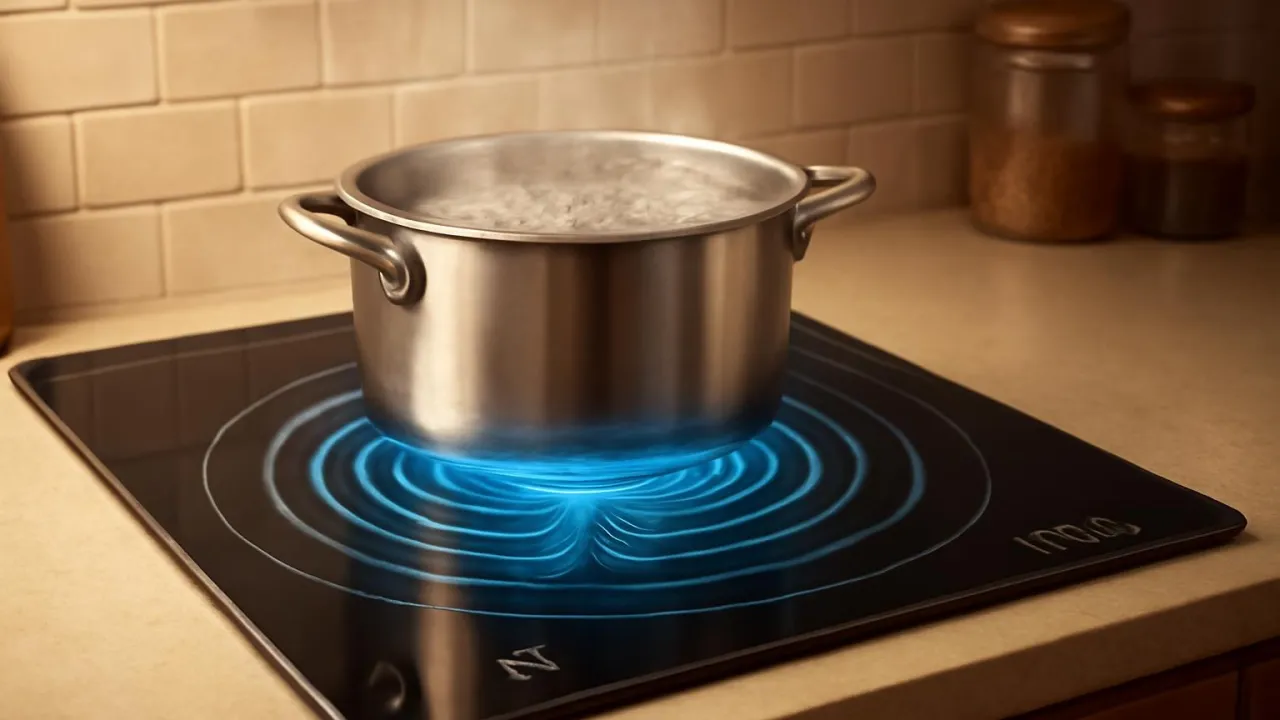
Induction cooktops can heat water faster than most microwave ovens!
✨ Word Sparks (Grade 2 Glossary)
Tap 🔊 to hear
energy
Power that makes things move or work
steel
A strong kind of metal
invisible
Something you cannot see
🪝
What if you could cook with invisible energy and no flames at all?
1
Cooking with a Secret Force
Induction cooktops look shiny and flat, but they use special magnets. These magnets make the pan hot, but the cooktop stays cool. People can cook safely and quickly.
2
How the Magic Happens
The cooktop sends into the metal pan. Only pans made of iron or will work. The food cooks fast because the heat goes straight to the pan.
3
Why People Love It
There are no flames or smoke, so it is very safe. The cooktop is easy to clean and cools down fast. Many kitchens use induction to save time and .
1. What makes the pan hot on an induction cooktop?
2. Why is an induction cooktop easy to clean?
🤯 Mind-Blowing Fact • Grade 3
Induction cooktops can safely melt chocolate without burning it!
✨ Word Sparks (Grade 3 Glossary)
Tap 🔊 to hear
induction
Making energy move with magnets
vibration
Fast shaking or moving back and forth
coil
Wire wound in a loop or spiral
🪝
Have you ever watched water boil without seeing any flames or glowing coils?
1
A New Way to Cook
cooktops seem like magic, but they use science to heat food. They have a smooth, glass surface that stays cool to the touch. Underneath, a of wire creates a changing magnetic field. This field only heats up metal pans made of iron or steel.
2
The Power of Magnetism
When you turn on the cooktop, electricity flows through the , making a magnetic field vibrate. This causes the metal pan to heat up quickly. The food inside cooks fast, while the cooktop itself remains cool. This process is called electromagnetic .
3
Safe and Fast Cooking
cooktops are safer because they do not use open flames or hot . If you remove the pan, the cooktop cools down almost right away. Many families like them because they use less energy and are easy to clean. Some restaurants use them for quick, even cooking.
4
A Modern Kitchen Marvel
The first cooktops were made in the 1930s, but they became popular much later. Today, they are found in homes and professional kitchens around the world. Their speed and safety make them a favorite for busy cooks. Induction technology is changing the way people prepare meals.
Induction cooktops can bring 2 cups of water to a boil in under 90 seconds!
✨ Word Sparks (Grade 4 Glossary)
Tap 🔊 to hear
eddy currents
Tiny electric loops inside metal
electromagnetic
Energy made by electricity and magnets
efficiency
How much energy is not wasted
🪝
Imagine cooking your favorite meal on a surface that never gets hot—how is that possible?
1
The Science Behind the Surface
Induction cooktops use a fascinating principle called induction, which was first explored in the early 1800s. Beneath the glass surface is a tightly wound copper coil, which generates a rapidly changing magnetic field when electricity flows through it. This magnetic field does not heat the cooktop itself, but it creates electric currents inside a metal pan. These currents, called , make the pan vibrate at a microscopic level, producing heat directly inside the metal.
2
A Leap in Kitchen Safety
Because only the pan gets hot, induction cooktops are much safer than gas or electric stoves. There are no open flames, so there is less risk of burns or kitchen fires. The glass surface stays cool except right under the pan, and it cools down quickly after cooking. This makes it easier to clean up spills and prevents food from burning onto the surface.
3
Energy Efficiency and Speed
One of the biggest advantages of induction cooking is its remarkable energy . Nearly 90% of the energy goes straight into heating the pan, compared to only 65% for regular electric stoves. This means water boils faster, food cooks more evenly, and less electricity is wasted. Many professional chefs prefer induction for its quick response and precise temperature control.
4
From Invention to Everyday Use
Although the idea of induction heating dates back to the 1930s, it took decades for the technology to become common in homes. Early models were expensive and rare, but now induction cooktops are found in kitchens around the world. As more people look for safe, efficient ways to cook, induction is becoming a favorite choice for families and chefs alike.
1. Why is induction cooking safer than gas stoves?
2. What makes the pan heat up on an induction cooktop?
🤯 Mind-Blowing Fact • Grade 5
Modern induction cooktops can deliver over 3,700 watts of power, yet remain cool to the touch everywhere except under the pan!
✨ Word Sparks (Grade 5 Glossary)
Tap 🔊 to hear
ferromagnetic
A metal that magnets can pull strongly
oscillating
Moving back and forth very quickly
resistive heating
Heat made when electricity meets resistance in metal
🪝
What if you could harness invisible waves to cook your food with pinpoint precision and almost zero wasted energy?
1
Electromagnetic Innovation in the Kitchen
Induction cooktops represent a remarkable leap in applied physics and culinary technology, relying on the principle of electromagnetic induction first described by Michael Faraday in 1831. Beneath the sleek glass-ceramic surface lies a tightly wound copper coil, which, when energized by alternating current, produces a rapidly magnetic field. Unlike traditional stoves, this field does not directly heat the cooktop; instead, it induces powerful eddy currents within the base of a compatible pan, generating heat precisely where it is needed.
2
How Induction Heats with Precision
The process starts when a ferrous pan is placed on the cooktop, completing the electromagnetic circuit. The alternating magnetic field penetrates the pan’s base, causing electrons in the metal to oscillate and create through molecular friction. This direct transfer of energy allows induction cooktops to achieve up to 90% energy efficiency, compared to approximately 40% for gas burners and 65% for conventional electric coils. As a result, water can reach a rolling boil in less than two minutes, and temperature adjustments occur almost instantly.
3
Safety, Sustainability, and Control
Induction technology greatly enhances kitchen safety, as the cooktop surface remains cool except directly under the pan, significantly reducing burn hazards. Since there is no open flame or exposed heating element, the risk of accidental kitchen fires is minimized. Additionally, induction cooktops are more environmentally friendly, using less electricity and producing less waste heat, which lowers household energy consumption and helps keep kitchens cooler.
4
From Laboratory Curiosity to Global Standard
The first commercial induction cooktops appeared at the Chicago World's Fair in 1933, but widespread adoption took decades due to high costs and limited pan compatibility. Advances in power electronics, glass-ceramic materials, and manufacturing have made induction cooktops accessible to households and restaurants worldwide. Today, they are prized for their speed, precision, and ability to maintain delicate temperatures, such as melting chocolate or simmering sauces without scorching.
5
The Future of Cooking Technology
As more people seek energy-efficient and safe cooking solutions, induction cooktops are becoming a cornerstone of modern kitchens. Ongoing research is exploring even smarter induction systems, including wireless power transfer and integration with smart home technology. By harnessing the invisible power of electromagnetic fields, induction cooking continues to revolutionize how we prepare food, blending scientific discovery with everyday convenience and sustainability.