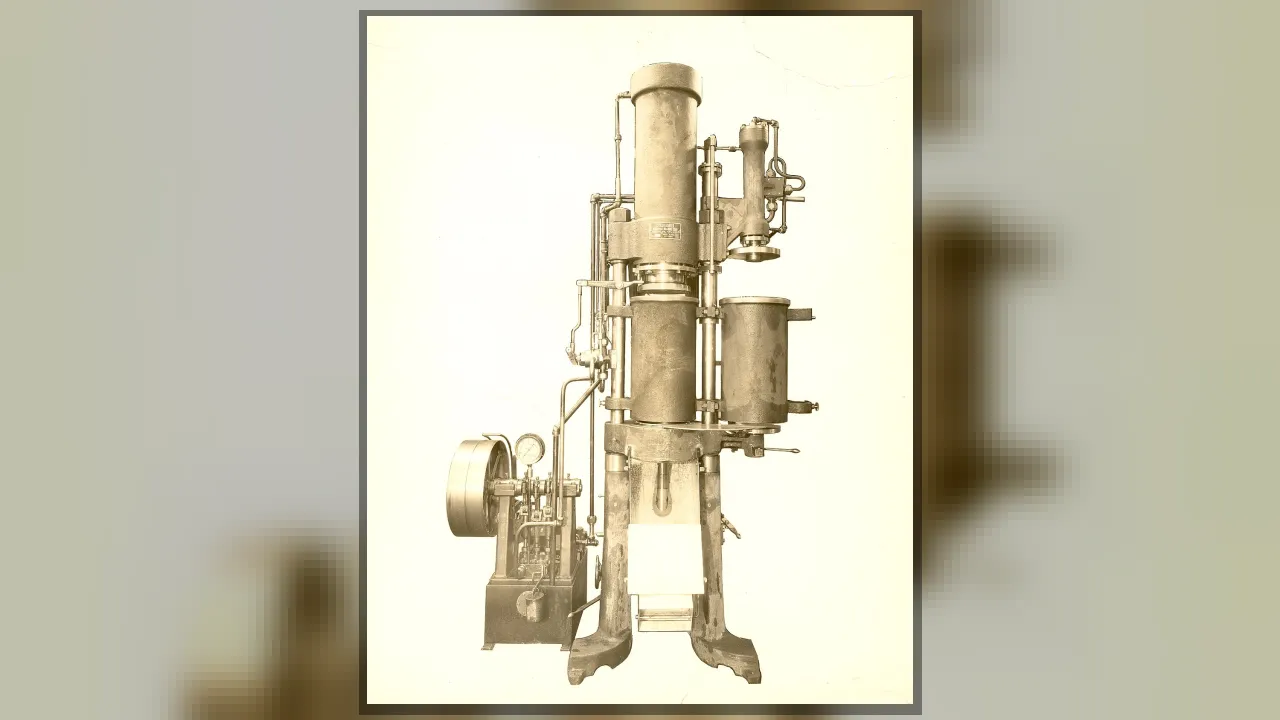
1. What fills the sealed pipes inside a hydraulic press to carry pushing power?
2. Where might you see hydraulic power lifting something heavy in your neighborhood?
🤯 Mind-Blowing Fact • Grade 2
Before leather self-sealing rings were invented in London, early hydraulic presses leaked squirting fountains of water every time someone pumped them!
✨ Word Sparks (Grade 2 Glossary)
Tap 🔊 to hear
hydraulic
Operated by liquid moving under tight pressure
cylinder
A strong hollow tube holding a piston
pressure
Steady pushing force spread over a surface
🪝
How can pumping a small handle lift a whole fire truck off the floor?
1
A Silent Giant
Step into a bright machine shop and listen to a quiet hum. A smooth steel slides downward without slamming, yet a thick iron bar bends beneath it like soft taffy!
2
Two Tubes and One Secret
In 1795, English inventor Joseph Bramah connected a skinny tube and a wide with oil-filled pipes. When you push down on the narrow piston, the trapped liquid pushes equally on every inch of the wide piston.
3
Pressing Cars and Seeds
Because the wide piston has much more surface space, its upward or downward force grows huge! Today, factories use presses to stamp car roofs, bale recycled cans, and squeeze oil from seeds.
1. Who patented the practical hydraulic press in 1795?
2. Why does the wide piston push much harder than the narrow piston?
🤯 Mind-Blowing Fact • Grade 3
Scientists use special diamond-anvil presses to squeeze tiny rock specks at pressures matching the center of Planet Earth!
✨ Word Sparks (Grade 3 Glossary)
Tap 🔊 to hear
incompressible
Unable to be squished into smaller space
Pascal's Law
Rule that trapped fluid shares pressure equally
plunger
Narrow rod that pushes fluid into pipes
🪝
Why does squeezing a tiny plunger at one end of an oil pipe unleash tons of crushing force at the other end?
1
Squeezing Without Sparks
Forget swinging a noisy sledgehammer! Watch a glowing slab of orange-hot steel rest inside a towering frame while a massive ram glides down silently. Within seconds, steady fluid force molds that stubborn metal into a jet landing gear.
2
Pascal's Law of Fluids
French scientist Blaise Pascal discovered in the 1600s that pressure applied to a trapped, liquid spreads equally in every direction. If you push 10 pounds onto a 1-square-inch , every single square inch inside the connected tank feels 10 pounds of push.
3
Bramah's Clever Seal
In 1795, Joseph Bramah and his young machinist Henry Maudslay turned Pascal's idea into a working press. Maudslay invented a cup-shaped leather collar that pressed tighter against the cylinder wall whenever liquid pressure rose, stopping leaks completely.
4
Trading Strokes for Strength
If the big ram has 100 times more area than the small , it pushes 100 times harder! In exchange, you must pump the small plunger 100 inches to move the giant ram just 1 inch.
1. If 10 pounds of push on a 1-square-inch plunger connects to a 50-square-inch ram, how much force does the big ram produce?
2. What problem did Henry Maudslay's cup-shaped leather collar solve?
🤯 Mind-Blowing Fact • Grade 4
Every time a driver taps a car's brake pedal, a miniature hydraulic system multiplies foot pressure through brake lines to clamp spinning wheel rotors to a halt!
✨ Word Sparks (Grade 4 Glossary)
Tap 🔊 to hear
cross-sectional area
Flat circular surface size inside a cylinder
forging
Shaping solid metal using immense compressive force
closed circuit
Sealed pipe network where fluid cannot escape
🪝
How did a leaky 18th-century workshop puzzle unlock the industrial power to forge locomotives, bridges, and spacecraft?
1
A Lever Made of Liquid
Picture trying to bend a six-inch-thick titanium beam using wooden levers—the timber would snap long before the metal yielded. Yet inside an aerospace forge, a hydraulic press shapes that titanium effortlessly by using pressurized oil as an unbreakable liquid lever.
2
How Pressure Multiplies Force
Unlike air, which compresses like a spring, hydraulic oil consists of tightly packed molecules that resist volume changes. According to Pascal's Principle, pressure equals force divided by area (P = F / A). When a narrow master piston pressurizes fluid inside a , identical pressure acts across every square centimeter of a wide slave ram, multiplying output force by the exact ratio of their .
3
Solving the High-Pressure Seal
Although Blaise Pascal described fluid multiplication in the 1650s, nobody could machine cylinders smooth enough to hold immense pressure for over a century. When Joseph Bramah patented his press in 1795, craftsman Henry Maudslay engineered a U-shaped self-energizing seal: fluid pressure pushed the flexible rim outward against the bore, turning the leak's own force into an airtight barrier.
4
Shaping the Modern World
Because fluid travels cleanly around corners through flexible hoses, hydraulic cylinders now power excavator arms, car brakes, aircraft wing flaps, recycling balers, and towering 50,000-ton presses that mold single-piece aluminum airliner bulkheads.
1. Why does hydraulic equipment use oil or water rather than plain air when extreme, steady force is required?
2. Why can hydraulic power reach tight places like airplane wings more easily than gears and steel rods?
🤯 Mind-Blowing Fact • Grade 5
Built during the 1950s Heavy Press Program, America's 50,000-ton Wyman-Gordon and Alcoa hydraulic presses are still operating over seventy years later to forge structural wing spars for modern spacecraft and airliners!
✨ Word Sparks (Grade 5 Glossary)
Tap 🔊 to hear
hydrostatics
Physics of fluids at rest under pressure
megapascal
Metric unit equal to one million pascals
volumetric displacement
Exact volume of fluid moved per stroke
🪝
How does Pascal's simple equation allow a tabletop pump to command 80,000 tons of aerospace forging force without violating energy conservation?
1
The Heavyweight Titan of Manufacturing
Deep inside an industrial forge, an eight-story iron frame groans barely audibly as giant hydraulic cylinders drive forged steel dies together with 80,000 metric tons of force—molding glowing nickel-superalloy turbine disks for jet engines in a single seamless stroke. At the heart of this colossus operates a remarkably elegant law of formulated in 1653 by French polymath Blaise Pascal.
2
Hydrostatic Equilibrium and Area Ratios
Pascal's Law states that any change in pressure applied to an enclosed, static, incompressible fluid is transmitted undiminished to every portion of the fluid and its container walls. Mathematically, input pressure P = F1 / A1 equals output pressure F2 / A2. Because circular piston area scales with the square of diameter (A = πd² / 4), making the output ram ten times wider than the input plunger multiplies cross-sectional area—and output force F2—by exactly one hundred!
3
Volumetric Conservation and Mechanical Work
Energy remains strictly conserved. Displacing volume V from the narrow cylinder pushes piston 1 downward by distance d1 = V / A1, while raising the massive slave ram by only d2 = V / A2. Consequently, F1 × d1 = F2 × d2: a hundredfold gain in crushing force demands a hundredfold longer pumping stroke, commonly supplied today by high-speed electric radial-piston pumps delivering pressures exceeding 30 (4,350 psi).
4
Bramah, Maudslay, and Precision Machining
Turning theory into hardware in 1795 London required solving catastrophic fluid blow-by. Joseph Bramah and 24-year-old Henry Maudslay pioneered both the self-tightening U-ring seal and precision metal-cutting lathes capable of boring uniform iron cylinders—innovations that simultaneously birthed modern hydraulic engineering and interchangeable machine-tool manufacturing.
5
Modern Frontiers of High-Pressure Science
Today, computer-controlled servo-hydraulic presses stamp automotive chassis panels to sub-millimeter tolerances, compact powdered ceramics, synthesize industrial diamonds at 5 gigapascals, and drive tunnel-boring shields beneath mountain ranges.
1. Because a circular piston's area scales with the square of its diameter, multiplying the output piston's diameter by 5 (at equal fluid pressure) multiplies output force by:
2. How is conservation of mechanical energy maintained when a hydraulic press multiplies force by 100?