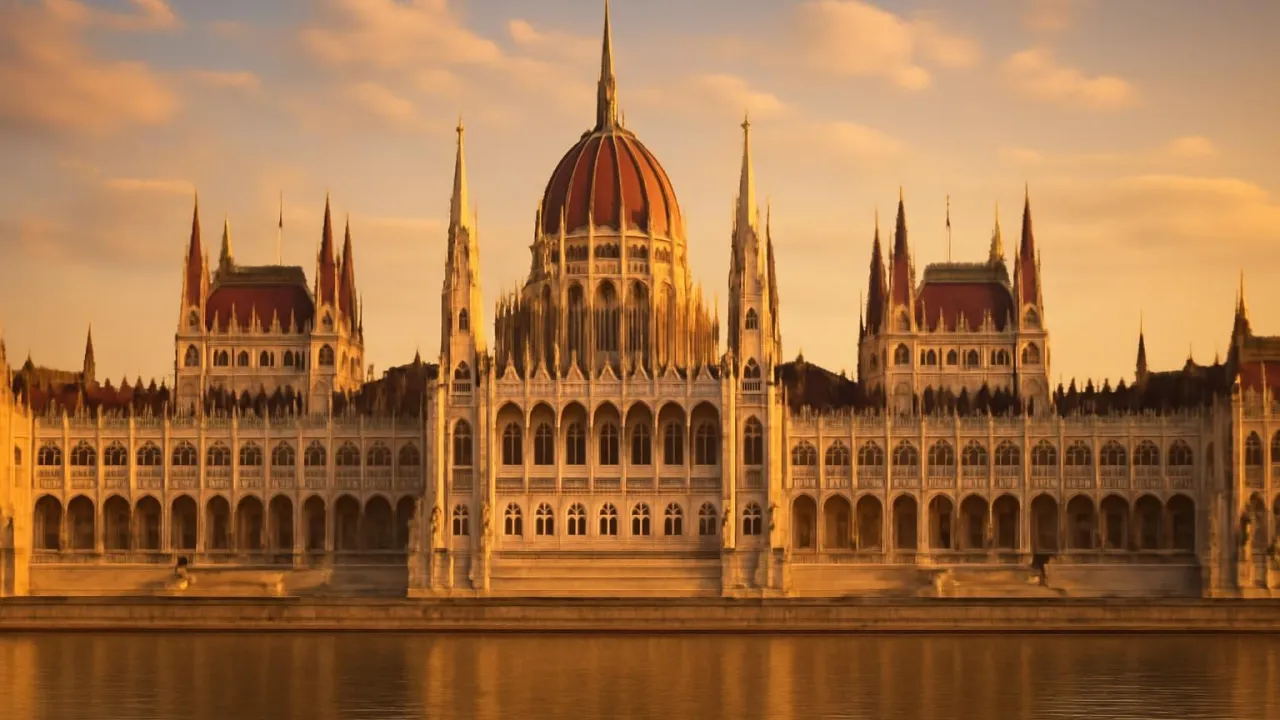
The Parliament Building has 242 statues decorating its walls and halls!
✨ Word Sparks (Grade 2 Glossary)
Tap 🔊 to hear
spires
Tall, pointy roof towers
dome
A big, round roof
statue
A carved figure or person
🪝
Have you ever seen a building with so many towers and windows?
1
Shining on the Danube
The Parliament Building sits right beside the Danube River, shining in the sunlight. Its tall and big reach high into the sky. People walk along the river and see its bright white walls.
2
A Home for Decisions
Inside, leaders from Hungary meet to make important decisions for the country. There are many rooms and long hallways where people talk and plan. Visitors can tour the building and see its beautiful decorations.
3
Windows and Statues Everywhere
The building has hundreds of windows and many stone on the outside. At night, lights make the whole building glow like a palace. It is one of the most famous places in Budapest.
The Parliament’s dome is exactly 96 meters tall, matching Hungary’s 896 founding year!
✨ Word Sparks (Grade 3 Glossary)
Tap 🔊 to hear
acoustics
How sound moves in a space
symmetry
Both sides look the same
arches
Curved parts that hold weight
🪝
Can you imagine walking through a palace with over 600 rooms?
1
A Palace Beside the Danube
The Hungarian Parliament Building stands tall on the banks of the Danube River in Budapest. Its Neo-Gothic style features pointed , spires, and a giant central dome. The building’s white limestone walls shine brightly in the sun. Tourists often take boat rides to see its beauty from the water.
2
Inside the Grand Halls
With 691 rooms and 10 courtyards, the Parliament is like a maze. Leaders gather in the main chamber to discuss and vote on laws. Long red carpets and golden decorations fill the halls. The building’s help voices carry during important speeches.
3
Statues and Symbols
Hundreds of statues decorate the walls, showing kings, warriors, and famous Hungarians. The dome rises 315 feet, making it one of the tallest buildings in Budapest. Stained glass windows fill the rooms with colorful light. The building’s makes it look the same from both sides.
4
How Was It Built?
Builders used over 40 million bricks and half a million precious stones. Special and pillars support the heavy roof and dome. The Parliament was finished in 1904 after nearly 20 years of construction. Today, it is a symbol of Hungary’s history and democracy.
1. What helps voices carry in the Parliament halls?
2. What is special about the dome’s height?
🤯 Mind-Blowing Fact • Grade 4
Builders used 40 million bricks and 242 statues to create this masterpiece.
✨ Word Sparks (Grade 4 Glossary)
Tap 🔊 to hear
pinnacle
A high, pointed top part
debate
A formal discussion or argument
heritage
Important history and culture
🪝
What secrets might echo through a hall lined with golden arches and stained glass?
1
A Neo-Gothic Wonder on the Danube
Rising above the Danube’s eastern bank, the Hungarian Parliament Building dazzles with its pointed spires, intricate stonework, and a massive central dome. Designed by Imre Steindl, the building was inspired by England’s Houses of Parliament but features unique Hungarian symbols throughout. Its Neo-Gothic style uses arches, , and detailed carvings to create a sense of grandeur. The Parliament’s riverside location makes it a dramatic landmark in Budapest’s cityscape.
2
Engineering for Majesty and Strength
Construction began in 1885, using over 40 million bricks and 88 pounds of gold leaf for decoration. The building’s 96-meter dome and symmetrical wings are supported by a network of stone arches and steel frames, distributing the immense weight. The Parliament’s acoustics were carefully engineered so every voice could be heard during . Over 242 statues and hundreds of stained glass windows add to its artistic and structural complexity.
3
A Center for Democracy and Heritage
The Parliament Building is the seat of Hungary’s National Assembly, where leaders and pass laws. Its 691 rooms include grand halls, libraries, and the Crown Jewels of Hungary, guarded at all times. The building’s symmetry and design symbolize the unity of the nation. Visitors from all over the world tour its halls to learn about Hungary’s history and government.
4
Legacy and Global Impact
As one of Europe’s largest parliament buildings, it stands as a symbol of democracy and national pride. Its architectural style influenced other public buildings across Hungary and beyond. The Parliament is recognized as a UNESCO World Site, helping preserve its beauty for future generations. Its glowing silhouette at night has become an iconic image of Budapest around the world.
The Parliament’s 96-meter dome and 691 rooms make it one of the world’s largest legislative buildings.
✨ Word Sparks (Grade 5 Glossary)
Tap 🔊 to hear
motif
A repeated design or symbol
resonance
How sound vibrates and fills space
façade
The front face of a building
🪝
If you stepped inside a hall where every word echoes beneath a golden dome, what stories would you hear?
1
A Neo-Gothic Masterpiece on the Danube
Gleaming along the Pest bank of the Danube, the Hungarian Parliament Building is a triumph of late 19th-century Neo-Gothic architecture. Designed by Imre Steindl and constructed between 1885 and 1904, it draws inspiration from London’s Palace of Westminster but incorporates distinct Hungarian , such as the Holy Crown and national crest. The structure’s symmetrical , 27 towers, and 96-meter central dome create a striking silhouette visible from across Budapest. Its riverside placement was chosen to symbolize Hungary’s connection to Europe and the importance of the Danube as a lifeline.
2
Engineering Ambition: Bricks, Steel, and Stone
The Parliament’s construction required over 40 million bricks, 500,000 precious stones, and 88 pounds of gold leaf for ornate decoration. Steel frameworks and stone arches support the immense weight of the 315-foot dome and expansive wings, ensuring stability on the soft riverbank soil. The building’s design incorporates advanced engineering techniques of the era, such as load-distributing arches and deep foundations, to prevent settling and structural damage. The interior features 691 rooms, 28 staircases, and 10 courtyards, making it one of the largest legislative buildings in the world.
3
Acoustics and Symbolism in Design
Acoustic engineers ensured that every debate and speech in the main assembly chamber could be heard clearly, using curved ceilings and sound-reflective surfaces to optimize . The dome’s height of 96 meters commemorates the year 896, marking the Magyar conquest of the Carpathian Basin. The building’s symmetry and repeated symbolize national unity and the balance of power between Hungary’s legislative chambers. Hundreds of statues, stained glass windows, and mosaics celebrate Hungarian history, legends, and culture throughout the complex.
4
A Center of Democracy and Heritage
Today, the Parliament Building is the seat of Hungary’s National Assembly, hosting debates, state ceremonies, and the safeguarding of the Hungarian Crown Jewels. Its halls are open to visitors, who marvel at the intricate gold detailing, crimson carpets, and the symbolic placement of the main staircase. As a UNESCO World Heritage Site, the building is protected as a cultural treasure. Its illuminated at night has made it one of Europe’s most photographed landmarks.
5
Global Influence and Enduring Legacy
The Hungarian Parliament Building has inspired public architecture throughout Hungary and Central Europe, setting a standard for grandeur and national symbolism. Its construction marked a period of rapid modernization and national pride in Hungary’s history. The building’s engineering solutions for riverbank construction are still studied by architects and civil engineers today. As Hungary’s political and cultural heart, it continues to host international visitors, fostering global appreciation for Hungarian heritage and democratic values.