1. During which kind of storm do bouncing hailstones form?
2. What finally makes a growing hailstone fall to the ground?
🤯 Mind-Blowing Fact • Grade 2
The largest hailstone ever measured in the United States fell in South Dakota in 2010—it was eight inches wide, as big as a volleyball!
✨ Word Sparks (Grade 2 Glossary)
Tap 🔊 to hear
updraft
fast wind blowing straight up inside storms
opaque
cloudy white so light cannot pass clearly
glaze
a smooth, shiny coating of clear ice
🪝
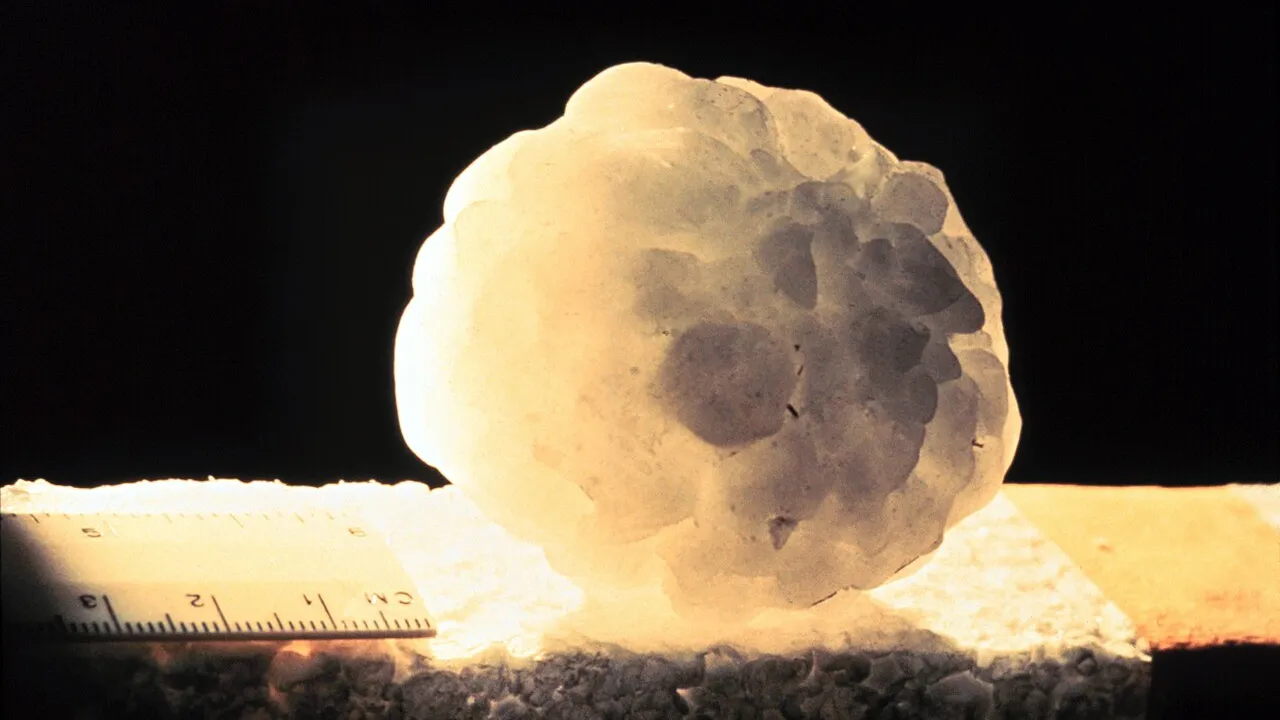
Why does slicing a hailstone open look just like slicing an onion?
1
Ice From a Warm Afternoon
Imagine eating watermelon on a hot June afternoon when sudden thunder booms and marble-sized ice balls rattle on the porch roof! Even in summer, the upper half of a giant thunderstorm cloud stays well below freezing.
2
Riding the Storm Elevator
Fierce upward blasts of wind—called —carry frozen raindrops miles high into icy cloud zones. As the tiny ice ball sweeps through super-cold liquid droplets, water coats its outside like on a candy apple.
3
Rings of Clear and White
Bouncing through warmer wet spots makes clear ice rings, while freezing instantly higher up traps tiny air bubbles to make milky-white rings!
1. What makes the milky-white rings inside a sliced hailstone look cloudy?
2. Why can hailstones form even when the air in your yard is 85 degrees Fahrenheit?
🤯 Mind-Blowing Fact • Grade 3
Colorado, Nebraska, and Wyoming meet at an area nicknamed 'Hail Alley,' where towns get pelted by hail seven to nine times every single year!
✨ Word Sparks (Grade 3 Glossary)
Tap 🔊 to hear
embryo
tiny frozen starter core of a hailstone
supercooled
liquid water chilled below freezing without turning solid
concentric
rings sharing the exact same center point
🪝
How fast must a thunderstorm's upward wind blow to build a baseball-sized hailstone?
1
Pebbles to Baseballs of Ice
Rattling against skylights and denting parked cars, hailstones are solid chunks of ice measuring at least five millimeters—about the width of a pencil eraser—all the way up to softballs! Unlike winter sleet, true hail grows only inside powerful cumulonimbus thunderstorms.
2
Starting From an Ice Embryo
Every hailstone begins as a tiny frozen raindrop or soft snow pellet called an . Roaring storm updrafts sweep that embryo above the freezing level into clouds packed with water—liquid droplets colder than 32 degrees Fahrenheit that have not frozen yet!
3
Wet Growth vs. Dry Growth
In slightly warmer zones just above freezing, water spreads smoothly across the stone before freezing slowly into bubble-free clear ice. Higher in frigid regions, droplets freeze on impact, trapping air bubbles in opaque white ice.
4
Updraft Speed Sets the Size
Pea-sized hail needs updrafts around 25 miles per hour, whereas baseball-sized hail demands roaring 80-to-100-mile-per-hour updrafts to stay aloft!
1. What determines how big a hailstone can grow before falling?
2. How does a clear ice ring form on a growing hailstone?
🤯 Mind-Blowing Fact • Grade 4
Florida has the most thunderstorms in the United States, yet high-altitude Wyoming and Colorado get far more hail because falling ice has less warm air to melt through!
✨ Word Sparks (Grade 4 Glossary)
Tap 🔊 to hear
Hail Alley
High Plains region famous for frequent hailstorms
freezing level
altitude where air temperature drops to 32°F
Doppler radar
weather radar measuring rain, hail, and wind motion
🪝
Why does mountain-high 'Hail Alley' along the Rockies get pounded by more hail than rainy Florida?
1
A Surprising Geography Puzzle
If you guessed that Florida—America's thunderstorm capital—gets the most hail in the nation, prepare for a surprise! Florida actually sees very little large hail because its warm tropical air melts most falling ice miles above the ground. Instead, North America's '' stretches where Colorado, Wyoming, and Nebraska meet! Because the High Plains sit over a mile above sea level, the cloud's hangs much closer to the ground, giving hailstones almost no warm air in which to melt before landing.
2
Hovering Across Tilted Updrafts
Old textbooks once pictured hailstones riding up and down like a yo-yo ten times to build ten rings. Modern proved something even cooler! In tilted supercell updrafts, a hailstone can hover and arc sideways across one broad updraft, passing through alternating pockets of rich and sparse supercooled liquid water to build multiple concentric rings in a single sweep!
3
Record-Breaking Ice Missiles
On July 23, 2010, a supercell over Vivian, South Dakota, dropped the heaviest and widest U.S. hailstone ever verified: 8 inches (20 centimeters) across and weighing 1.94 pounds (0.88 kilograms)!
4
Dual-Polarization Radar Warnings
Today, National Weather Service dual-polarization radars transmit both horizontal and vertical radio pulses, telling tumbling, jagged hailstones apart from flattened raindrops so families and farmers get crucial minutes to shelter cars and livestock.
1. Why does 'Hail Alley' in the High Plains experience much more ground hail than stormy Florida?
2. What did modern radar reveal about how hailstones gain multiple concentric rings?
🤯 Mind-Blowing Fact • Grade 5
Engineers test solar panels and roof shingles by firing laboratory-frozen ice balls out of compressed-air 'hail cannons' at over 80 miles per hour!
✨ Word Sparks (Grade 5 Glossary)
Tap 🔊 to hear
accretion
growth by collecting layers of freezing droplets
latent heat of fusion
heat energy released when liquid freezes solid
terminal velocity
top steady speed of a falling object
🪝
How do storm physicists read a hailstone's crystal structure under polarized light like a flight data recorder?
1
Accretion on Graupel and Frozen-Drop Embryos
Slice a jagged hailstone into a paper-thin wafer and place it between cross-polarized filters in a cold laboratory, and a dazzling mosaic of rainbow-tinted ice grains leaps into view! Right at the bull's-eye sits a 2-to-5-millimeter hail embryo—either a conical lump of rimed snow called graupel (common in dry High Plains storms) or a frozen giant raindrop (common in humid maritime air). From that seed, hail grows by as storm updrafts sweep supercooled liquid droplets past its icy surface.
2
Thermodynamics of Wet vs. Dry Growth Regimes
Every gram of supercooled water that freezes onto a hailstone releases 334 joules of , warming the stone's skin! Between minus 5 and minus 15 degrees Celsius in dense liquid-water zones, released latent heat keeps the surface right at 0 degrees Celsius; unfrozen water films fill crevices before freezing slowly into large, transparent crystal grains (wet growth). In colder regions below minus 20 degrees Celsius, droplets freeze instantaneously on impact into tiny, randomly oriented crystals packed with air microbubbles (dry growth).
3
Spongy Ice, Spikes, and Terminal Velocity
Giant hailstones often sprout icicle-like lobes because tumbling aerodynamic wakes sling unfrozen water films outward as they spin! Terminal fall speeds climb with the square root of diameter: a 1-centimeter stone falls near 9 meters per second (20 mph), whereas a 10-centimeter softball hurtles earthward past 45 meters per second (100 mph).
4
Dual-Polarization Three-Body Scatter Signatures
Meteorologists spot giant hail miles aloft using dual-polarization Doppler radar: tumbling ice spheres yield near-zero differential reflectivity alongside a classic 'hail spike' echo behind the storm core.
5
Agricultural Impact and Engineering Resilience
Causing billions of dollars in annual crop and roof damage across mid-latitude continents, hail research guides engineers in testing impact-resistant solar panels and roofing shingles with compressed-air ice cannons!