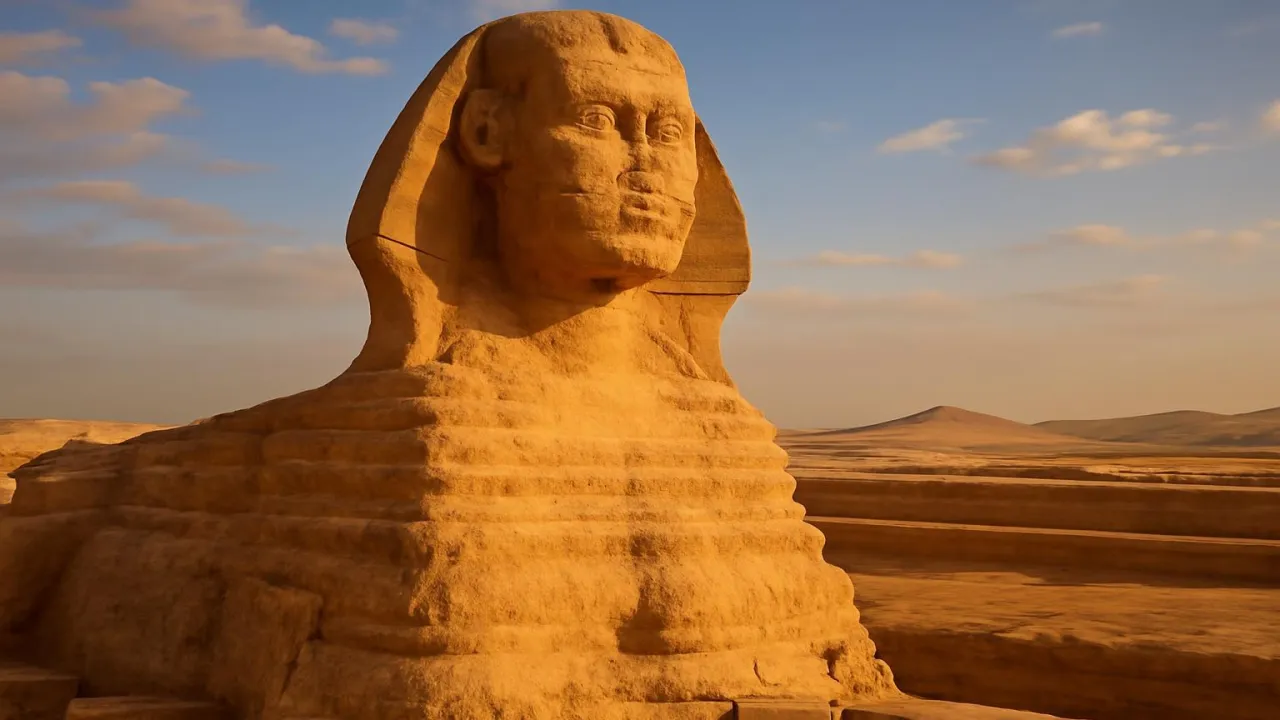
The Sphinx’s body is longer than two school buses lined up!
✨ Word Sparks (Grade 2 Glossary)
Tap 🔊 to hear
Pharaoh
A king of ancient Egypt.
Carved
Cut or shaped from stone.
Mystery
Something we do not fully know.
🪝
Can you imagine a statue with a human face and a lion’s body?
1
A Face from Long Ago
The Sphinx’s face looks calm and wise, but its nose is gone. Some people think it was made to look like a , and it has watched over the desert for thousands of years.
2
A Lion’s Mighty Body
Its body is shaped like a giant lion, lying down with huge paws. The Sphinx was from one giant rock, and it is bigger than a house.
3
A Place Full of Mysteries
Visitors come from all over the world to see the Sphinx. People wonder how it was built and why it was made, and they love to take pictures beside it.
The Sphinx was carved from a single massive limestone ridge.
✨ Word Sparks (Grade 3 Glossary)
Tap 🔊 to hear
Erosion
When wind or water wears away stone.
Monument
A large structure built to remember something.
Limestone
A soft, light-colored rock.
🪝
What secrets might a stone guardian with a lion’s body and a human face keep?
1
A Monument from Ancient Egypt
The Great Sphinx sits on the Giza Plateau, guarding the pyramids nearby. Its face is believed to show a pharaoh’s features, though its nose was broken off long ago. This statue has watched over the desert for more than 4,500 years. Wind and sand have slowly caused , shaping its surface.
2
How Was the Sphinx Made?
Workers carved the Sphinx directly from the bedrock, using simple tools and teamwork. Its body stretches 240 feet long, and it stands 66 feet tall, making it one of the world’s largest statues. The Sphinx’s paws reach out in front, as if it is resting like a lion. Ancient builders had to solve big engineering challenges to shape such a huge .
3
A Symbol of Mystery and Power
The Sphinx’s lion body and human head symbolize strength and wisdom in Egyptian culture. Many legends surround the Sphinx, and people wonder about hidden chambers beneath it. Today, tourists visit to see its grand size and take photos with the ancient guardian.
4
Protecting the Sphinx Today
Scientists and engineers work to protect the Sphinx from further and damage. They study the and use special materials to help preserve it. The Sphinx remains a powerful symbol of Egypt’s history and achievements. Its mysteries inspire visitors and researchers from around the world.
The Sphinx’s face is over 13 feet (4 meters) wide!
✨ Word Sparks (Grade 4 Glossary)
Tap 🔊 to hear
Monolithic
Made from one huge piece of stone.
Restoration
Fixing something to make it last longer.
Pharaoh
A king or queen of ancient Egypt.
🪝
If you stood before the Sphinx at sunrise, what ancient riddles might it whisper to you?
1
A Guardian of the Giza Plateau
The Great Sphinx of Giza has watched over Egypt’s pyramids since the reign of Khafre, around 2550 BCE. Its massive limestone body, with a lion’s form and a human face, stands as a symbol of royal power and protection. The Sphinx’s face is thought to resemble Khafre himself, though its broken nose adds to its air of mystery. Every year, millions of visitors marvel at its size and ancient beauty.
2
Engineering an Ancient Wonder
Egyptian builders carved the Sphinx from a single limestone ridge using copper chisels, wooden mallets, and teamwork. The statue is about 240 feet long and 66 feet tall, making it the largest statue of the ancient world. Its paws alone stretch over 50 feet in front, and its body is aligned precisely with the rising sun. The builders’ knowledge of geometry and stonework was crucial to creating such a lasting monument.
3
Weathering, Erosion, and Restoration
Over thousands of years, the Sphinx has suffered from wind, sand, and pollution, causing significant erosion and damage. Ancient Egyptians tried to repair it by adding stone blocks to its paws and body, and modern scientists continue efforts today. Engineers study the limestone’s properties to find the best ways to protect the monument. Preserving the Sphinx helps us learn about ancient engineering and cultural achievements.
4
A Legacy of Mystery and Inspiration
The Sphinx has inspired legends, art, and stories for centuries, from ancient riddles to modern movies. Some people believe there are hidden chambers beneath its paws, though no secret rooms have been found. Its combination of lion strength and human intelligence makes it a powerful symbol in Egyptian culture. As a UNESCO World Heritage site, the Sphinx connects people around the world to Egypt’s ancient past.
1. What tools did builders use to carve the Sphinx?
2. Why is the Sphinx important to people today?
🤯 Mind-Blowing Fact • Grade 5
The Sphinx’s body was originally painted in bright colors, including red, blue, and yellow.
✨ Word Sparks (Grade 5 Glossary)
Tap 🔊 to hear
Nemes
A striped royal headdress worn by pharaohs.
Bedrock
The solid rock found beneath the ground.
Conservation
Protecting something important from harm or loss.
🪝
Imagine standing in the desert, feeling the wind and sand swirl as you gaze up at the Sphinx’s ancient, silent face—what stories would it tell you about the dawn of civilization?
1
The Sphinx: Sentinel of Ancient Egypt
The Great Sphinx of Giza, carved during the reign of Pharaoh Khafre around 2550 BCE, remains one of humanity’s most iconic monuments. With the body of a recumbent lion and the head of a human, the Sphinx was designed to symbolize royal authority and the protective power of the pharaoh. Its face, over 13 feet wide, is widely believed to represent Khafre himself, though the missing nose and beard have fueled centuries of speculation. The Sphinx’s gaze is fixed directly east, aligning with the rising sun and connecting it to ancient Egyptian solar beliefs. As the world’s largest monolithic statue, it continues to inspire wonder and curiosity.
2
Architectural and Engineering Marvels
The Sphinx was carved directly from a single limestone outcrop, using copper chisels, stone hammers, and wooden wedges to split and shape the rock. Measuring about 240 feet (73 meters) long and 66 feet (20 meters) high, the monument required sophisticated planning and labor organization. The paws alone extend more than 50 feet (15 meters), and the head was originally adorned with a royal headdress called a . Builders had to solve complex engineering challenges, including stabilizing the soft limestone base and creating precise proportions without modern machinery or blueprints.
3
Erosion, Restoration, and Scientific Study
For over 4,500 years, the Sphinx has endured relentless erosion from wind, sand, and occasional flooding of the nearby Nile. Ancient Egyptians attempted repairs as early as 1400 BCE, and modern conservationists have used advanced materials and scientific analysis to slow further deterioration. Geologists study the Sphinx’s limestone layers to understand how environmental factors have shaped its surface, while engineers monitor cracks and structural weaknesses. Preservation efforts are essential for protecting this irreplaceable link to ancient engineering and art.
4
Cultural Impact and Enduring Mysteries
The Sphinx has inspired countless legends, from ancient riddles to modern theories about hidden chambers and lost civilizations. Although no secret rooms have been found beneath the monument, ground-penetrating radar continues to reveal fascinating details about the surrounding . The Sphinx’s combination of lion strength and human intellect made it a powerful symbol in Egyptian mythology, representing both wisdom and might. Today, it stands as a UNESCO World Heritage site, attracting millions of visitors and scholars who seek to unravel its mysteries.
5
Legacy in the Modern World
The Sphinx is not only a marvel of ancient engineering but also a testament to the enduring creativity of the human spirit. Its image appears in art, literature, and popular culture worldwide, reminding us of the achievements of early civilizations. Ongoing archaeological research at Giza continues to reveal new insights into how the Sphinx was built and maintained. As global interest grows, international teams collaborate to protect the monument for future generations. The Great Sphinx of Giza remains a bridge between past and present, inviting us all to wonder, learn, and dream.