🇺🇸 U.S. HISTORY
🏛️ Presidential Oratory Milestone • Gettysburg, Pennsylvania (November 19, 1863)
VA History & Social Science SOL K.1, 1.2, 2.4, VS.1–VS.10, USI & USII
Gettysburg Address (1863)
Ten Short Sentences That Defined American Freedom
Grade 1 • Early Reader • 60 words
⏳ Era / StatehoodDelivered: November 19, 1863
🗺️ Region / CapitalSoldiers' National Cemetery, Gettysburg, Pennsylvania
📜 Key Milestone272-Word Speech Calling for a 'New Birth of Freedom'
⚡ Historical SparkCaptured America's core promise of equality in barely two minutes
🤯 Mind-Blowing Fact • Grade 1
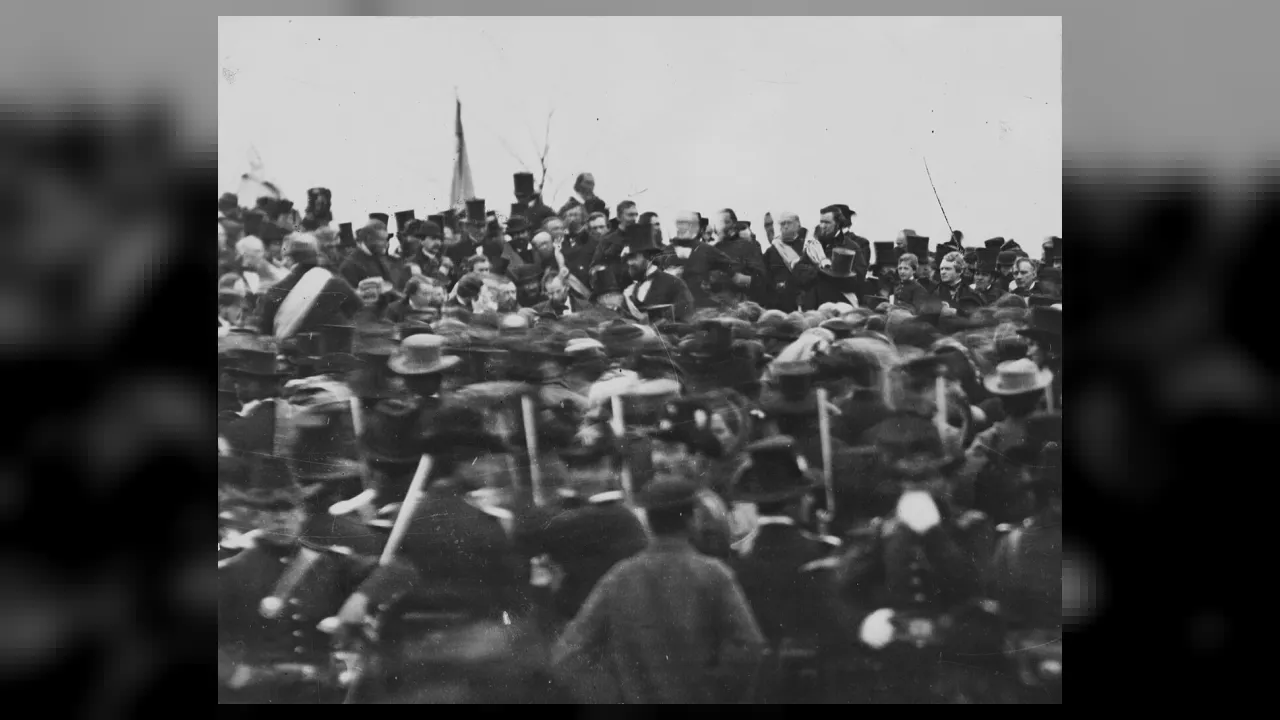
Abraham Lincoln spoke so briefly at Gettysburg that the photographer's slow camera was not even finished setting up before he sat back down!
✨ Word Sparks (Grade 1 Glossary)
Tap 🔊 to hear
address
An important speech spoken to a crowd
score
An old word meaning the number twenty
equal
Having the same human worth and rights
🪝
Can a two-minute speech be remembered for hundreds of years?
1
Crisp Autumn Air on a Hill
Hush falls over the big crowd! Autumn leaves blow across quiet green hills in Pennsylvania. Tall Abraham Lincoln takes off his top hat.
2
Just Ten Clear Sentences
On November 19, 1863, Lincoln spoke at Gettysburg to honor brave fallen soldiers. His Gettysburg lasted only two short minutes!
3
Government for the People
Lincoln reminded everyone that all people are created . He called on Americans to keep freedom alive forever.
1. Which president delivered the famous Gettysburg Address in 1863?
2. About how long did it take President Lincoln to speak the entire Gettysburg Address?
🤯 Mind-Blowing Fact • Grade 2
The day after the ceremony, two-hour speaker Edward Everett wrote President Lincoln a kind note saying Lincoln came closer to the central idea in two minutes than Everett had in two hours!
✨ Word Sparks (Grade 2 Glossary)
Tap 🔊 to hear
dedicate
To honor and set aside for special memory
perish
To disappear or come to an end
cemetery
Peaceful resting place honoring people who died
🪝
What does 'Four score and seven years ago' mean in everyday numbers?
1
Two Hours Followed by Two Minutes
Imagine standing outdoors in Gettysburg, Pennsylvania, on November 19, 1863, among fifteen thousand listeners! First, famous speaker Edward Everett talked for two full hours without notes. Then President Abraham Lincoln stood up with two handwritten pages.
2
Counting Back to 1776
Lincoln began, 'Four score and seven years ago.' Since one score equals twenty, four score and seven meant eighty-seven years—pointing right back to 1776 and the Declaration of Independence!
3
A New Birth of Freedom
In just 272 words, Lincoln honored fallen Civil War soldiers by asking living citizens to protect 'government of the people, by the people, for the people.'
1. Since 'score' means twenty, how many years is 'four score and seven'?
2. What important 1776 document was Lincoln pointing back to in his opening line?
🤯 Mind-Blowing Fact • Grade 3
Five handwritten copies of the Gettysburg Address written by Abraham Lincoln himself survive today, including one kept in the White House's Lincoln Bedroom!
✨ Word Sparks (Grade 3 Glossary)
Tap 🔊 to hear
proposition
Important guiding idea put forward as truth
consecrate
To make a place deeply honored and sacred
endure
To last strongly through difficult challenges
🪝
Why did organizers invite President Lincoln to speak for just 'a few appropriate remarks' after the main speaker?
1
Healing After a Great Battle
Four and a half months after the three-day Battle of Gettysburg in July 1863 turned back General Robert E. Lee's northern march, Pennsylvania townspeople created the Soldiers' National Cemetery to honor fallen Union soldiers properly.
2
Not Written on an Envelope
A popular myth claims Abraham Lincoln scribbled his speech hastily on the back of an envelope aboard the train. In truth, Lincoln cared deeply about his message, drafting carefully on White House stationery before polishing final lines in Gettysburg the night before November 19.
3
Testing Democracy's Survival
Following Edward Everett's two-hour history lecture, Lincoln rose and described the Civil War as a test of whether any nation dedicated to human equality could .
4
Words Carved in Marble
Calling for 'a new birth of freedom,' Lincoln's 272 words connected Union victory with ending slavery—and today stand carved into marble inside the Lincoln Memorial in Washington, D.C.
1. Where did Abraham Lincoln actually write most of the Gettysburg Address?
2. Where can visitors read the entire Gettysburg Address carved into stone walls today?
🤯 Mind-Blowing Fact • Grade 4
Lincoln thought at first that his speech might not have gone well, telling a friend afterward that it 'won't scour'—an old farm saying for a muddy plow blade—yet history judged it one of the greatest speeches ever written!
✨ Word Sparks (Grade 4 Glossary)
Tap 🔊 to hear
orator
Eloquent speaker skilled at moving public audiences
in vain
Without accomplishing its true purpose or meaning
self-government
Democracy where citizens govern themselves through laws
🪝
How did Abraham Lincoln link the 1776 Declaration of Independence and the 1787 Constitution together in just ten sentences?
1
November 19, 1863, on Cemetery Hill
Step onto breezy Cemetery Hill outside Gettysburg, Pennsylvania, on November 19, 1863, where fifteen thousand citizens, governors, and wounded veterans gathered four months after the Civil War's largest battle. Cemetery organizer David Wills had invited famed Massachusetts statesman Edward Everett as principal and asked President Abraham Lincoln simply to dedicate the grounds with 'a few appropriate remarks.'
2
Anchoring the Nation in 1776
Notice how cleverly Lincoln chose his opening math: 'Four score and seven years ago' subtracted eighty-seven years from 1863, bypassing 1787 and landing squarely in 1776! By doing so, Lincoln anchored America's founding in Thomas Jefferson's Declaration of Independence and its core proposition that 'all men are created equal,' framing the Constitution as the vessel meant to fulfill that promise.
3
From Honoring the Fallen to Challenging the Living
In humble, poetic rhythm, Lincoln explained that speeches could never consecrate ground already made sacred by soldiers' bravery. Instead, the living had to dedicate themselves to 'the unfinished work'—ensuring fallen heroes had not died .
4
Global Test of Self-Government
In the 1860s, kings and emperors across Europe doubted ordinary citizens could govern themselves without splitting apart. Lincoln's closing pledge—that the nation would experience 'a new birth of freedom' and preserve 'government of the people, by the people, for the people'—redefined democracy worldwide.
1. Why did Lincoln count back eighty-seven years to 1776 instead of seventy-six years to 1787?
2. Why did Lincoln say democracy's survival in America mattered to the whole earth?
🤯 Mind-Blowing Fact • Grade 5
One hundred years after Gettysburg, Dr. Martin Luther King Jr. stood on the steps of the Lincoln Memorial in 1963 and echoed Lincoln's famous opening rhythm with the words 'Five score years ago'!
✨ Word Sparks (Grade 5 Glossary)
Tap 🔊 to hear
egalitarian
Believing all people deserve equal rights and dignity
posterity
All future generations of people yet to come
reinter
To rebury fallen soldiers respectfully in a cemetery
🪝
How did 272 words spoken in two minutes transform the meaning of the Civil War and permanently reshape American constitutional thought?
1
From Battlefield Aftermath to National Dedication
Following the pivotal clash at Gettysburg on July 1–3, 1863—where Union General George Meade turned back Confederate General Robert E. Lee at the cost of more than 50,000 combined casualties—Pennsylvania attorney David Wills spearheaded an interstate effort to Union dead decently on Cemetery Hill. Scheduling dedication ceremonies for November 19, 1863, organizers selected renowned former Harvard president and Secretary of State Edward Everett for the two-hour keynote oration and invited President Abraham Lincoln two weeks prior to offer brief dedicatory remarks.
2
Deliberate Craftsmanship, Not Improvisation
Despite enduring folklore about train-car envelopes, Lincoln drafted the first half in ink on Executive Mansion stationery in Washington and completed pencil revisions at David Wills's brick townhouse on Gettysburg's town square after consulting Secretary of State William H. Seward. Suffering from the early stages of mild varioloid (smallpox) that hospitalized him right after returning to Washington, Lincoln nevertheless stood steady before roughly 15,000 attendees once Everett concluded his 13,607-word classical narrative.
3
Rhetorical Compression Across Past, Present, and Future
Structured across a crisp three-part arc—birth in 1776, crisis in 1863, and rededication for —Lincoln's ten sentences compressed volumes of political philosophy into 272 words (in the definitive Bliss Copy). Opening with 'Four score and seven years ago,' he elevated the Declaration of Independence's creed ('dedicated to the proposition that all men are created equal') into the moral soul of the Republic, treating the Constitution as the legal frame meant to realize that universal truth.
4
A New Birth of Freedom
Ten months after signing the Emancipation Proclamation, Lincoln united Union preservation with universal emancipation: only 'a new birth of freedom' purging bondage could justify the staggering sacrifice on Gettysburg's ridges and prove to skeptical European monarchies that popular self-rule—'government of the people, by the people, for the people'—would not perish from the earth.
5
Five Manuscripts and Timeless Echoes
Requested for charitable sanitary fairs supporting wounded troops, Lincoln penned five slightly varying autograph manuscripts—Nicolay, Hay, Everett, Bancroft, and Bliss—adding the pivotal phrase 'under God' orally at Gettysburg and preserving it in later copies. One century later, standing beneath those exact words at the Lincoln Memorial in August 1963, Dr. Martin Luther King Jr. opened 'I Have a Dream' with 'Five score years ago,' carrying Gettysburg's unfinished work forward.