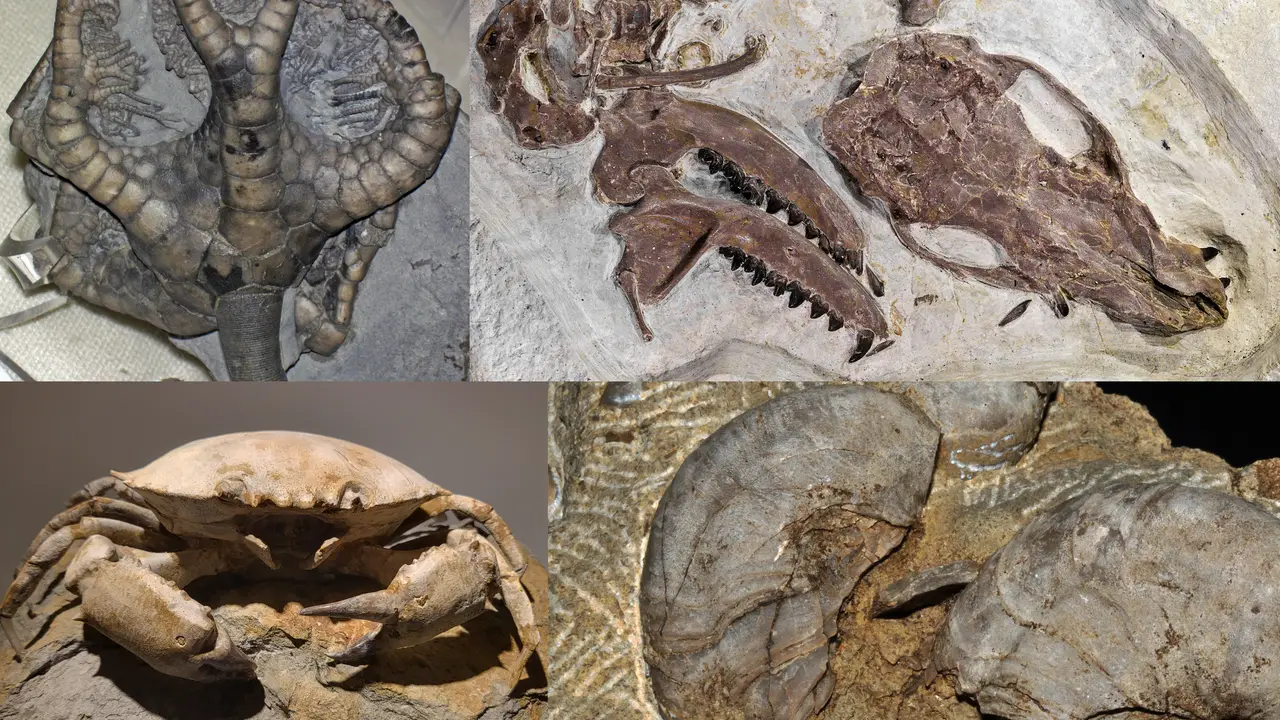
🌋 Where It FormsLayered sedimentary shale, limestone, and sandstone beds across ancient seafloors and rivers
💎 Key PropertiesHollow negative impressions (molds) and filled 3D stone replicas (casts) in sedimentary rock
⚡ Planet Earth SparkPreserves exact shapes of seashells, ferns, and dinosaur footprints millions of years after they vanish
🤯 Mind-Blowing Fact • Grade 1
Virginia's official state fossil, Chesapecten jeffersonius, is a palm-sized scalloped seashell over four million years old found along Virginia riverbanks!
✨ Word Sparks (Grade 1 Glossary)
Tap 🔊 to hear
Fossil
Ancient plant or animal clue preserved in rock
Mold
Hollow rock dent shaped like a shell
Cast
Solid rock copy formed inside a mold
🪝
Have you ever pressed a seashell into play-dough to see its twin print?
1
Clues in Stone
Split open a flat creek rock and look inside! A spiral shell print stares right back at you. are clues left by plants and animals long ago!
2
Hollow Mold
When a buried shell slowly melts away underground, it leaves a hollow dent in the rock. Scientists call that empty dent a !
3
Solid Cast
Later, mud or crystal fills that hollow like batter in a waffle iron! It hardens into a solid rock copy called a .
1. What do scientists call the hollow empty dent left in rock after a shell dissolves?
2. What forms when mud or minerals fill up a hollow fossil mold and harden?
🤯 Mind-Blowing Fact • Grade 2
Finding marine seashell molds and casts high near the snowy summit of Mount Everest proved to scientists that the world's tallest mountain once lay at the bottom of an ancient ocean!
✨ Word Sparks (Grade 2 Glossary)
Tap 🔊 to hear
Sedimentary
Rock formed from pressed layers of mud or sand
Trace Fossil
Fossilized footprint, burrow, or trail of movement
Ammonite
Extinct sea creature with a coiled spiral shell
🪝
How can a seashell turn into a rock copy even after the real shell completely disappears?
1
Step One: Fast Burial
Picture a curled shell sinking to the muddy bottom of a warm prehistoric sea! Soft sand and mud blanket the shell before waves can smash it. Over thousands of years, heavy layers press that mud into solid rock.
2
Step Two: Mold and Cast
Underground water slowly seeps through the rock and dissolves the real shell away! The hollow shell-shaped space left behind is an external mold. If new sand or dissolved minerals fill that space and harden, a 3D stone replica called a cast pops out when the rock splits!
3
Footprints Count Too!
Body parts are not the only fossils! Dinosaur tracks pressed into wet river mud harden into —where the sunken footprint is a mold and the sand filling it from above forms a natural cast.
1. In what main type of rock do almost all mold and cast fossils form?
2. What did seashell fossils discovered near the top of Mount Everest prove to geologists?
🤯 Mind-Blowing Fact • Grade 3
In 1687, colonial settlers along Virginia's James River sketched Chesapecten jeffersonius—making it the very first fossil from North America ever illustrated in a scientific book!
✨ Word Sparks (Grade 3 Glossary)
Tap 🔊 to hear
Steinkern
Stone core formed from mud inside a shell
Carbon Film
Thin dark fossil outline left by pressed plants
Paleontologist
Scientist who studies ancient life through fossils
🪝
Why don't igneous volcanoes or squeezed metamorphic rocks hold nearly as many fossils as sedimentary layers?
1
Why Sedimentary Rock Wins
Hunt for fossils in granite or basalt, and you will come home empty-handed! Molten magma is way too hot—burning up shells and bones—while intense metamorphic heat and pressure usually smear fossils beyond recognition. Gentle sedimentary rocks like shale, siltstone, and limestone bury organisms coolly in mud and sand, safeguarding delicate ridges and spines.
2
External Molds Versus Internal Molds
Seashells can actually leave TWO different molds! An external mold records the bumpy ribs on the outside of the shell. Meanwhile, if mud packs tightly INSIDE an empty snail or clam shell before the shell dissolves away, that hardened mud core—called an internal mold or ''—shows the smooth shape of the creature's inner chamber!
3
Carbon Films of Ancient Ferns
Flat plant leaves rarely leave deep 3D molds. Instead, rock pressure squeezes out water and gases until a lacy black silhouette of pure carbon—a impression—remains on dark shale, common across southwest Virginia's coal beds!
4
Reading Rock Layers Like Pages
In undisturbed sedimentary cliffs, the oldest fossils rest in bottom layers while younger species appear higher up, letting read life's timeline chapter by chapter.
1. Why are fossils almost never found inside igneous rocks like granite?
2. What creates an 'internal mold' (steinkern) of a prehistoric snail shell?
🤯 Mind-Blowing Fact • Grade 4
At Culpeper Stone Quarry in Virginia's Piedmont, paleontologists uncovered over 4,000 three-toed dinosaur footprints preserved as natural mudstone molds and sandstone casts from 200 million years ago!
✨ Word Sparks (Grade 4 Glossary)
Tap 🔊 to hear
Superposition
Rule stating bottom rock layers formed earliest
Index Fossil
Widespread short-lived fossil that dates rock layers
Brachiopod
Ancient hinged-shell sea animal common in limestone
🪝
How do Virginia's four geologic provinces record completely different fossil worlds—from ancient trilobite seas to Ice Age whales?
1
Aragonite Dissolution and Mold-Cast Chemistry
Why do some fossil beds hold real original shells while others hold only hollow molds and stone casts? It comes down to mineral chemistry! Oysters and build shells of stable calcite, which often survives intact for hundreds of millions of years. Many snails, clams, and coiled ammonites, however, build shells out of aragonite—a less stable cousin of CaCO3. After sediment hardens into rock around the shell, slightly acidic groundwater dissolves the aragonite shell completely, leaving a razor-sharp external mold ready to be cast by incoming silica, calcite, or glittering golden pyrite!
2
Fossils Across Virginia's Provinces
Traveling across Virginia is like riding a geologic time machine! In the Valley and Ridge province, 450-million-year-old Paleozoic limestones hold , corals, and rolled-up trilobite molds from warm inland seas. Farther west in the Appalachian Plateau, 300-million-year-old Pennsylvanian shales preserve scale-tree bark casts and lacy swamp ferns. Jump east to the Coastal Plain along the York and James Rivers, and Pliocene sand cliffs yield shark teeth, whale bones, and millions of Chesapecten shells!
3
Silicone Casts in Paleontology Labs
When paleontologists find an empty hollow fossil mold in solid sandstone—no natural cast included—they act like nature's helpers! Pouring liquid silicone rubber into the rock dent and peeling it free reveals a flexible positive cast displaying microscopic scales, skin pebbles, or trilobite eyes.
4
Index Fossils and Relative Dating
By combining the Law of (older layers on bottom) with ''—widespread creatures like specific ammonites or trilobites that lived during one narrow slice of time—geologists match the ages of rock cliffs across entire oceans!
1. Why do snail and ammonite shells turn into hollow molds more often than calcite oyster shells in the exact same rock layer?
2. What two qualities make an ancient organism a useful 'index fossil' for matching rock layer ages across continents?
🤯 Mind-Blowing Fact • Grade 5
In Upstate New York's famous 'Beecher's Trilobite Bed,' ancient bacteria replaced soft trilobite legs, gills, and antennae with gleaming golden fool's gold (pyrite), creating solid metallic 3D fossil casts 450 million years old!
✨ Word Sparks (Grade 5 Glossary)
Tap 🔊 to hear
Lithification
Compacting and cementing loose sediment into solid rock
Endocast
3D stone cast formed inside a hollow skull
Authigenic
Mineral grown right in place inside buried sediment
🪝
How could completely soft, boneless ocean creatures from 560 million years ago leave crisp sandstone molds and casts before shells or skeletons had even evolved?
1
Biostratinomy, Diagenesis, and Moldic Porosity
Less than one-tenth of one percent of all species that ever lived on Earth entered the fossil record—because taphonomic filters (scavenging, wave abrasion, oxidation, and acid dissolution) work relentlessly against preservation! For a classic mold-and-cast pair to form, rapid burial below the taphonomic active zone must first entomb a shell or bone inside fine-grained clastic or carbonate mud. Once early cementation lithifies the surrounding matrix so the cavity will not collapse, undersaturated pore fluids dissolve the biogenic mineral—creating 'moldic porosity.' Subsequent precipitation of quartz, sparry calcite, hematite, or framboidal pyrite inside that void produces a faithful pseudomorph or natural cast of the original exterior.
2
Composite Molds and Pyritized Soft Anatomy
When thin-shelled bivalves or trilobites dissolve before surrounding mud finishes compacting, overburden pressure gently presses the external mold downward onto the internal steinkern—creating a 'composite mold' that blends both external ribbing and internal muscle-scar impressions onto a single rock plane! Even rarer, in anoxic black shales like New York's Beecher's Trilobite Bed, sulfate-reducing bacteria coated decaying trilobite antennae and feathery gills in golden iron sulfide (pyrite), creating 3D metallic casts of soft limbs 450 million years old.
3
The Ediacaran 'Death Mask' Mystery
One of paleontology's greatest puzzles was how quilted, jelly-like Ediacaran organisms (575–539 million years ago)—living long before mineralized shells or teeth evolved—left crisp high-relief molds and sandstone casts in Australia and Newfoundland! Geochemists discovered that sticky microbial mats carpeted Precambrian seafloors; when storm sands buried soft fronds, rapid bacterial decay precipitated silica or iron-sulfide 'death masks' that stiffened the sand mold within days before the soft tissue vanished.
4
Pompeii Plaster Casts and Natural Endocasts
Natural cranial ''—like South Africa's famous Taung Child fossil, where calcite-cemented cave sand filled an ancient hominin skull cavity—preserve 3D imprints of brain folds and blood vessels! Archaeologists adapted this exact geological principle at Roman Pompeii in 1863, pouring liquid plaster into hollow ash molds left by vanished wooden furniture and organic remains buried by Mount Vesuvius in 79 CE.
5
Laser Photogrammetry and Digital Paleontology
Today, paleontologists scan fragile dinosaur trackway molds in the field using sub-millimeter LiDAR and photogrammetry—digitally inverting negative rock impressions into 3D-printable casts that let museum students anywhere in the world hold exact replicas without chipping a single natural outcrop.