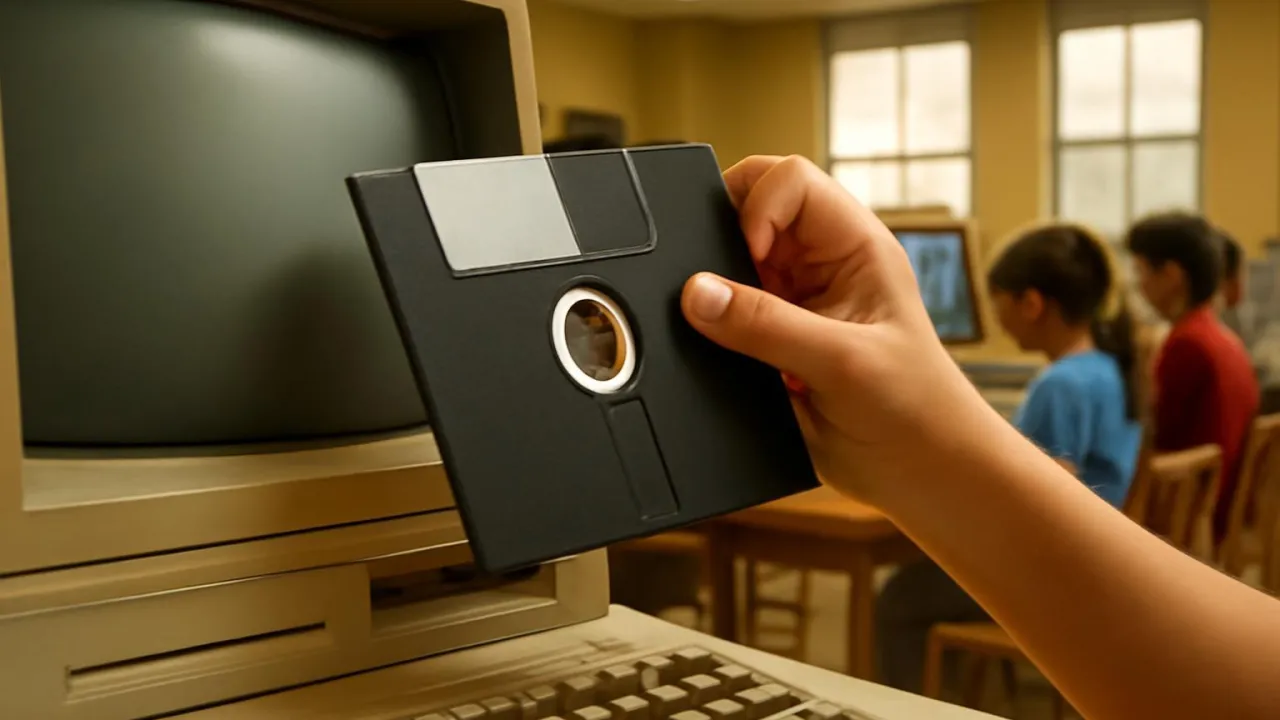
Have you ever heard a computer make a whirring click?
1
A Spinning Storage Surprise
Floppy disks were soft, square, and slid into computers. They spun around quickly and made a clicking sound. People used them to save their stories and games.
2
How Did It Work?
Inside each floppy disk was a thin circle. The computer wrote tiny marks on it to save information. You could carry your in your backpack.
3
Why Did People Love Them?
Floppy disks were easy to share with friends. They helped people move from one computer to another. Today, we use flash drives and clouds instead.
The biggest floppy disks could hold only 1.44 megabytes—less than one photo today!
✨ Word Sparks (Grade 3 Glossary)
Tap 🔊 to hear
magnetic
Made to work with magnets
data
Facts or information computers use
storage
A place to keep things safe
🪝
What if you could carry your whole computer project in your pocket?
1
A Pocket-Sized Data Keeper
Floppy disks were thin, square tools that stored computer files. They had a plastic shell and a soft, disk inside. You could slide one into a computer’s disk drive. The disk would spin and the drive would make a gentle whirring sound.
2
How Did Floppy Disks Work?
A floppy disk used material to record information. The computer’s drive used a read-write head to change the magnetism in tiny spots. These spots formed digital codes for words, pictures, or games. This process is called magnetic .
3
Why Were They Important?
Before the Internet, floppy disks helped people share files easily. Students brought homework to school on them. Businesses sent important documents using floppy disks. They made computers more useful for everyone.
4
From Floppy to Flash
Floppy disks could only hold a small amount of . Today, flash drives and cloud can hold thousands of times more. But floppy disks started the idea of portable computer memory. Their invention changed how we save and share information.
NASA once used floppy disks to help run space shuttle computers!
✨ Word Sparks (Grade 4 Glossary)
Tap 🔊 to hear
magnetism
A force that pulls certain metals
digital
Made of codes that computers use
portable
Easy to carry and move around
🪝
Imagine if your homework or favorite game fit on a spinning square!
1
The Birth of Portable Memory
In the early 1970s, engineers at IBM created the floppy disk to help people move computer data easily. The original disks were 8 inches wide and could store only a small amount of information. Their flexible magnetic surface was protected by a thin plastic shell. When inserted into a disk drive, the disk spun rapidly, producing a faint mechanical hum.
2
How Floppy Disks Store Data
A floppy disk works by using to record and retrieve data. The disk drive’s read-write head changes the direction of tiny magnetic particles on the disk’s surface. These changing patterns represent information, such as text, images, or programs. This process is called magnetic data storage and was a major breakthrough in computer technology.
3
Changing the World of Computing
Floppy disks made it possible to share files, programs, and even early video games between computers. Students, teachers, and office workers could carry important documents in their pockets. The disks’ portability and reusability helped computers spread to schools, homes, and businesses everywhere. They played a key role in the rise of personal computing.
4
From Floppy to Modern Memory
Although floppy disks could only hold about 1.44 megabytes, they inspired new ways to store more information. Flash drives, CDs, and cloud storage now hold thousands of times more data. The floppy disk’s invention showed the world how important storage could be, shaping the future of technology.
1. What was a key reason floppy disks became popular?
2. What technology replaced floppy disks for most people?
🤯 Mind-Blowing Fact • Grade 5
The original 8-inch floppy disk could only store about 80 pages of text!
✨ Word Sparks (Grade 5 Glossary)
Tap 🔊 to hear
binary
A code using only ones and zeros
flux reversal
Switching magnetic directions to store data
obsolete
No longer used because of something newer
🪝
What engineering secrets let a thin, flexible disk store the world’s first digital homework?
1
Inventing the Floppy Disk: A Revolution in Data Storage
In 1971, IBM engineers led by Alan Shugart launched the first floppy disk, a groundbreaking device that transformed computer data storage. The original 8-inch floppy disk was flexible, lightweight, and protected by a thin plastic envelope. Unlike earlier storage methods like punch cards or magnetic tapes, floppy disks allowed users to quickly save, erase, and rewrite digital files. This new invention made it possible for people to easily transport computer data between different machines, which was a major leap for both business and personal computing.
2
The Science of Magnetic Data Storage
Each floppy disk contained a circular sheet coated with iron oxide, a magnetic material. When inserted into a disk drive, the disk spun at speeds up to 300 revolutions per minute. A read-write head hovered just above the spinning surface, changing the magnetic orientation of tiny particles to represent data—ones and zeros. This process, called magnetic , enabled the disk to store programs, documents, and even early digital images. The drive’s precise mechanism ensured that data could be accessed or updated without damaging the delicate surface.
3
Floppy Disks in Everyday Life and Industry
Floppy disks quickly became essential tools for students, scientists, and businesses worldwide. They allowed people to share software, transfer school assignments, and back up important files with ease. In the 1980s and 1990s, nearly every personal computer included a floppy disk drive as a standard feature. Even NASA relied on floppy disks to load critical software onto space shuttle computers, demonstrating their importance in both education and advanced engineering.
4
The Decline and Legacy of the Floppy Disk
As technology advanced, the storage capacity of floppy disks—typically 1.44 megabytes for the most common 3.5-inch version—became a limitation. Newer devices like CDs, DVDs, flash drives, and cloud storage could hold thousands or even millions of times more data. Despite becoming , the floppy disk’s influence lives on: the familiar disk icon still represents 'save' in many computer programs, a tribute to its lasting impact on digital culture.
5
Engineering Impact and Global Influence
The invention of the floppy disk marked a turning point in the history of information technology. It democratized access to computers by making data portable, affordable, and easy to manage for people everywhere. The engineering principles behind magnetic storage paved the way for modern hard drives and solid-state memory. By solving the challenge of portable digital storage, the floppy disk helped launch the digital age and continues to inspire new generations of inventors.