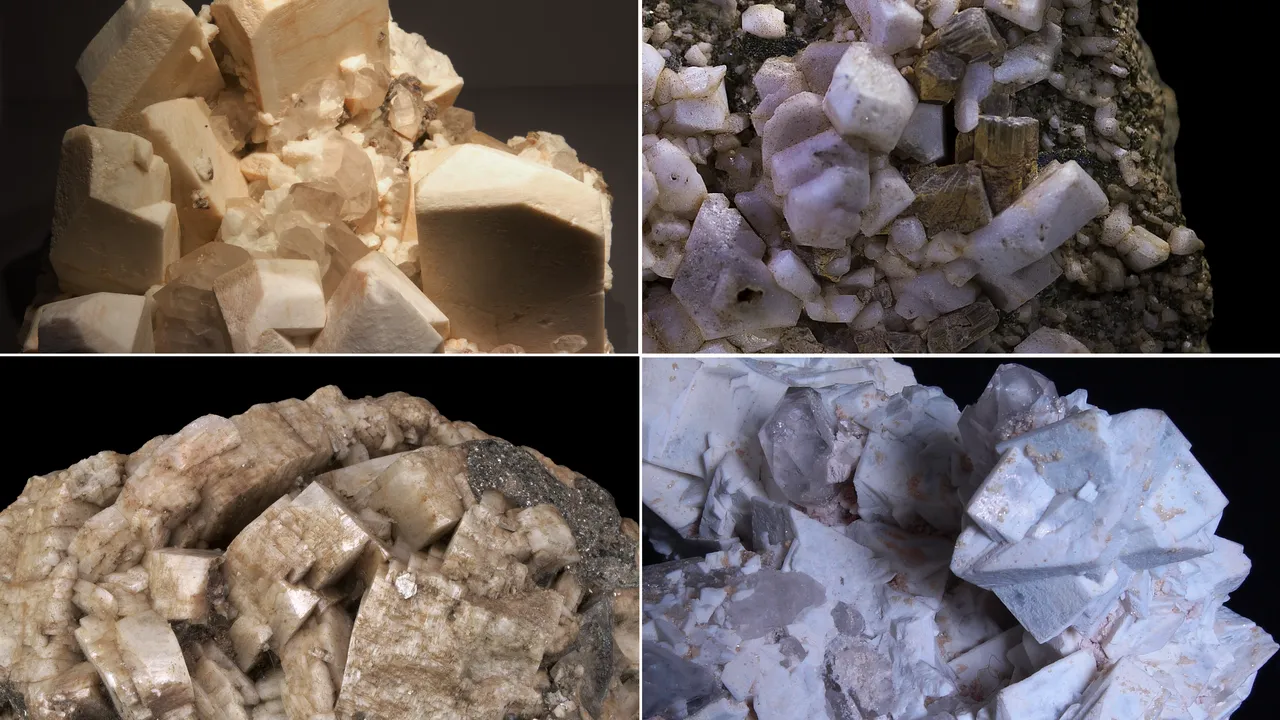
1. How much of Earth's rocky crust is made of feldspar?
2. What does rainwater slowly turn feldspar into over thousands of years?
🤯 Mind-Blowing Fact • Grade 2
Virginia's famous green 'amazonite' feldspar crystals from Amelia County were prized by museums across the globe for their vivid robin's-egg turquoise color!
✨ Word Sparks (Grade 2 Glossary)
Tap 🔊 to hear
Abundant
Found in very large amounts everywhere
Labradorite
Dark feldspar that flashes bright rainbow colors
Kaolin
Pure white clay formed from weathered feldspar
🪝
How can a hard pink mountain rock turn into your smooth white cereal bowl?
1
Earth's Number-One Mineral
Look closely at a granite countertop or mountain boulder, and you will spot rectangular pink, white, or gray blocks packed between glassy quartz grains. Those blocks are feldspar—the most mineral group anywhere in Earth's crust!
2
Flashing Moonstones
Most feldspar looks pearly pink or chalky white, yet some varieties hide dazzling surprises! flashes electric blue and green like butterfly wings when tilted, while moonstone glows with a milky silver shimmer.
3
From Mountain to Mug
Over long ages, rain and wind break down wild feldspar into fine white clay. Ceramic artists mix both that clay and powdered feldspar together in hot kilns to bake glossy dinner plates and mugs!
1. Which gemstone variety of feldspar flashes bright blue and green like butterfly wings when tilted?
2. How is feldspar used in making ceramic mugs and dinner plates?
🤯 Mind-Blowing Fact • Grade 3
South Dakota's Mount Rushmore was carved into Harney Peak granite packed with giant crystals of durable feldspar and quartz that erode less than one inch every 10,000 years!
✨ Word Sparks (Grade 3 Glossary)
Tap 🔊 to hear
Orthoclase
Potassium feldspar, often salmon-pink in granite
Plagioclase
Sodium-calcium feldspar showing fine parallel lines
Striations
Tiny parallel grooves on crystal cleavage faces
🪝
How can you tell blocky white feldspar apart from glassy white quartz on a hike?
1
Two Major Feldspar Branches
Nearly sixty percent of Earth's continental and oceanic crust belongs to the feldspar family! Geologists divide common feldspars into two main teammates: potassium feldspar (often salmon-pink or green amazonite) and feldspar (usually white to dark gray, rich in sodium and calcium).
2
Cleavage Versus Fracture
Out on a rocky trail, quartz and white feldspar often sit side by side in granite. Here is the secret to telling them apart: quartz shatters with curved, shell-like surfaces and never has flat cleavage planes. Feldspar, ranked number 6 on the Mohs hardness scale, splits along two flat cleavage surfaces that meet at nearly 90-degree box corners!
3
Tiny Twin Stripes
Tilt a piece of feldspar in bright sunlight with a hand lens, and you may spot tiny parallel hairline grooves—like microscopic vinyl record tracks—etched across one flat face! Those '' are a surefire clue for plagioclase.
4
Soil Maker for Forests and Farms
As rainwater gently dissolves feldspar over millennia, it releases potassium and calcium nutrients while leaving behind soft clay—helping create rich soil where forests and crops take root.
1. How can a hiker tell white feldspar apart from white quartz inside a piece of granite?
2. Where does orthoclase feldspar sit on the 1-to-10 Mohs hardness scale?
🤯 Mind-Blowing Fact • Grade 4
When Apollo 15 astronauts spotted a gleaming white feldspar rock on the Moon in 1971—nicknamed the 'Genesis Rock'—radiometric tests showed it had crystallized 4.1 billion years ago from the Moon's primordial magma ocean!
✨ Word Sparks (Grade 4 Glossary)
Tap 🔊 to hear
Tectosilicate
Mineral with a 3D framework of silicon-oxygen
Hydrolysis
Chemical weathering where acidic water alters minerals
Anorthosite
Igneous rock made almost entirely of plagioclase
🪝
Why are both the deepest ocean floor on Earth and the brightest highlands on the Moon packed with feldspar?
1
Framework Silicates of Two Crusts
Stand on a pink granite peak in Shenandoah National Park or examine a dark basalt lava rock from Hawaii, and feldspar dominates both! Feldspars are (framework silicates) built from a sturdy 3D cage of silicon, aluminum, and oxygen atoms holding potassium, sodium, or calcium ions. Continental granite is rich in pink potassium feldspar (KAlSi3O8) and sodium-rich albite, whereas dense oceanic basalt is packed with gray calcium-rich plagioclase. Even the bright lunar highlands visible from your backyard are made of —an ancient rock composed of over 90 percent calcium plagioclase!
2
Optical Illusions Inside Gem Feldspars
When molten magma cools slowly, blended feldspar chemistries separate into ultra-thin alternating microscopic layers, a texture called exsolution lamellae. In labradorite and Finnish spectrolite, light waves bouncing off these nanometer-thin layers interfere constructively to produce dazzling iridescent flashes called labradorescence. In Virginia's Piedmont, Montpelier hosts one of the world's largest deposits of and iridescent moonstone-like feldspar!
3
Chemical Weathering and Earth's Thermostat
Although Mohs-6 feldspar resists physical scratching, weak carbonic acid in rainwater slowly attacks it through : converting hard potassium feldspar into soft kaolinite clay, dissolved silica, and potassium bicarbonate ions. Washed down rivers into the sea, those bicarbonate ions help marine organisms build carbonate shells—quietly drawing carbon dioxide out of Earth's atmosphere over geologic timescales!
4
Glassmaking and Ceramic Flux
Every glass bottle, fiberglass boat hull, and porcelain sink owes a debt to feldspar. Alumina from crushed feldspar makes container glass tougher against thermal shock and impact, while alkalis lower furnace melting temperatures.
1. What did the feldspar-rich 'Genesis Rock' brought back from the Moon's highlands reveal to planetary scientists?
2. How does chemical weathering (hydrolysis) of feldspar affect Earth's soil and atmosphere?
🤯 Mind-Blowing Fact • Grade 5
Archaeologists can determine the exact thousand-year window when prehistoric humans buried stone tools simply by measuring tiny flashes of light released from trapped electrons inside buried feldspar sand grains!
✨ Word Sparks (Grade 5 Glossary)
Tap 🔊 to hear
Solid Solution
Crystal series smoothly blending two chemical formulas
Perthite
Streaky intergrowth of potassium and sodium feldspars
Polysynthetic Twinning
Repeated crystal symmetry flips creating fine striations
🪝
How does a triangular diagram of three feldspar end-members allow petrologists to decode the cooling history of any volcano or mountain root?
1
The Ternary Feldspar System and Coupled Substitution
Pick up almost any crustal rock on Earth, Mars, or the Moon, and you are holding framework aluminosilicates from the feldspar ternary diagram: potassium-rich orthoclase/microcline (KAlSi3O8), sodium-rich albite (NaAlSi3O8), and calcium-rich anorthite (CaAl2Si2O8). Plagioclase feldspars form a continuous solid-solution series from albite to anorthite via coupled substitution—swapping one Na+ and one Si4+ ion simultaneously for one Ca2+ and one Al3+ ion to preserve exact electrical neutrality! Meanwhile, because larger potassium ions fit awkwardly into sodium-calcium lattices at low temperatures, slow cooling causes alkali feldspars to unmix into ribbon-like intergrowths called .
2
Polysynthetic Twinning and Bowen's Continuous Branch
In Norman L. Bowen's famous Reaction Series, plagioclase defines the 'continuous branch': calcium-rich anorthite crystallizes first in hot basaltic magmas (~1,200°C) and reacts continuously with the cooling melt to become progressively richer in sodium toward granitic temperatures (~650°C). Because triclinic plagioclase crystals frequently flip their internal lattice symmetry back and forth during growth—a phenomenon called albite —hand-lens observers see diagnostic razor-straight striations along one cleavage plane that never appear on quartz.
3
Bragg Diffraction and Labradorescence
In gem-grade labradorite and moonstone (adularia), sub-microscopic exsolution lamellae spaced 100 to 300 nanometers apart act as natural photonic crystals. Entering white light undergoes thin-film Bragg diffraction across dozens of alternating calcic and sodic planes, selectively reflecting brilliant electric blues, golds, and peacocks depending on lamellar thickness!
4
Silicate Weathering and the Urey Cycle
Across hundreds of millions of years, chemical weathering of plagioclase and alkali feldspars regulates planetary habitability via the carbonate-silicate (Urey) cycle. Warmer, wetter climates accelerate carbonic-acid hydrolysis of continental feldspars into kaolinite and smectite clays, transporting dissolved calcium and bicarbonate ions to oceans where marine carbonate burial draws down greenhouse CO2 and stabilizes global temperatures.
5
Luminescence Dating in Archaeology and Quaternary Science
Because buried sand-sized potassium feldspar grains steadily trap radiation-excited electrons inside crystal defects until exposed to sunlight, geologists sample dark sediment layers and measure infrared stimulated luminescence (IRSL) from feldspar grains to pinpoint the exact millennium ancient river terraces, dunes, or archaeological hearths were last touched by daylight!
1. How do sodium-rich albite (NaAlSi3O8) and calcium-rich anorthite (CaAl2Si2O8) maintain electrical balance across the plagioclase solid-solution series?
2. How does luminescence dating of buried feldspar grains reveal when a sand dune or archaeological layer was last in sunlight?