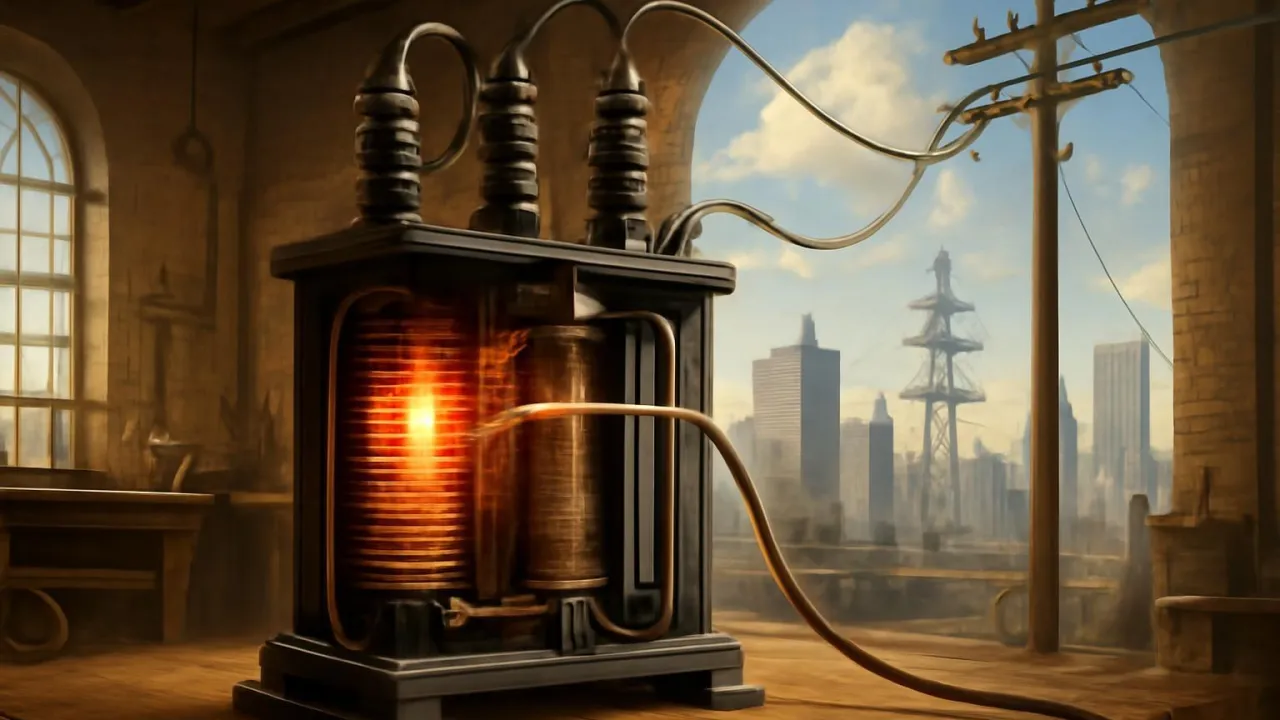
Transformers can make electricity travel over mountains and rivers!
✨ Word Sparks (Grade 2 Glossary)
Tap 🔊 to hear
magnet
Something that pulls metal things
power plant
A place that makes electricity
field
An invisible area where forces work
🪝
Have you ever seen a big gray box near power lines?
1
The Power Changer
Transformers change strong electricity to safe electricity. They help lights and computers work in your house. If electricity stayed too strong, it could break things. That is why transformers are important for everyone.
2
Inside the Box
A transformer has wire coils wrapped around metal. When electricity flows, it makes a magnetic . This field helps change the voltage. The new voltage travels safely to homes and schools.
3
Helping the Whole City
Transformers are found in neighborhoods and . They help cities and towns get power. Without them, electricity could not travel far. Transformers keep everything running safely and smoothly.
The biggest transformers can weigh more than 400 tons!
✨ Word Sparks (Grade 3 Glossary)
Tap 🔊 to hear
electromagnetic
Using both electricity and magnetism
induction
Making electricity with a magnetic field
core
The center part of something
🪝
What if electricity was too strong for your TV or lights?
1
The Secret of Safe Power
Transformers make sure electricity is just right for homes and schools. When electricity leaves a power plant, it is at a very high voltage. If this strong voltage came straight to your house, it could damage wires and devices. Transformers lower the voltage so it is safe to use.
2
How Transformers Work
A transformer has two wire coils called the primary and secondary coils. When electricity flows through the primary coil, it creates a magnetic field around an iron . This field causes the secondary coil to pick up energy, changing the voltage. This process is called .
3
Why Voltage Changes Matter
High voltage helps electricity travel long distances without losing much energy. But homes and schools need low voltage to be safe. Transformers step voltage up for travel, then step it down before it enters buildings.
4
Transformers Everywhere
Transformers are found on tall poles, in metal boxes, and inside big power stations. They come in many sizes, from small ones in toys to giant ones in power grids. Without transformers, cities could not share electricity safely or efficiently.
A single large transformer can power over 100,000 homes at once!
✨ Word Sparks (Grade 4 Glossary)
Tap 🔊 to hear
electric grid
A network that carries electricity everywhere
induce
To cause something to happen
current
The flow of electricity
🪝
Imagine if every lightbulb in your city suddenly burned out at once—what could prevent that?
1
From Power Plant to Your Plug
When electricity is made at a power plant, it has to travel many miles to reach homes and businesses. To do this efficiently, the voltage is increased using a transformer, which helps the electricity move through wires without losing much energy. Before the electricity enters your house, another transformer lowers the voltage to a safe level. This careful control keeps everything from lightbulbs to computers working properly.
2
The Science Inside the Box
A transformer uses two coils of wire—the primary and secondary—wrapped around an iron core. When electric flows through the primary coil, it creates a changing magnetic field in the core. This magnetic field a current in the secondary coil, which changes the voltage. The number of turns in each coil decides if the voltage goes up or down.
3
Inventors and Early Experiments
In the 1880s, inventors like Lucien Gaulard, John Dixon Gibbs, and later Nikola Tesla and George Westinghouse, developed practical transformers. Their work made it possible to send electricity across cities and even countries. The transformer was a key invention in the spread of electrical power, leading to the modern .
4
Transformers in Our World
Today, transformers are everywhere—from giant power stations to the tiny chargers for your devices. They make sure electricity is safe and usable, no matter where you are. Without transformers, we could not have reliable lights, computers, or even phone chargers. Their invention changed how people live, work, and connect around the world.
Some ultra-high voltage transformers can handle over 1 million volts—enough to power entire cities!
✨ Word Sparks (Grade 5 Glossary)
Tap 🔊 to hear
alternating current
Electricity that changes direction many times a second
transmission line
A big wire that carries electricity far
laminated
Made of thin layers to stop energy loss
🪝
What engineering marvel lets electricity travel hundreds of miles without losing its power?
1
Transformers: The Backbone of Modern Power
Every time you flip a light switch, a hidden network of transformers is at work behind the scenes. These devices allow electricity generated at massive power plants to travel long distances across without losing energy to heat. By stepping up the voltage to hundreds of thousands of volts, transformers minimize energy loss, making the delivery of electricity to cities and towns both efficient and reliable.
2
Electromagnetic Induction and Voltage Control
Transformers operate using the principle of electromagnetic induction, discovered by Michael Faraday in 1831. Each transformer contains two coils—the primary and secondary—wound around a shared iron core. When flows through the primary coil, it produces a changing magnetic field, which induces a current in the secondary coil. The ratio of turns between the coils determines whether the voltage is increased (stepped up) or decreased (stepped down), allowing precise control over electrical energy.
3
From Early Invention to Global Power Grids
The first practical transformer was demonstrated by Lucien Gaulard and John Dixon Gibbs in the 1880s, but it was William Stanley, working for Westinghouse, who built the first reliable commercial model in 1886. This breakthrough enabled the development of (AC) power systems, which soon replaced direct current (DC) for distributing electricity over large areas. The transformer’s invention was crucial in building the vast, interconnected electric grids that power modern civilization.
4
Engineering Design and Real-World Impact
Modern transformers can be enormous, with some weighing over 400 tons and handling voltages above 750,000 volts. Their iron cores reduce energy loss from heat, while special cooling systems prevent overheating. Transformers are essential in everything from national power grids to small electronic devices, ensuring that the right voltage reaches every user safely and efficiently. Without them, electrical energy could not be shared across continents or even between neighborhoods.
5
Transformers in the Future of Energy
As the world shifts toward renewable energy and smart grids, transformers are evolving to handle new challenges. Engineers are designing more efficient, eco-friendly models using advanced materials and digital monitoring systems. These innovations help integrate solar and wind power into the grid and protect against blackouts. The humble transformer, invented over a century ago, remains a key player in powering our future world.