2. What helpful invisible force does the churning liquid outer core make for Earth?
🤯 Mind-Blowing Fact • Grade 2
Mars lost its global magnetic shield billions of years ago after its liquid core cooled down—allowing solar wind to strip away most of Mars's ancient air!
✨ Word Sparks (Grade 2 Glossary)
Tap 🔊 to hear
Magnetosphere
Invisible magnetic shield surrounding planet Earth
Solar Wind
Fast stream of particles blown from Sun
Aurora
Glowing northern or southern lights in sky
🪝
Why does a hiker's compass needle always swing north—even in the middle of the woods?
1
Less Squeeze Means Liquid!
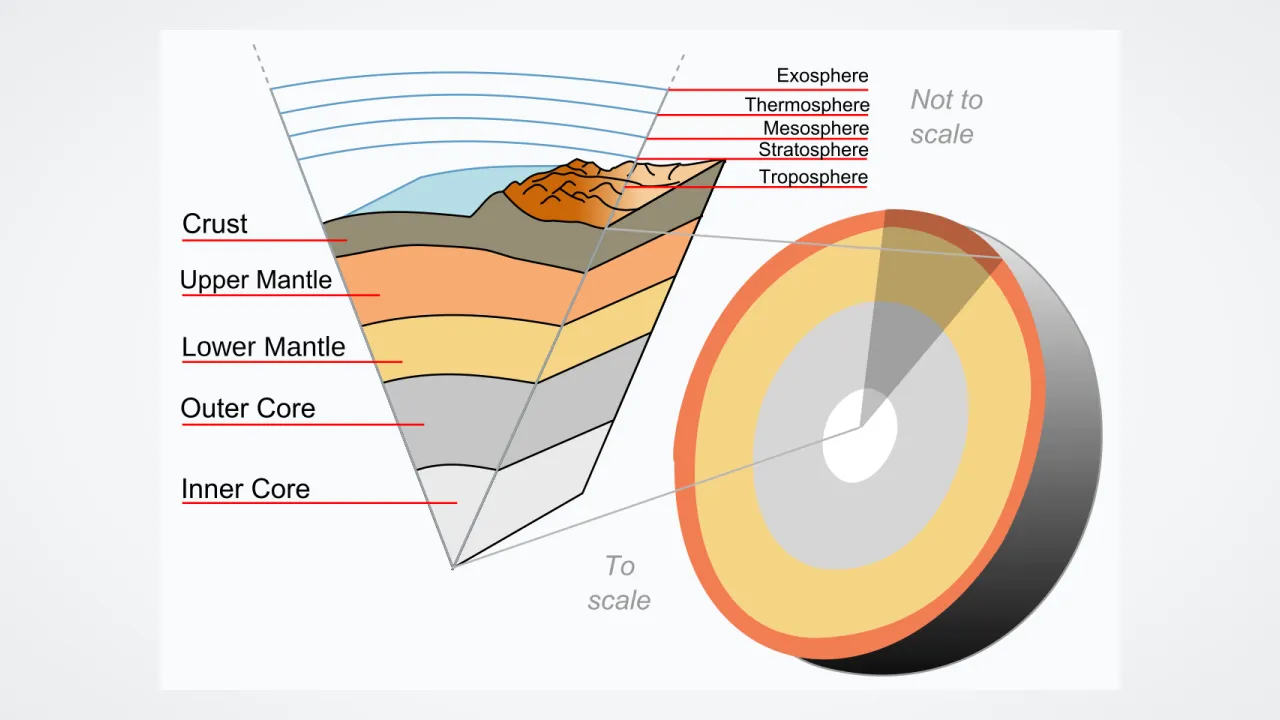
Travel 1,800 miles straight down below the ground, and solid mantle rock suddenly gives way to a glowing sea of liquid iron and nickel! Because pressure here is slightly lower than at the very center, the 8,000°F metal melts and flows as easily as water.
2
Making a Planetary Shield
Moving metal makes electricity, and moving electricity makes magnetism! As hot liquid iron churns across 1,400 miles of thickness, it wraps our planet in an invisible magnetic bubble called the .
3
Auroras in the Night Sky
Our magnetic shield blocks fierce streaming from the Sun so Earth keeps its air and oceans—and channels glowing green northern lights near the poles!
1. Why is the outer core liquid while the hotter inner core right below it is solid?
2. How does the magnetosphere created by the outer core protect life on Earth?
🤯 Mind-Blowing Fact • Grade 3
Earth's magnetic poles have actually flipped places hundreds of times over geologic history—meaning a compass 800,000 years ago would have pointed straight toward Antarctica!
✨ Word Sparks (Grade 3 Glossary)
Tap 🔊 to hear
S-Wave
Side-to-side earthquake wave blocked by liquids
Convection
Heat transfer by rising warm fluid currents
Magnetic Pole
North or south end where magnetism converges
🪝
How did missing earthquake waves prove that a 1,400-mile-thick layer of Earth is completely liquid?
1
The Clue of the Missing S-Waves
Earthquakes send out two main kinds of deep vibrations: P-waves (push-pull waves) that travel through both solids and liquids, and (side-to-side shear waves) that can ONLY travel through solids! When seismologists noticed that S-waves completely vanished on the far side of the globe below 2,890 kilometers (1,800 miles), they knew they had hit a giant liquid layer!
2
Thin as Soup, Heavy as Lead
People sometimes picture the outer core as thick, sticky goo, yet high-pressure physics reveals a surprise: molten iron in the outer core is as runny as liquid water in a swimming pool, even though every bucketful weighs ten times more than water!
3
Earth's Geodynamo Engine
Heat rising off the inner core makes liquid iron boil upward in currents, while Earth's daily spin twists those currents into giant corkscrew columns. Together, swirling liquid iron generates powerful electric currents that sustain our planetary magnetic field.
4
Animal Navigators
Humans with compasses aren't the only ones thanking the outer core—sea turtles, monarch butterflies, and migrating songbirds sense Earth's magnetic field lines to navigate thousands of miles!
1. Which earthquake wave observation proved beyond doubt that Earth's outer core is liquid?
2. Which animals use the magnetic field generated by Earth's outer core to navigate long migrations?
🤯 Mind-Blowing Fact • Grade 4
Satellites from the European Space Agency's Swarm mission detected a roaring 'jet stream' of molten iron 260 miles wide racing westward near the top of the liquid outer core beneath Alaska and Siberia!
✨ Word Sparks (Grade 4 Glossary)
Tap 🔊 to hear
Shadow Zone
Area on Earth blocked from direct earthquake waves
Coriolis Effect
Curving force caused by Earth's daily rotation
Geomagnetic Reversal
Complete flip of Earth's north and south magnetism
🪝
Why is Earth's magnetic North Pole currently racing across the Arctic Ocean from Canada toward Siberia?
1
Bounded by the Gutenberg Discontinuity
Drop 2,890 kilometers beneath Earth's surface, and you cross the sharpest material boundary anywhere inside our planet! Discovered by seismologist Beno Gutenberg in 1914, the core-mantle boundary separates solid silicate rock above from a 2,260-kilometer-thick ocean of molten iron, nickel, and about 10 percent lighter elements (such as sulfur, oxygen, and silicon) below. Across that single boundary, seismic P-wave speeds plunge abruptly from nearly 13.7 km/s to 8.1 km/s while S-waves vanish entirely, casting a vast seismic across the opposite side of Earth.
2
Coriolis Spirals and the Geodynamo
How does non-magnetic hot liquid iron create magnetism? At 4,000°C to 5,400°C, permanent bar magnets cannot exist because heat scrambles atomic alignment! Instead, Earth runs a self-sustaining electromagnetic 'geodynamo.' Buoyant plumes of hot, light-element-rich iron rise from the inner-core boundary while Earth's 24-hour rotation twists those currents via the into spiraling roller-columns parallel to Earth's spin axis—inducing electric currents and magnetic loops that reinforce one another.
3
Wandering Poles and Geomagnetic Reversals
Because outer-core iron churns turbulently at tens of kilometers per year—millions of times faster than mantle rock creeps—Earth's magnetic poles never sit completely still! High-speed 'jet streams' of molten iron surging beneath the Arctic have pulled the North Magnetic Pole from northern Canada across toward Siberia by over 1,000 kilometers since 1900, requiring regular updates to airplane and smartphone navigation maps.
4
Fossil Magnetism Locked in Seafloor Basalt
Every few hundred thousand years on average, turbulent eddies in the outer core cause Earth's magnetic north and south poles to trade places completely—leaving zebra-like magnetic stripes frozen inside cooling seafloor basalt!
1. Why does Earth's magnetic North Pole wander kilometers every year instead of staying pinned to one spot?
2. What happens to seismic P-waves and S-waves at the Gutenberg Discontinuity (2,890 km deep) where the mantle meets the liquid outer core?
🤯 Mind-Blowing Fact • Grade 5
Physicists at the University of Maryland built a 3-meter-wide spinning steel sphere filled with 12 tons of molten sodium metal to recreate miniature outer-core magnetohydrodynamic storms right inside a laboratory!
✨ Word Sparks (Grade 5 Glossary)
Tap 🔊 to hear
Curie Point
Temperature above which permanent magnets lose magnetism
Magnetohydrodynamics
Physics of electrically conducting fluids making magnetism
Dipole
Magnetic field having one north and south pole
🪝
Why can't a giant permanent iron magnet exist at 4,500°C—and how does magnetohydrodynamics build Earth's shield anyway?
1
Curie Temperature Paradox and Magnetohydrodynamics
Heat an ordinary iron horseshoe magnet past 770°C—its Curie temperature—and thermal agitation instantly destroys its permanent ferromagnetism! Because Earth's liquid outer core blazes between ~4,000°C at the Gutenberg core-mantle boundary (2,890 km) and ~5,400°C at the inner-core boundary (5,150 km) under pressures of 135 to 330 gigapascals, our planet's magnetic field cannot come from a permanent magnet. Instead, it arises via (MHD): as electrically conductive molten Fe-Ni alloy flows across weak seed magnetic fields, Lorentz forces induce electrical currents that generate fresh magnetic flux—converting thermal and compositional kinetic energy into a self-exciting planetary dynamo!
2
The Core Density Deficit and Light Elements
In 1952, geophysicist Francis Birch compared shock-wave laboratory densities of pure liquid iron against seismic density profiles of the outer core (9.9 to 12.2 g/cm³) and uncovered a crucial clue: the outer core is roughly 8 to 10 percent LESS dense than pure iron-nickel at those pressures! That 'core density deficit' proves that early magma-ocean core formation dissolved lighter elements—silicon, oxygen, sulfur, carbon, and hydrogen—into the molten metal. As the solid inner core crystallizes pure iron-nickel, incompatible light elements concentrate into buoyant boundary layers that drive vigorous outer-core convection.
3
Taylor Columns and the South Atlantic Anomaly
Rapid planetary rotation organizes low-viscosity outer-core flow (~10^-2 pascal-seconds, comparable to liquid water!) into helical 'Taylor columns' aligned parallel to Earth's spin axis, producing a predominantly dipolar surface field tilted ~11 degrees from geographic north. Beneath southern Africa and South America, however, reverse-flux patches swirling atop the core-mantle boundary weaken the overhead shield in a region called the South Atlantic Anomaly—where low-Earth-orbit satellites briefly encounter elevated solar radiation.
4
Matuyama-Brunhes Reversals Without Extinction
Supercomputer dynamo simulations—and laboratory spinning spheres of liquid sodium—reproduce Earth's erratic geomagnetic reversals! Roughly 780,000 years ago during the Brunhes-Matuyama reversal, strength dipped temporarily for several thousand years into complex multipolar loops before snapping into our modern northward orientation—leaving Earth's thick atmosphere intact to shield surface life from cosmic rays even while auroras danced near the equator!
5
Core-Mantle Heat Flux Control
Ultimately, the rocky lower mantle acts as a thermal blanket throttling the outer core: cold subducted slabs resting near 2,890 km draw out ~10 to 15 terawatts of core heat, steering the vigor and reversal frequency of the geodynamo below.