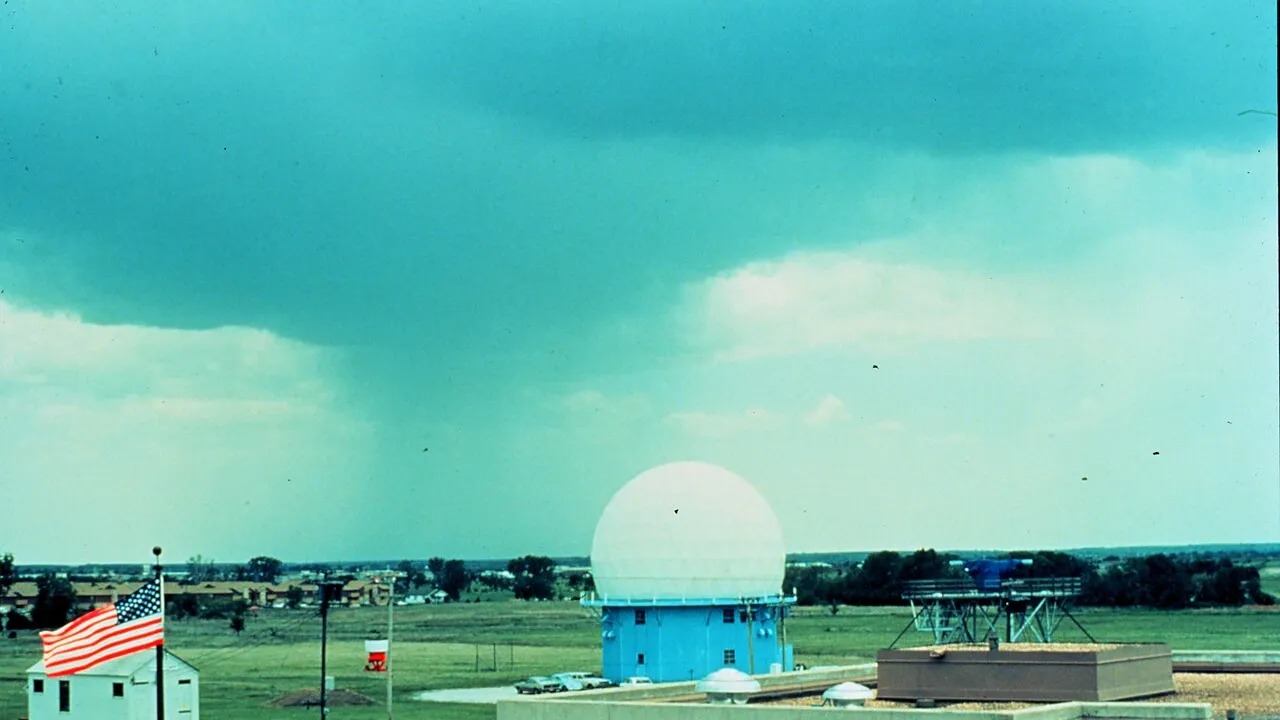
1. How does Doppler weather radar spot rain clouds miles away?
2. Why is the spinning radar dish hidden inside a round white dome?
🤯 Mind-Blowing Fact • Grade 2
Doppler radar is sensitive enough to detect flocks of migrating songbirds, bats leaving caves at dusk, and even swarms of flying insects!
✨ Word Sparks (Grade 2 Glossary)
Tap 🔊 to hear
pitch
How high or low a sound seems
radome
Protective round cover over radar dish
detect
Spot or sense something hidden
🪝
Why does an ambulance siren sound higher coming toward you and lower driving away?
1
The Siren Sound Clue
Weee-ooo! Listen as a fire truck zooms past on the street: its siren sounds higher-pitched coming closer and lower-pitched moving away! Austrian scientist Christian Doppler explained how motion squishes or stretches waves—called the Doppler effect.
2
Tracking Moving Raindrops
Regular radar could only tell WHERE rain was falling and how heavy it looked. Doppler weather radar is even smarter: by checking whether returning radio waves are squished or stretched, it measures how fast wind blows raindrops toward or away from the tower!
3
Early Tornado Warnings
When radar spots winds blowing rapidly toward the dish right beside winds blowing rapidly away, meteorologists know a thunderstorm is spinning and can warn towns minutes before a tornado touches down!
1. What extra superpower does DOPPLER radar have beyond older regular radar?
2. What everyday sound shows the exact same Doppler effect used by weather radar?
🤯 Mind-Blowing Fact • Grade 3
The acronym RADAR was coined in 1940 by the U.S. Navy and stands for RAdio Detection And Ranging!
✨ Word Sparks (Grade 3 Glossary)
Tap 🔊 to hear
reflectivity
Strength of radar echo bounced back
velocity
Speed of motion in a specific direction
microwave
Short radio wave used in radar
🪝
How did World War II airplane trackers accidentally discover weather radar?
1
Fuzzy Blobs on Early Screens
During the 1940s, military radar operators scanning the sky for airplanes kept seeing fuzzy glowing blobs blocking their screens! At first they thought those echoes were an annoying glitch—until weather scientists realized beams were bouncing off heavy rainstorms. After the war, meteorologists turned surplus radars into storm-tracking tools!
2
Reflectivity: Reading Rain Colors
Across the United States, 159 NEXRAD Doppler radar towers scan the sky day and night. Light mist returns weak echoes painted blue or light green on weather apps. Soaking rain glows yellow and orange, while giant hailstones bounce back super-strong echoes painted bright red, purple, or white!
3
Velocity: Green Meets Red
Forecasters also check a second screen called mode. By convention, green pixels show wind blowing toward the radar tower and red pixels show wind blowing away. Bright green touching bright red reveals dangerous rotation inside a cloud!
4
Scanning Layer by Layer
Every few minutes, the dish tilts upward step by step like slicing a layer cake, building a complete 3D picture of storms.
1. On a standard radar reflectivity map, what do bright red and purple echoes usually signal?
2. On a Doppler velocity map, what does bright green right beside bright red tell a meteorologist?
🤯 Mind-Blowing Fact • Grade 4
Big falling raindrops are NOT shaped like pointy teardrops—Dual-Pol radar confirms air pushes their bottoms flat so they look like tiny hamburger buns!
✨ Word Sparks (Grade 4 Glossary)
Tap 🔊 to hear
decibel
Unit measuring radar echo power level
polarization
Horizontal or vertical wave orientation
watershed
Land area draining into one river
🪝
How can upgraded Dual-Polarization radar tell the difference between flat raindrops, round hailstones, and flying leaves?
1
Three Clues From Every Pulse
Inside each twenty-eight-foot NEXRAD dish—including stations serving Virginia from Sterling, Wakefield, Blacksburg, and Roanoke—a transmitter fires over a thousand microwave bursts per second at the speed of light. Three measurements turn those echoes into a detailed map: time elapsed reveals exact distance, echo strength (measured in , or dBZ) reveals drop size and intensity, and the Doppler frequency shift reveals wind speed toward or away from the dish.
2
Dual-Polarization Sees Shapes!
Between 2011 and 2013, NOAA upgraded every U.S. NEXRAD radar with Dual- technology. Older radars sent only horizontal waves, measuring target width alone. Dual-Pol radars transmit BOTH horizontal and vertical waves at once! Because air resistance flattens big falling raindrops like hamburger buns while tumbling hailstones look round and snowflakes flutter flat, meteorologists can now distinguish heavy rain from sleet, snow, or giant hail!
3
Hook Echoes and Debris Signatures
During severe outbreaks, forecasters watch for a curved 'hook echo' wrapping rain around a rotating updraft—and check Dual-Pol data to confirm immediately if a tornado has lofted twigs or shingles at night.
4
Flash-Flood Life Saver
By adding up radar echoes minute by minute over mountain , computers estimate rainfall totals across remote creeks that have zero rain gauges!
1. How does Dual-Polarization radar tell large raindrops apart from round hailstones?
2. How does Doppler radar help prevent flash-flood tragedies in steep mountain valleys?
🤯 Mind-Blowing Fact • Grade 5
Because radar reflectivity grows with the SIXTH power of drop width ($D^6$), one pea-sized 10-millimeter hailstone bounces back as much radar energy as one MILLION tiny 1-millimeter drizzle drops!
✨ Word Sparks (Grade 5 Glossary)
Tap 🔊 to hear
attenuation
Weakening of beam passing through heavy rain
radial
Moving straight toward or away from center
hydrometeor
Any rain, snow, or hail particle
🪝
Why does Earth's curvature hide low-level storm winds far from a radar tower—and how are phased-array radars solving the speed gap?
1
S-Band Physics and Rayleigh Scattering
The United States NEXRAD network operates 159 WSR-88D (Weather Surveillance Radar—1988 Doppler) installations transmitting S-band microwaves near 10-centimeter wavelength ($2.7\text{ to }3.0\text{ GHz}$) at peak power around 700 kilowatts. Ten-centimeter waves resist , penetrating torrential rain bands without losing energy before reaching storms behind them! Under Rayleigh scattering theory, radar reflectivity factor ($Z$) scales with the SIXTH power of diameter ($Z = \sum D^6$): a single 10-millimeter hailstone reflects a million times more microwave power than a 1-millimeter raindrop, which is why meteorologists compress values onto a logarithmic decibel scale ($\text{dBZ}$), from $-10\text{ dBZ}$ in mist to $+70\text{ dBZ}$ in giant hail cores.
2
Radial Velocity and the Pulse-Doppler Dilemma
By comparing phase shifts between consecutive returned pulses, WSR-88D calculates velocity—the component of motion directly toward or away from the antenna (cross-beam motion produces zero Doppler shift). Engineers balance a mathematical trade-off called the 'Doppler dilemma': high pulse-repetition frequencies measure faster extreme winds cleanly without velocity aliasing, whereas lower repetition rates allow beams to travel farther (up to 460 km in reflectivity) before the next pulse leaves!
3
Dual-Pol Correlation Coefficient
Dual-Polarization adds Differential Reflectivity ($Z_{DR}$, width-to-height ratio) and Correlation Coefficient ($\rho_{HV}$, uniformity of targets). Uniform raindrops score near $\rho_{HV} = 0.99$; irregular lofted debris inside a nocturnal tornado plunges below $0.80$, producing an unmistakable Tornadic Debris Signature (TDS).
4
Earth Curvature and Radar Horizon
Even tilted at its lowest $0.5^{\circ}$ angle, a straight radar beam climbs higher above Earth's curved surface with distance—passing nearly 3 kilometers overhead at 180 kilometers range and overshooting shallow winter snow squalls!
5
Next-Generation Phased-Array Radar
Researchers are now testing solid-state Phased-Array Radars whose flat electronic panels steer multiple beams instantaneously without mechanical spinning, scanning an entire supercell in under sixty seconds instead of five minutes!