🇺🇸 U.S. HISTORY
🏛️ Allied Military & Liberation Milestone • June 6, 1944
VA History & Social Science SOL K.1, 1.2, 2.4, VS.1–VS.10, USI & USII
D-Day Normandy Landings
The Largest Amphibious Rescue Mission in World History
Grade 1 • Early Reader • 67 words
⏳ Era / StatehoodJune 6, 1944 (Operation Overlord)
🗺️ Region / Capital50-Mile Normandy Coastline, France (Commanded by Gen. Dwight D. Eisenhower)
📜 Key MilestoneNearly 160,000 Allied troops crossed the English Channel on 5,000+ vessels in one day
⚡ Historical SparkUnited twelve Allied nations in extraordinary planning, weather forecasting, and courage to liberate Western Europe
🤯 Mind-Blowing Fact • Grade 1
New Orleans boat builder Andrew Higgins invented flat-bottom wooden landing boats so clever that General Eisenhower said he helped win the war!
✨ Word Sparks (Grade 1 Glossary)
Tap 🔊 to hear
allies
Friendly countries teaming up to help
paratrooper
Soldier who parachutes safely from airplanes
liberate
Set people and towns free again
🪝
Have you ever heard of five thousand ships crossing wavy waters together on a single morning?
1
Crossing the Channel
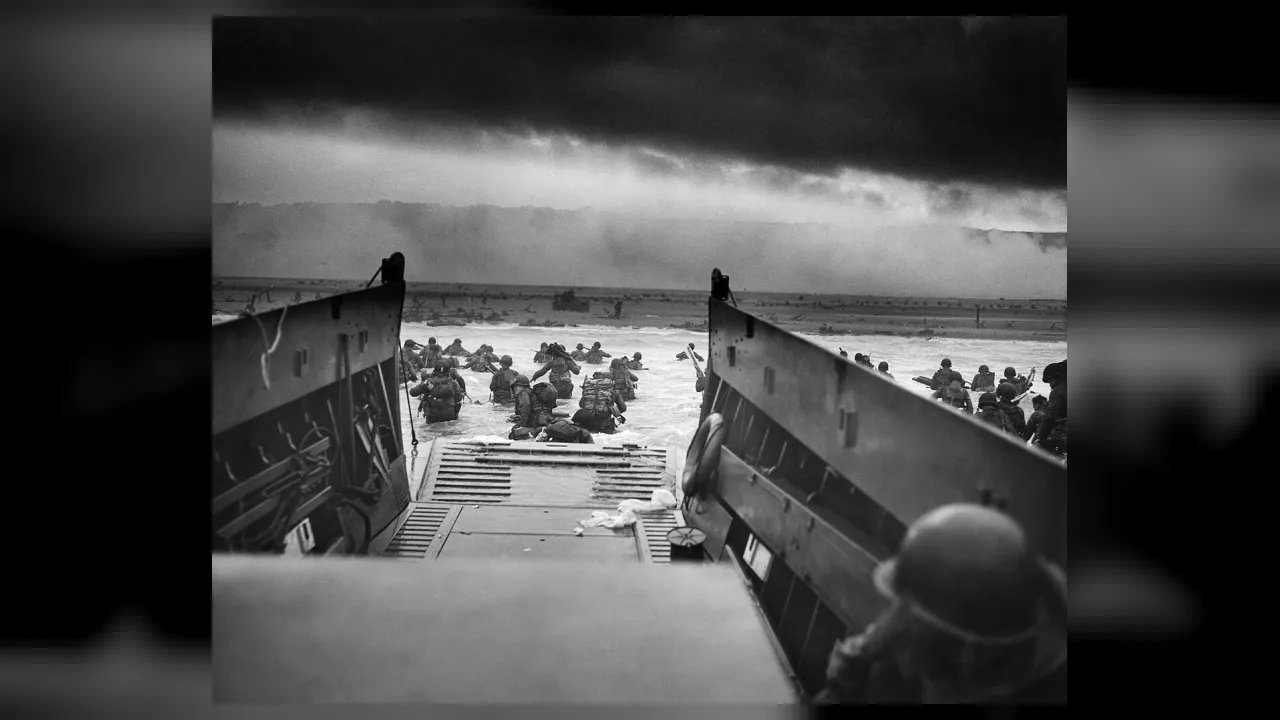
Splash! Before sunrise on June 6, 1944, five thousand ships sail across the choppy English Channel. Soldiers from friendly countries team up to free Europe.
2
General Eisenhower's Team
General Dwight D. Eisenhower leads this big mission called D-Day. float down under silk parachutes while landing boats reach five sandy beaches in France.
3
Bringing Freedom Back
Working together took huge courage and teamwork. Less than one year later, freedom returned to towns across Western Europe!
1. On what historic date did the D-Day landings take place?
2. Which American general led the Allied team on D-Day and later became U.S. President?
🤯 Mind-Blowing Fact • Grade 2
In military planning, the 'D' in D-Day simply stands for 'Day'—the secret start date of an important mission!
✨ Word Sparks (Grade 2 Glossary)
Tap 🔊 to hear
amphibious
Moving smoothly from ocean ships onto land
channel
Wide stretch of sea between two lands
code name
Secret word hiding a mission's real plan
🪝
How did a weather forecaster spot one calm break in a storm to launch 5,000 ships?
1
Waiting on the Weather
Listen to rain drumming on tent roofs in southern England on June 4, 1944! Fierce winds forced General Dwight D. Eisenhower to delay his huge mission by a day until weather experts spotted a brief calm window for June 6.
2
Five Beaches in Normandy
Overnight, paratroopers landed by moonlight behind France's coast to guard bridges. At dawn, over 150,000 American, British, Canadian, and Allied troops waded ashore across five beaches code-named Utah, Omaha, Gold, Juno, and Sword.
3
Floating Harbors and Victory
Because Normandy lacked deep ports, Allied engineers towed giant concrete floating piers across the ! From Normandy, Allied forces marched eastward to restore democracy across Western Europe.
1. Which three major Allied nations landed whole beach divisions side by side at Normandy?
2. What does the first 'D' in 'D-Day' actually stand for?
🤯 Mind-Blowing Fact • Grade 3
The small Blue Ridge town of Bedford, Virginia became home to the National D-Day Memorial to honor the extraordinary bravery and sacrifice of its local citizen-soldiers in the 29th Infantry Division!
✨ Word Sparks (Grade 3 Glossary)
Tap 🔊 to hear
decoy
Clever fake object used to trick observers
meteorologist
Scientist who studies and predicts the weather
beachhead
Shore area secured so helpers can land
🪝
How did Allied planners keep an army of 160,000 troops, 5,000 ships, and 11,000 airplanes a surprise?
1
Operation Overlord Takes Shape
Picture thousands of sailors, nurses, mechanics, and soldiers gathering along England's southern coast in spring 1944! For four years during World War II, Nazi Germany had occupied France and Western Europe. Under Supreme Allied Commander General Dwight D. Eisenhower, twelve Allied nations planned Operation Overlord to open a western front.
2
Inflatable Tanks and Weather Charts
To surprise defenders, Allied intelligence staged a clever army using inflatable rubber tanks and fake radio messages pointing toward Pas-de-Calais, the narrowest part of the English Channel. Meanwhile, Group Captain James Stagg's predicted a thirty-six-hour lull in June storms, prompting Eisenhower's famous order: 'Okay, let's go.'
3
Courage on Utah and Omaha Beaches
Before dawn on June 6, 1944, more than twenty thousand Allied airborne troops parachuted and glided inland. At daybreak, flat-bottomed Higgins boats carried soldiers onto Utah, Omaha, Gold, Juno, and Sword beaches—including many brave soldiers from Bedford, Virginia.
4
Turning Point Toward Peace
Once linked together, engineers assembled artificial 'Mulberry' harbors and an undersea fuel pipeline, allowing over two million Allied troops to liberate Paris by August and end the war in Europe eleven months later.
1. How did the Allies trick defenders into expecting the landing somewhere else?
2. Which Virginia town hosts the National D-Day Memorial honoring Allied courage?
🤯 Mind-Blowing Fact • Grade 4
African American soldiers of the 320th Barrage Balloon Battalion waded ashore on Omaha and Utah Beaches tethering silver hydrogen balloons high overhead on steel cables to block low-flying enemy planes!
✨ Word Sparks (Grade 4 Glossary)
Tap 🔊 to hear
prefabricated
Built in pieces beforehand for quick assembly
reinforcements
Extra troops and supplies sent to help
coalition
Alliance of diverse nations working toward unity
🪝
Why did D-Day require tides, moonlight, meteorology, and engineering to align within a single morning?
1
A Puzzle of Moon, Tide, and Weather
Imagine studying ocean charts beside General Dwight D. Eisenhower at Southwick House in England while gale-force rain lashes the windows! Launching Operation Overlord—the largest amphibious landing in history—required two rare natural conditions at once: a bright full moon for nighttime paratroopers and a rising low tide at dawn so landing craft could spot beach obstacles. Only three days in early June 1944 matched both!
2
Deception and Multinational Teamwork
When storms ruined June 5, chief meteorologist James Stagg spotted a brief high-pressure ridge approaching from the Atlantic for June 6. Simultaneously, Operation Fortitude fooled German commanders with phantom radio networks, double agents, and inflatable Sherman tanks, keeping enemy miles northeast near Calais.
3
Across the Channel at Dawn
Supported by 6,939 vessels and 11,590 Allied aircraft, 24,000 airborne soldiers landed inland overnight while 132,000 troops crossed a fifty-mile Normandy beachfront at dawn: Americans at Utah and Omaha, British at Gold and Sword, and Canadians at Juno, joined by Free French, Polish, Norwegian, Dutch, Belgian, Czech, Greek, Australian, and New Zealand forces. Virginia's 116th Infantry Regiment of the 29th Division led the first wave onto Omaha Beach.
4
Engineering Miracles and Liberation
Allied engineers immediately towed two massive 'Mulberry' harbors from Britain and laid 'PLUTO'—Pipe-Lines Under The Ocean—pumping fuel directly to Normandy. Within eighty days, Paris stood free, opening the final Allied drive that ended World War II in Europe in May 1945.
1. Why did Operation Overlord planners need both a full moon and a dawn low tide on the same date?
2. What were 'Mulberry' harbors and 'PLUTO' on the Normandy coast?
🤯 Mind-Blowing Fact • Grade 5
Before D-Day began, General Eisenhower wrote a short note in his pocket taking 100% personal blame in case the landings failed—demonstrating one of history's clearest examples of accountable leadership!
✨ Word Sparks (Grade 5 Glossary)
Tap 🔊 to hear
expeditionary
Sent overseas to accomplish a shared mission
caisson
Giant watertight concrete box sunk as breakwater
accountable
Willing to take responsibility for hard decisions
🪝
How did scientific forecasting, industrial logistics, and twelve-nation diplomacy converge on June 6, 1944 to alter twentieth-century history?
1
Strategic Imperative for a Second Front
By 1943, Allied leaders Franklin D. Roosevelt, Winston Churchill, and Soviet counterparts agreed that liberating Nazi-occupied Western Europe required a cross-Channel landing in northern France. Appointed Supreme Commander of the Allied Force, General Dwight D. Eisenhower coordinated land, sea, and air commanders from twelve Allied nations alongside French Resistance networks that quietly mapped coastal defenses and disrupted rail lines.
2
Operation Bodyguard and Meteorological Precision
Because Normandy's fifty-mile stretch between the Cotentin Peninsula and the Orne River lay farther from England than Pas-de-Calais, Allied counterintelligence executed Operation Bodyguard and Operation Fortitude—using fictitious 'First U.S. Army Group' radio traffic, wooden aircraft, and coded intercepts to convince German strategists that Normandy was merely a diversion. Meanwhile, weather ships in the North Atlantic detected a fleeting barometer rise between cyclones, enabling Eisenhower to launch Operation Neptune/Overlord on June 6, 1944.
3
Airborne Drop and Five-Beach Assault
Shortly after midnight, 24,000 soldiers of the U.S. 82nd and 101st Airborne and British 6th Airborne Divisions parachuted and glided inland to secure causeways and bridges. Following naval and aerial bombardment from 6,939 ships and 11,590 aircraft, 132,715 soldiers landed across Utah, Omaha, Gold, Juno, and Sword beaches—where units including the U.S. 1st and 29th Infantry Divisions (featuring Virginia National Guardsmen from Bedford, Roanoke, and Staunton), Army Rangers scaling hundred-foot cliffs at Pointe du Hoc, and the African American 320th Barrage Balloon Battalion overcame steep bluffs to link a foothold.
4
Logistics at Unprecedented Scale
Securing beaches was only half the challenge: sustaining mechanized armies required towing giant concrete Mulberry across the Channel and unspooling flexible undersea fuel lines. By late August 1944, over two million Allied personnel and half a million vehicles had landed in France, liberating Paris on August 25.
5
Civic Memory and Democratic Responsibility
Before the ships sailed, Eisenhower drafted two messages: a public encouragement to troops and a private handwritten note accepting full personal responsibility had the landings failed. Preserved today at Normandy's cemeteries and Bedford, Virginia's National D-Day Memorial, D-Day endures as a benchmark of leadership and international cooperation.