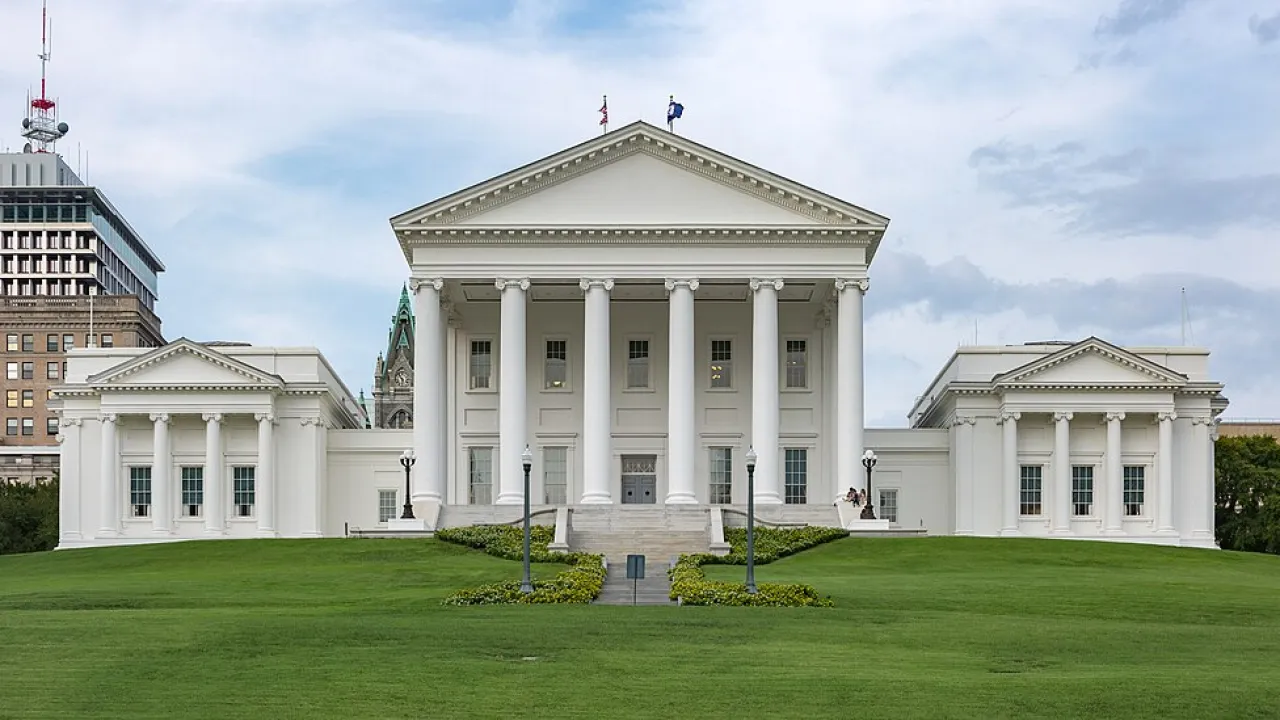
1. Why is Virginia nicknamed the 'Mother of Presidents'?
2. Which river-side city is the capital of the Commonwealth of Virginia today?
🤯 Mind-Blowing Fact • Grade 2
Virginia is officially called a 'Commonwealth'—one of only four U.S. states to use that historic title reminding citizens that government exists for the common good of the people!
✨ Word Sparks (Grade 2 Glossary)
Tap 🔊 to hear
permanent
lasting for a long time without disappearing
peninsula
land bordered by water on three sides
independence
freedom for a nation to govern itself
🪝
How can you travel from sandy ocean beaches to cool mountain caverns without ever leaving Virginia?
1
Waterways to the Chesapeake Bay
Stand on a dock along the Chesapeake Bay and watch blue crabs scuttle beneath sailboats! Four major Virginia rivers—the Potomac, Rappahannock, York, and James—flow eastward into this giant bay before meeting the Atlantic Ocean.
2
Powhatan Homelands and Jamestown
Long before 1607, Powhatan, Monacan, and Cherokee communities fished rivers and grew corn, beans, and squash across Virginia. In May 1607, English settlers sailed up the James River to build Jamestown, the first English settlement in North America.
3
Victory at Yorktown
More than 170 years later, George Washington won the final major battle of the Revolutionary War at Yorktown, Virginia, helping America win !
1. What made Jamestown historic when settlers built it along the James River in 1607?
2. At which Virginia town did George Washington's victory in 1781 help end the Revolutionary War?
🤯 Mind-Blowing Fact • Grade 3
Virginia's General Assembly, which first met inside a wooden church at Jamestown in July 1619, is the oldest continuous lawmaking body in the entire Western Hemisphere!
✨ Word Sparks (Grade 3 Glossary)
Tap 🔊 to hear
Tidewater
low coastal land where ocean tides reach rivers
Fall Line
natural border where waterfalls stop river ships
legislative
having the duty to debate and make laws
🪝
What five geographic regions stretch like stair steps from Virginia's sandy coast to its western plateaus?
1
Five Stair-Step Regions
Imagine walking west from the Atlantic waves at Virginia Beach all the way to Cumberland Gap! First comes the flat Coastal Plain (), separated by waterfall rapids called the from the rolling hills of the Piedmont. Next rise the rounded Blue Ridge Mountains, followed by the fertile Shenandoah Valley and underground caverns of the Valley and Ridge region, and finally the high Appalachian Plateau in the far southwest.
2
Three Native Language Groups
Virginia's First Peoples spoke three major language families matched to these regions: Algonquian languages (including the Powhatan) in , Siouan languages (including the Monacan) in the Piedmont, and Iroquoian languages (including the Cherokee) in the southwest and south.
3
1619 and Founding Ideas
In 1619 at Jamestown, Virginia's General Assembly met as the first elected body in English North America—the same pivotal year the first enslaved Africans were brought to Point Comfort. Later, Virginians Thomas Jefferson and James Madison authored the Declaration of Independence and guided the U.S. Constitution.
4
Tenth State in the Union
Virginia ratified the Constitution on June 25, 1788, becoming the tenth state, with its capital moved from Williamsburg to central Richmond.
1. Moving from east to west, which Virginia region comes right after the Coastal Plain (Tidewater) across the Fall Line?
2. Which Indigenous language group lived mainly in Virginia's Coastal Plain (Tidewater) region, including the Powhatan?
🤯 Mind-Blowing Fact • Grade 4
The Chesapeake Bay Bridge-Tunnel in southeastern Virginia stretches 17.6 miles across open bay water and actually dives underwater through tunnels so giant Navy ships and cargo vessels can sail right over the cars!
✨ Word Sparks (Grade 4 Glossary)
Tap 🔊 to hear
statute
written law passed by a governing assembly
estuary
wide bay where freshwater rivers mix with seawater
desegregation
ending unfair laws that separated people by race
🪝
How did Virginia's Fall Line, peninsulas, and founding charters shape the birth of American democracy?
1
Four Rivers, Peninsulas, and Five Regions
Look closely at eastern Virginia and you will see three long peninsulas carved by four tidal rivers flowing into the Chesapeake Bay—from north to south: the Potomac, Rappahannock, York, and James, plus the Eastern Shore peninsula across the bay! Ships sailed inland until rocky rapids at the Fall Line blocked navigation, sparking Fall Line port cities such as Alexandria, Fredericksburg, Richmond, and Petersburg. Westward, the land climbs across the Piedmont, the Blue Ridge Mountains (source of many rivers), the limestone Valley and Ridge (home to the Great Valley of Virginia), and the coal-rich Appalachian Plateau.
2
Charters of Liberty and the Virginia Dynasty
Two landmark Virginia documents directly inspired the U.S. Bill of Rights: George Mason's 1776 Virginia Declaration of Rights, which affirmed freedom of the press and religion, and Thomas Jefferson's Virginia for Religious Freedom. After ratifying the Constitution as the tenth state on June 25, 1788, Virginia gave the young republic four of its first five presidents—Washington, Jefferson, Madison, and Monroe—plus later presidents William Henry Harrison, John Tyler, Zachary Taylor, and Woodrow Wilson.
3
Crossroads of the Civil War and Civil Rights
Because Richmond and Washington, D.C., sat just a hundred miles apart, more major Civil War battles occurred in Virginia than in any other state, ending when General Robert E. Lee surrendered to General Ulysses S. Grant at Appomattox Court House in April 1865. In the twentieth century, brave Virginia students led by sixteen-year-old Barbara Johns in Farmville protested unequal schools in 1951, becoming part of the landmark Brown v. Board of Education Supreme Court decision.
4
Modern Virginia's Global Economy
Today, Northern Virginia technology corridors, Hampton Roads shipbuilding and naval ports, Shenandoah Valley agriculture, and NASA's Langley Research Center power a thriving Commonwealth.
1. Which two Virginia documents written by George Mason and Thomas Jefferson served as models for the U.S. Bill of Rights?
2. Where in Virginia did General Robert E. Lee surrender to General Ulysses S. Grant in April 1865, effectively ending the Civil War?
🤯 Mind-Blowing Fact • Grade 5
Roughly seventy percent of the world's internet data traffic routes through data centers in Northern Virginia's Loudoun County—once quiet Piedmont horse-and-dairy country!
✨ Word Sparks (Grade 5 Glossary)
Tap 🔊 to hear
burgess
elected citizen representative in colonial Virginia's assembly
paradox
two real facts that seem to contradict
trajectory
curved flight path followed by a spacecraft
🪝
Why did so many turning points in American constitutional law, wartime strategy, and civil rights converge between the Chesapeake Bay and Cumberland Gap?
1
Physiography from Tidewater Estuaries to Mount Rogers
Covering 42,775 square miles, the Commonwealth of Virginia ascends across five classic Appalachian-Atlantic provinces. East of the Fall Line, the Coastal Plain (Tidewater) embraces the Chesapeake Bay—North America's largest estuary—fed by four navigable tidal rivers: the Potomac, Rappahannock, York, and James. West of the Fall Line rapids, the rolling crystalline Piedmont rises to the ancient Blue Ridge Mountains, reaching 5,729 feet at Mount Rogers. Beyond the Blue Ridge lie the karst caverns and fertile Shenandoah limestone floors of the Valley and Ridge province, culminating in the rugged sandstone gorges of the Appalachian Plateau.
2
Indigenous Homelands, 1607 Jamestown, and the Paradox of 1619
Long before the Virginia Company of London's three ships anchored at Jamestown in May 1607, Algonquian-speaking Tsenacommacah (the Powhatan Paramount Chiefdom), Siouan-speaking Monacan confederacies, and Iroquoian-speaking Cherokee and Nottoway communities stewarded Virginia's forests and fisheries; seven federally recognized tribes and eleven state-recognized tribes carry that heritage forward today. The year 1619 crystallized an enduring American : in July, convened at Jamestown as English North America's first representative legislature, and in August, an English privateer landed enslaved Angolans at Point Comfort (present-day Hampton).
3
Revolutionary Crucible and Constitutional Architecture
From Patrick Henry's speeches at St. John's Church in Richmond to the Franco-American siege victory at Yorktown in October 1781, Virginia stood at the center of independence. Equally enduring were its legal blueprints: George Mason's June 1776 Virginia Declaration of Rights, Thomas Jefferson's 1776 Declaration of Independence and 1786 Statute for Religious Freedom, and James Madison's Virginia Plan at Philadelphia. When Virginia ratified the U.S. Constitution by an 89-to-79 vote on June 25, 1788, as the tenth state, Madison fulfilled Virginia's call for a federal Bill of Rights.
4
Civil War Division, Reconstruction, and Civil Rights Leadership
During the Civil War (1861–1865), Virginia split as northwestern counties formed West Virginia while armies clashed from Manassas (Bull Run) and Fredericksburg to Petersburg and Appomattox Court House. Following Reconstruction, twentieth-century Virginians championed constitutional equality: Howard University-trained attorney Oliver Hill, Spottswood Robinson, and Farmville high school student Barbara Johns spearheaded Davis v. County School Board of Prince Edward County—one of the five cases consolidated into the Supreme Court's 1954 Brown v. Board of Education ruling—and in 1989 L. Douglas Wilder became the first elected African American governor in U.S. history.
5
Aerospace, Maritime Power, and Digital Infrastructure
From Langley Research Center in Hampton—where 'Hidden Figures' mathematicians Katherine Johnson, Dorothy Vaughan, and Mary Jackson calculated orbital trajectories—to Norfolk's deep-water port and Northern Virginia's global internet fiber hubs, the Old Dominion unites four centuries of civic history with twenty-first-century innovation.